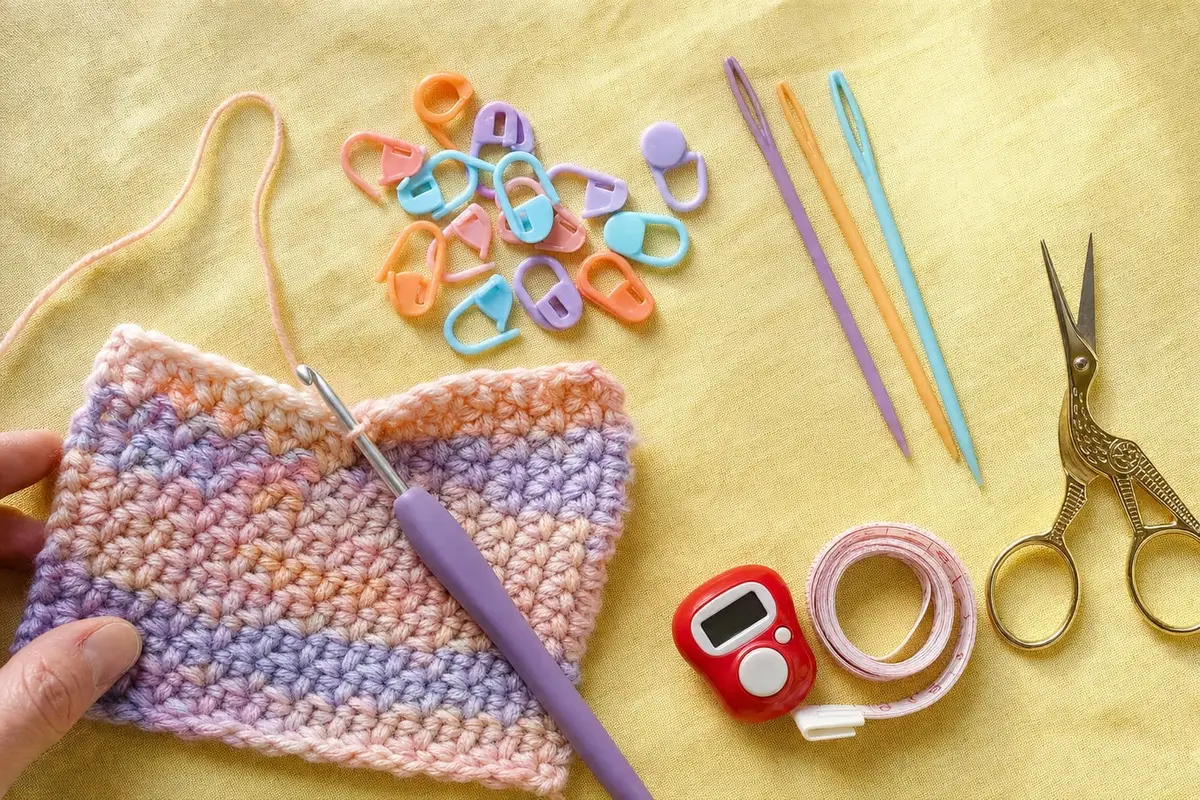
Based on listings checked on October 25, 2026, the five crochet tools worth having beyond hook and yarn are locking stitch markers such as Clover's 3033 set, bent-tip yarn needles such as Clover Chibi, small sharp scissors such as Gingher's 3.5-inch stork, a row counter such as Clover's Kacha-Kacha, and a hook case such as Prym's hook roll.
Some links on this page are affiliate links: if you buy through them, we may earn a commission at no extra cost to you. It never changes our rankings. As an Amazon Associate I earn from qualifying purchases. Affiliate policy
Comparison
| Product | Tool | Material | Detail |
|---|---|---|---|
| Clover Quick Locking Stitch Markers (3033) | stitch markers | plastic | locking, can be used unlocked |
| Clover Chibi Bent Tip Tapestry Needles (3121) | yarn needles | steel | 3 bent-tip needles, screw-cap case |
| Gingher 3.5" Stork Embroidery Scissors | scissors | steel blades, gold-plated handles | 3.5 in, leather sheath |
| Clover Kacha-Kacha Row Counter (336) | row counter | plastic | push-button, made in Japan |
| Prym Crochet Hook Roll and Organizer | hook case | lined fabric | 10 x 3.5 in, double zippers |
Our picks
Clover Quick Locking Stitch Markers (3033)
Locking markers that can also be used unlocked, so they clip into crochet stitches and come out again without cutting yarn.
Clover Chibi Bent Tip Tapestry Needles (3121)
Steel needles with bent, rounded tips that Clover says prevent yarn from splitting, in a screw-cap case that keeps them together.
Gingher 3.5" Stork Embroidery Scissors
Small 3.5-inch stork scissors with a leather sheath, sharp enough for clean yarn cuts and small enough for a project bag.
Clover Kacha-Kacha Row Counter (336)
A push-button counter that adds one row or round per press, made in Japan.
Prym Crochet Hook Roll and Organizer
A lined fabric roll with double zippers that keeps hooks together and their heads protected, sold by Amazon.com.
Beyond a hook and a ball of yarn, a handful of small tools makes crochet easier: something to mark stitches, something to weave in ends, something to cut yarn cleanly, something to count rows and somewhere to keep your hooks. This list picks one product for each, described from its listing and maker information; we did not use them ourselves.
At a glance
| Tool | Pick | What to look for | Crochet use | Who can skip it |
|---|---|---|---|---|
| Stitch markers | Clover Quick Locking (3033) | open or locking, plastic | marks the first single crochet (UK double crochet) of each spiral round in amigurumi, or an increase point | someone working only flat rows |
| Yarn needles | Clover Chibi bent tip (3121) | large eye, blunt or bent tip | weaves in 6-inch tails, sews amigurumi parts on, joins granny squares | nobody: every project needs one |
| Scissors | Gingher 3.5-inch stork | small, sharp, sheathed | trims tails and cuts yarn at color changes | nobody, though any small sharp pair works |
| Row counter | Clover Kacha-Kacha (336) | one-press counting | counts rows of double crochet (UK treble) in blankets or rounds in amigurumi | short projects |
| Hook case | Prym hook roll | lined, closes securely | keeps a set from about 3.5 to 6.5 mm (E-4 to K-10½) together | someone who owns one or two hooks |
Stitch markers: Clover Quick Locking
Why you need them: markers show where a round starts, where a repeat begins or where to increase, which is essential when you work amigurumi in continuous rounds.
Lion Brand’s guide to stitch markers explains the key point for crocheters: closed markers do not work with most crochet techniques, while open markers can be attached to a stitch. Clover’s 3033 markers are locking, and Clover notes they can also be used in the unlocked position, so they clip in and out of crochet stitches. They are plastic, in several colors.
Keep in mind: the number of markers in the pack is given by retailers rather than the listing.
Yarn needles: Clover Chibi bent tip
Why you need them: every project ends with yarn tails to weave in, and every amigurumi needs its parts sewn on.
Sarah Maker’s tutorial on weaving in ends explains that tapestry needles are used to weave yarn tails into crochet fabric, and advises leaving at least 6 inches of yarn to weave in. Clover’s 3121 set holds three steel needles with bent, rounded tips that Clover says prevent yarn from splitting, in a screw-cap case.
Keep in mind: the needle sizes differ between the listing and the maker’s descriptions, so check them if you need a particular size.
Scissors: Gingher 3.5-inch stork
Why you need them: small, sharp scissors cut yarn cleanly at the end of a project and when changing colors.
The Gingher stork scissors are 3.5 inches long, with gold-plated handles and a leather sheath, made in Italy. The sheath makes them safe to carry in a project bag.
Keep in mind: the listing is the only source for these specifications; the blade material is described differently in different places.
Row counter: Clover Kacha-Kacha
Why you need it: a blanket or a long scarf repeats the same row many times, and amigurumi patterns count rounds; losing count is one of the most common beginner problems.
Clover describes the Kacha-Kacha as tracking rows with a push of a button, and the listing states it is made in Japan. It is marketed for knitting, but counts crochet rows and rounds just as well.
Keep in mind: the counting range is not stated on the listing.
Hook case: Prym hook roll
Why you need it: hooks stored loose get lost or nicked, and a damaged head snags yarn.
Prym’s hook roll is a lined fabric organizer, 10 by 3.5 inches, with double side zippers and a hook-and-loop flap. It is sold by Amazon.com.
Keep in mind: the number of hooks it holds is not stated on the listing.
How to use stitch markers in crochet
Clip a marker into the first stitch of a round when you work in a spiral, and move it up each time you come back to it. Use a second marker in a different color for a pattern repeat or an increase point. On long rows, a marker every 20 or 25 stitches makes counting quicker. Because crochet stitches sit on top of the fabric rather than on a needle, markers go into the stitch itself, which is why open or locking markers are the type to buy.
Weaving in ends, quickly
Sarah Maker advises leaving at least 6 inches of yarn to weave in. Thread the tail on a blunt or bent-tip needle, run it through the backs of stitches on the wrong side for an inch or two, change direction once or twice so it cannot slip back, then trim close to the fabric. A bent tip makes it easier to pick up stitches without catching the front of the work.
Tools by type of project
- Amigurumi: stitch markers are essential for continuous rounds, and a yarn needle for closing pieces and sewing parts on. A row counter helps with long sequences of rounds.
- Blankets: a row counter keeps track of long repeats, a tape measure checks that squares match, and blocking tools square them up before joining.
- Garments and hats: a tape measure for gauge and fit, and stitch markers for increases.
- Dishcloths and first projects: only scissors and a yarn needle; markers help but are optional.
Tools you can skip at first
You do not need a full notions kit to start. A pen and paper count rows as well as a counter, a safety pin can stand in for a stitch marker in a pinch, and any small sharp scissors will do. Buy tools as projects ask for them, and choose ones made for yarn: blunt needles, open markers and small scissors.
Building a kit over time
A simple order works for most crocheters: scissors and a yarn needle first, stitch markers with the first project in the round, a tape measure when gauge starts to matter, a row counter for the first blanket, and a case once you own more than a few hooks. Keep everything in one pouch or bag so it travels with your work. A small zippered pouch inside the project bag is enough at first; when your collection grows, a hook roll such as the Prym organizer keeps hooks separate from needles and markers, so nothing sharp or small gets lost at the bottom of the bag.
Tools still to add
A tape measure and blocking mats belong on this list: you need a ruler or tape to check gauge, and mats to pin finished pieces to shape. The products we checked were unavailable or their pages would not load, so we will add them once a listing can be verified. In the meantime, any soft tape measure with inches and centimeters works for checking gauge.
Clover, a long-standing tool maker
Three of the picks come from Clover, a Japanese company that traces its founding to 1925 and has used the name Clover since 1964. That is not why they are here: each was chosen for its type, and we would replace any of them with a better-documented tool.
Next steps
For the hooks themselves, see our comparison of the best crochet hooks. If you are buying tools for someone else, our list of gifts for crocheters covers the next level up, from yarn winders to yarn bowls.
Key facts
- Lion Brand's 2011 guide to stitch markers, updated in 2023, notes that closed stitch markers do not work with most crocheting techniques, while open split-ring markers are perfect for attaching to crochet stitches.Lion Brand, How to Use Stitch Markers, 2023
- Sarah Maker's 2022 tutorial on weaving in ends, updated in 2024, says tapestry needles are used to weave yarn tails into crochet fabric and advises leaving at least 6 inches of yarn to weave in.Sarah Maker, How to Weave In Ends (Sarah Stearns), 2024
- Clover traces its founding to October 1925 in Japan, was incorporated in 1947 and took the name Clover Mfg. Co., Ltd. in July 1964.Clover Mfg., Corporate Information, 1964
- The Craft Yarn Council's 2018 guidelines advise comparing a gauge swatch with the pattern's gauge and changing hook size until it matches, a check that needs a ruler or tape measure.Craft Yarn Council, Standards & Guidelines for Crochet and Knitting, 2018
How we selected
We listed the small tools that crochet tutorials ask for again and again, from marking stitches to weaving in ends, then reviewed about ten products sold on Amazon.com on October 25, 2026, checking materials and features against maker pages where possible. We kept one product per type, excluded tools that were unavailable or whose pages would not load (which left the tape measure and blocking mats unfilled for now), and favored tools designed for yarn. We did not use these tools ourselves; details given only by retailers are not quoted.
FAQ
What tools do I need to start crocheting?
Only a hook, yarn, scissors and a yarn needle to weave in the ends. Stitch markers are the next most useful tool, especially for working in the round. A row counter, a hook case and a tape measure are helpful but optional.
What kind of stitch markers are best for crochet?
Open or locking markers that clip into a stitch and come out again. Closed ring markers, made for knitting needles, do not work with most crochet techniques, as Lion Brand notes, because they cannot be removed from a stitch.
What is the difference between a yarn needle and a sewing needle?
A yarn needle, also called a tapestry needle, has a large eye for yarn and a blunt or rounded tip that slides between stitches instead of piercing the yarn. Bent-tip versions make it easier to pick up stitches when weaving in ends or sewing pieces together.
Do I need a row counter for crochet?
Not at first, but it helps on projects with many identical rows or rounds, such as blankets and amigurumi. You can count with a pen and paper or an app instead; a push-button counter is quicker to use without putting your work down.
Sources
- Lion Brand: How to Use Stitch Markers (2011, updated 2023)
- Sarah Maker: How to Weave In Ends (2022, updated 2024)
- Clover: Quick Locking Stitch Markers (3033)
- Clover: Bent Tip Darning Needles (3121)
- Clover: Kacha-Kacha counter (336)
- Craft Yarn Council: Standards & Guidelines for Crochet and Knitting (PDF, 2018)