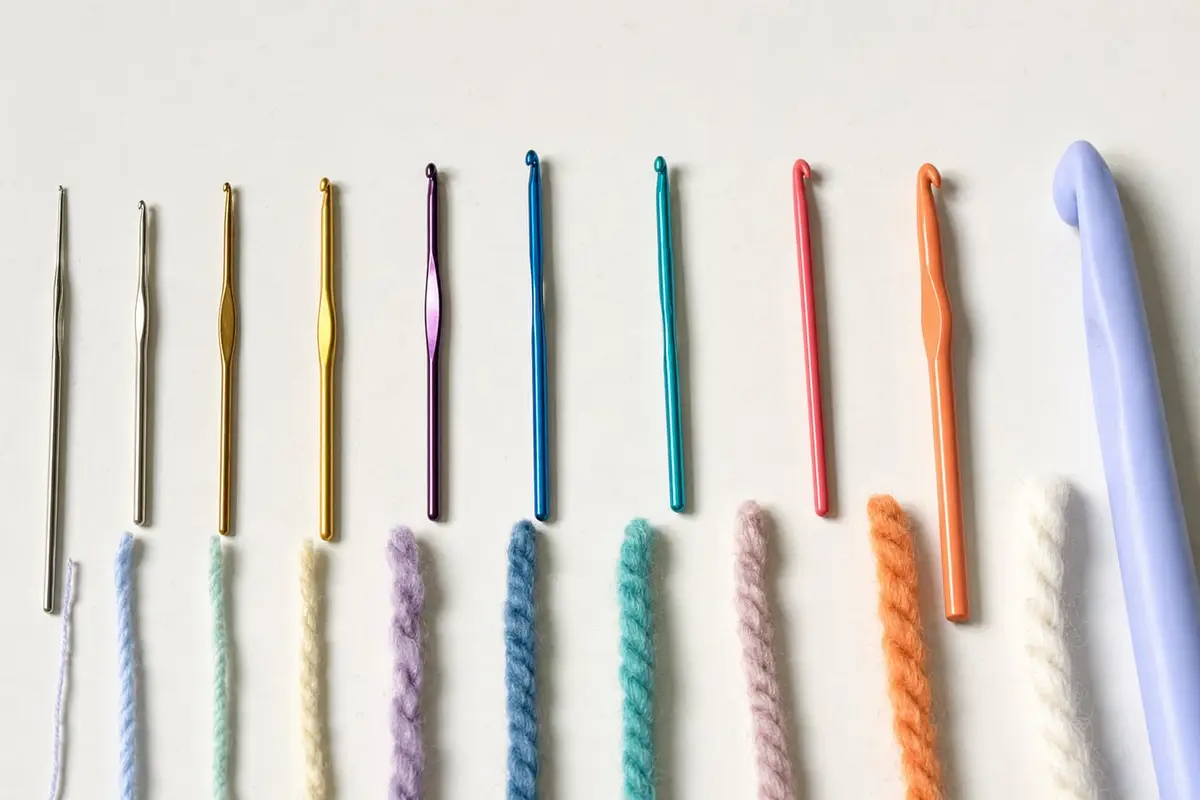
According to the Craft Yarn Council's 2018 chart, a 3.5 mm hook is an E-4, 4 mm a G-6, 5 mm an H-8, 5.5 mm an I-9, 6 mm a J-10 and 6.5 mm a K-10½. Choose the size your yarn label or pattern gives, in millimeters, then adjust after a gauge swatch: smaller if your swatch is too large.
Crochet hook size — A crochet hook size is the diameter of the hook's shaft, measured in millimeters; US hooks also carry a letter and often a number, such as H-8 for 5 mm, but the Craft Yarn Council's 2018 guidelines advise relying on the millimeter size.
Some links on this page are affiliate links: if you buy through them, we may earn a commission at no extra cost to you. It never changes our rankings. As an Amazon Associate I earn from qualifying purchases. Affiliate policy
Crochet hooks are labeled three ways at once: a letter, a number and a size in millimeters, as in “H-8, 5 mm”. The letters and numbers are an American convention and differ slightly between brands; the millimeters are the measurement that counts. This chart lists every standard size and explains how to choose the right one.
Quick answer by yarn
Labels usually print the hook to use. Red Heart Super Saver, a Medium (4) acrylic, gives a 5.5 mm (I-9); Lily Sugar’n Cream, a Medium (4) cotton, gives 5 mm (H-8); Lion Brand Pound of Love gives 6 mm (J-10). For a Light (3) DK the Craft Yarn Council’s range is 4.5 to 5.5 mm (7 to I-9), for Bulky (5) 6.5 to 9 mm (K-10½ to M-13). Amigurumi makers go one or two sizes below the label, and thread crocheters use steel hooks. If you are a beginner with a worsted yarn, start with an H-8 or I-9; if you mainly work lace in thread, this chart’s regular sizes will not suit you, and the steel section below applies.
The crochet hook size chart
From the Craft Yarn Council’s Standards & Guidelines (2018). Sizes without a letter in the council’s chart have no common US equivalent.
| Millimeters | US size | Typical yarn weight (CYC 2018) |
|---|---|---|
| 2.25 mm | B-1 | Super Fine (1) |
| 2.50 mm | none | Super Fine (1) |
| 2.75 mm | C-2 | Super Fine (1) |
| 3.125 mm | D | Super Fine (1) |
| 3.25 mm | D-3 | Super Fine (1) |
| 3.50 mm | E-4 | Super Fine (1) to Fine (2) |
| 3.75 mm | F-5 | Fine (2) |
| 4 mm | G-6 | Fine (2) |
| 4.25 mm | G | Fine (2) |
| 4.50 mm | 7 | Fine (2) to Light (3) |
| 5 mm | H-8 | Light (3) |
| 5.25 mm | I | Light (3) |
| 5.50 mm | I-9 | Light (3) to Medium (4) |
| 5.75 mm | J | Medium (4) |
| 6 mm | J-10 | Medium (4) |
| 6.50 mm | K-10½ | Medium (4) to Bulky (5) |
| 7 mm | none | Bulky (5) |
| 8 mm | L-11 | Bulky (5) |
| 9 mm | M/N-13 | Bulky (5) to Super Bulky (6) |
| 10 mm | N/P-15 | Super Bulky (6) |
| 11.50 mm | P-16 | Super Bulky (6) |
| 15 mm | P/Q | Super Bulky (6) to Jumbo (7) |
| 15.75 mm and 16 mm | Q | Jumbo (7) |
| 19 mm | S | Jumbo (7) |
| 25 mm | T/U/X | Jumbo (7) |
| 30 mm | T/X | Jumbo (7) |
The yarn weight column follows the council’s recommended hook ranges per category. Our yarn weight chart gives the full ranges and gauges.
Steel hooks for thread
Steel hooks, used with crochet thread and lace-weight yarn, follow their own numbering. The Craft Yarn Council’s 2018 guidelines explain that the higher the number, the smaller the hook, the reverse of regular hooks. A steel 0 measures around 2.55 mm and a steel 10 around 1.15 mm, depending on the brand. If you are new to crochet, you will not need steel hooks until you work with thread.
How to choose the right hook
- Start from the yarn label. It gives a recommended hook size, usually in millimeters and US letters. Lion Brand’s 2026 hook guide suggests starting in the middle of the range when the label gives one.
- Follow the pattern if it names a size. The designer chose it to reach a specific gauge.
- Check the gauge. For anything that must fit, make a 4-inch swatch. The Craft Yarn Council’s rule: if your swatch is larger than the pattern’s gauge, use a smaller hook; if it is smaller, use a larger one.
- Go smaller for amigurumi. Toys need tight stitches so the stuffing does not show; designers typically go one or two sizes below the label.
- Trust millimeters over letters. The council notes that letter and number sizing vary from company to company. Its own chart lists a 4 mm G-6 and a 4.25 mm G, and a 5.5 mm I-9 and a 5.25 mm I.
The hook beginners need
Most beginner patterns use medium weight (4) yarn, for which the Craft Yarn Council recommends 5.5 to 6.5 mm (I-9 to K-10½). Many beginner lessons and kits use a 5 mm (H-8) or a 5.5 mm (I-9). If you buy one hook to start, a 5 or 5.5 mm is the safe choice; a small set from 3.5 to 6.5 mm covers almost every beginner project.
Hook size by project
| Project | Typical yarn | Typical hook |
|---|---|---|
| Practice square, dishcloth | Medium (4) cotton or acrylic | 5 to 5.5 mm (H-8 to I-9) |
| Blanket in worsted | Medium (4) | 5.5 to 6.5 mm (I-9 to K-10½) |
| Chunky scarf or blanket | Bulky (5) to Super Bulky (6) | 6.5 to 15 mm (K-10½ to Q) |
| Amigurumi in worsted | Medium (4) | one to two sizes below the label, often 4 to 5 mm |
| Doily or lace edging | crochet thread | steel hooks, around 1.15 to 2.55 mm |
These are starting points drawn from the Craft Yarn Council’s ranges; the pattern’s stated hook and gauge always come first, and your own tension may move you one size up or down.
Head shape: inline or tapered
Hooks of the same size can have different heads. On an inline hook, the head is the same width as the shaft and lines up with it; on a tapered hook, the shaft narrows into a throat below a rounder head. Okie Girl Bling ‘n Things names Susan Bates as a classic inline brand and Boye as a tapered one. June Gilbank of PlanetJune notes that outside North America the tapered shape is used almost exclusively, and that there is no best style. Try both if you can; our comparison of the best crochet hooks includes one of each.
Handles and materials
Size is not the only choice. Aluminum hooks glide quickly, bamboo and wood hooks grip slippery yarn a little more, steel is used for thread, and ergonomic hooks add a thicker handle that some crocheters find more comfortable to hold. How you hold the hook also changes which handle suits you: see how to hold a crochet hook.
Key facts
- The Craft Yarn Council's 2018 hook chart lists 2.25 mm as B-1, 2.75 mm as C-2, 3.25 mm as D-3, 3.5 mm as E-4, 3.75 mm as F-5, 4 mm as G-6, 5 mm as H-8, 5.5 mm as I-9, 6 mm as J-10, 6.5 mm as K-10½, 8 mm as L-11 and 9 mm as M/N-13.Craft Yarn Council, Standards & Guidelines for Crochet and Knitting, 2018
- The Craft Yarn Council's 2018 guidelines advise relying on the millimeter size on the package because letter and number sizing vary from company to company, and recommend a smaller hook if a gauge swatch is larger than the pattern's gauge.Craft Yarn Council, Standards & Guidelines for Crochet and Knitting, 2018
- The same 2018 guidelines explain that steel crochet hooks, used with crochet thread and lace-weight yarn, are sized in reverse: the higher the number, the smaller the hook.Craft Yarn Council, Standards & Guidelines for Crochet and Knitting, 2018
- Lion Brand's 2026 hook size guide advises starting in the middle of the millimeter range on the yarn label and notes that US letter sizes vary by manufacturer, so the millimeter size stamped on the shaft is the only consistent measurement.Lion Brand, Crochet Hook Size Guide for Every Yarn Project, 2026
FAQ
What size crochet hook should a beginner use?
For a beginner using medium weight (4) yarn, a 5 mm (H-8) or 5.5 mm (I-9) hook is the usual choice; the Craft Yarn Council's range for that weight is 5.5 to 6.5 mm (I-9 to K-10½). Follow the size printed on your yarn label if it differs.
What is the difference between a G and a G-6 hook?
In the Craft Yarn Council's chart, G-6 is 4 mm while a hook marked only G is 4.25 mm, and the same happens with I (5.25 mm) and I-9 (5.5 mm). Brands label sizes differently, which is why the millimeter size is the one to check.
Why are steel hook numbers backwards?
Steel hooks, used for thread and lace, follow their own numbering in which a higher number means a smaller hook. A US steel 10, for example, is much finer than a steel 0. Check the millimeter size to compare a steel hook with a regular one.
What happens if I use the wrong hook size?
A hook that is too small makes tight, stiff fabric and a smaller piece; one that is too large makes loose, open fabric and a larger piece. For items that must fit, make a gauge swatch and change hook sizes until it matches the pattern.