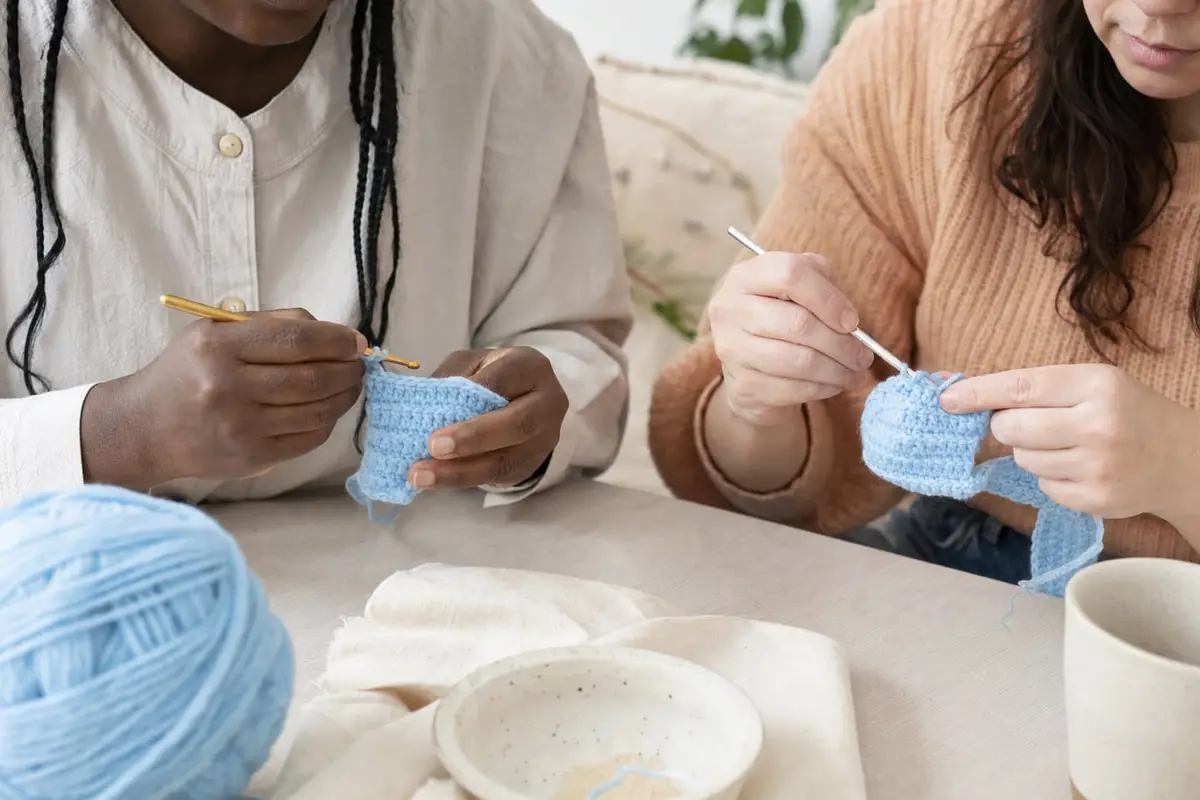
Hold a crochet hook in one of two ways: the pencil grip, like a pen with your thumb and index finger on the flat thumb rest, or the knife grip, with your hand over the hook as when cutting with a knife. As Itchin4Stitchin's guide (updated 2025) puts it, the best grip is the one most natural for you.
Thumb rest — The thumb rest is the flattened section in the middle of most crochet hooks, where the thumb and index finger hold the hook; it usually carries the hook's size and keeps the head turned in the right direction.
Some links on this page are affiliate links: if you buy through them, we may earn a commission at no extra cost to you. It never changes our rankings. As an Amazon Associate I earn from qualifying purchases. Affiliate policy
How you hold the hook shapes everything that follows: your tension, your speed and how comfortable a long session feels. There is no single correct grip. There are two common ones, and the Crochet Guild of America’s beginner class objectives, developed for the Craft Yarn Council’s instructor program, ask teachers to demonstrate both. This page shows each, where your thumb goes, and how the other hand controls the yarn.
At a glance
| Pencil grip | Knife grip | |
|---|---|---|
| Hand position | under the hook, like holding a pen | over the hook, like cutting with a knife |
| Thumb and index finger | on the flat thumb rest | thumb on the flat side, index finger on top |
| Handle | rests on the side of the hand | tucked under the palm |
| Often chosen for | fine control, small work | a firm hold, speed, thicker yarn |
| Works with | regular and slim ergonomic handles, such as Clover Soft Touch | regular and thick ergonomic handles, such as Furls or Tulip Etimo |
| Practice setup | 5 mm (H-8) or 5.5 mm (I-9) hook, smooth Medium (4) worsted yarn | same |
| First stitches to practice | chain (ch), then single crochet (sc, UK double crochet) | same |
| Less suited to | crocheters who like to work fast with bulky yarn | very fine work with steel hooks and thread |
Whichever you choose, keep the hook’s head turned slightly toward you, not facing straight up or down, as Itchin4Stitchin advises, and hold it firmly without squeezing.
The pencil grip
- Find the thumb rest, the flattened section in the middle of most hooks, usually where the size is printed.
- Hold the hook as you would a pencil, with the thumb rest between your thumb and index finger.
- Rest the shaft against the side of your middle finger; Itchin4Stitchin places the third finger near the tip of the hook, where it helps guide the stitches.
- Turn the head slightly toward you so the hook catches the yarn as you rotate your wrist.
Handy Little Me describes the movement that follows: with the pencil grip, you work from above, bringing the hook down into the stitches.
The knife grip
- Lay the hook across your palm, with the handle tucked under it.
- Place your index finger along the top of the hook, almost straight, as you would on a table knife, a position Jo to the World describes.
- Hold the flat thumb rest between your thumb and your middle or index finger.
- Turn the head slightly toward you.
With this grip, Handy Little Me notes, the hook works from below and moves up into the stitches. Itchin4Stitchin finds that the knife grip provides a firm hold, especially useful for fast crocheting and thicker yarns.
Holding the yarn
The other hand does two jobs: it holds the piece just below the hook, and it controls the yarn coming from the ball. That control is your tension, which Sigoni Macaroni defines as the stress you apply to the yarn as you use it. A common setup:
- Let the working yarn come over the back of your hand.
- Wrap it once around your little finger, as Handy Little Me suggests, to add a light drag.
- Pass it over your index finger and lift that finger slightly, so the yarn stays taut between the ball and the hook.
- Pinch the work just below the hook between your thumb and middle finger, moving up every few stitches.
If your piece comes out larger than intended, your tension is loose; if smaller, it is tight. Change hook sizes rather than squeezing harder, and see our crochet hook size chart for the next size up or down.
Which grip should you choose?
Try both on a short chain and a few rows of single crochet, then keep the one that feels natural. As Itchin4Stitchin says, the knife and pencil holds are only two of many ways to hold a hook, and the best is the one that is most natural and comfortable for you. Handy Little Me observes that most crocheters prefer one grip naturally and some switch between them depending on the project. What matters most is consistency while you learn: changing grips changes your tension.
Common grip problems and fixes
- The hook keeps turning in your hand. Hold it at the flat thumb rest, not on the round shaft; the flat area stops it from rotating.
- The yarn slips off the hook. Turn the head slightly toward you, so the throat faces the yarn as you pull through.
- Your stitches are very tight. Relax the hand holding the yarn first; if they stay tight, move up one hook size rather than gripping harder.
- Your hand tires quickly. Loosen your grip, take short breaks, and try the other grip or a hook with a thicker handle to see which feels better.
- The work slides away from the hook. Move the fingers of your yarn hand up the piece every few stitches so they stay close to the hook.
Left-handed crocheters
Hold the hook in your left hand and the yarn in your right, using either grip. Handy Little Me notes that the method is practically the same, just reversed, and that the simplest way to follow a right-handed tutorial is to mirror it. Many video tutorials and kits now film both versions.
Handles and grips
The shape of the handle changes how each grip feels. A slim aluminum hook suits the pencil grip well; thicker ergonomic handles, molded, cushioned or flat and wide, fill the hand more in the knife grip. Our comparison of ergonomic crochet hooks describes each handle type, and our beginner’s guide to crochet takes you from the slip knot to your first rows.
Key facts
- Itchin4Stitchin's guide, updated in 2025, describes the pencil grip as holding the hook like a pencil with the thumb rest between thumb and forefinger, and the knife grip as mimicking the way you hold a knife while cutting.Itchin4Stitchin, How to Hold a Crochet Hook (RaeLynn Endicott), 2025
- The same guide says the knife grip gives a firm hold that suits fast crocheting and thicker yarns, and that the hook should be turned slightly toward you, not facing straight up or down.Itchin4Stitchin, How to Hold a Crochet Hook (RaeLynn Endicott), 2025
- Handy Little Me's 2025 tutorial notes that most crocheters naturally prefer one grip, some switch depending on the project, and left-handed crocheters can mirror right-handed instructions.Handy Little Me, How to Hold a Crochet Hook (Louise Bollanos), 2025
- Sigoni Macaroni defines tension as the stress applied to the yarn while you use it: a piece larger than intended points to loose tension, a smaller one to tight tension.Sigoni Macaroni, How to Hold Your Yarn and Control Tension, 2024
FAQ
What is the correct way to hold a crochet hook?
There is no single correct way. The two common grips are the pencil grip and the knife grip, and both make the same stitches. Pick the one that feels natural, keep the hook turned slightly toward you, and stay with it while you learn so your tension stays consistent.
Is the pencil grip or the knife grip better?
Neither is better. The pencil grip gives fine control and suits many beginners; the knife grip gives a firm hold that some crocheters prefer for speed and thicker yarns. Some people switch between them depending on the project.
How do I hold the yarn when I crochet?
Your other hand holds the work and controls the yarn. A common method is to wrap the working yarn once around your little finger, pass it over your index finger and lift that finger slightly, so the yarn stays taut between the ball and the hook.
How do left-handed people hold a crochet hook?
The same way, mirrored: the hook goes in the left hand and the yarn in the right. Left-handed crocheters can follow right-handed tutorials by mirroring them, and many video tutorials and kits now include left-handed versions.
Sources
- Itchin4Stitchin: How to Hold a Crochet Hook (2016, updated 2025)
- Handy Little Me: How to Hold a Crochet Hook (2025)
- Jo to the World Creations: How to Hold a Crochet Hook
- Sigoni Macaroni: How to Hold Your Yarn and Control Tension (2020, updated 2024)
- Crochet Guild of America: Objectives for Beginner Crochet Classes