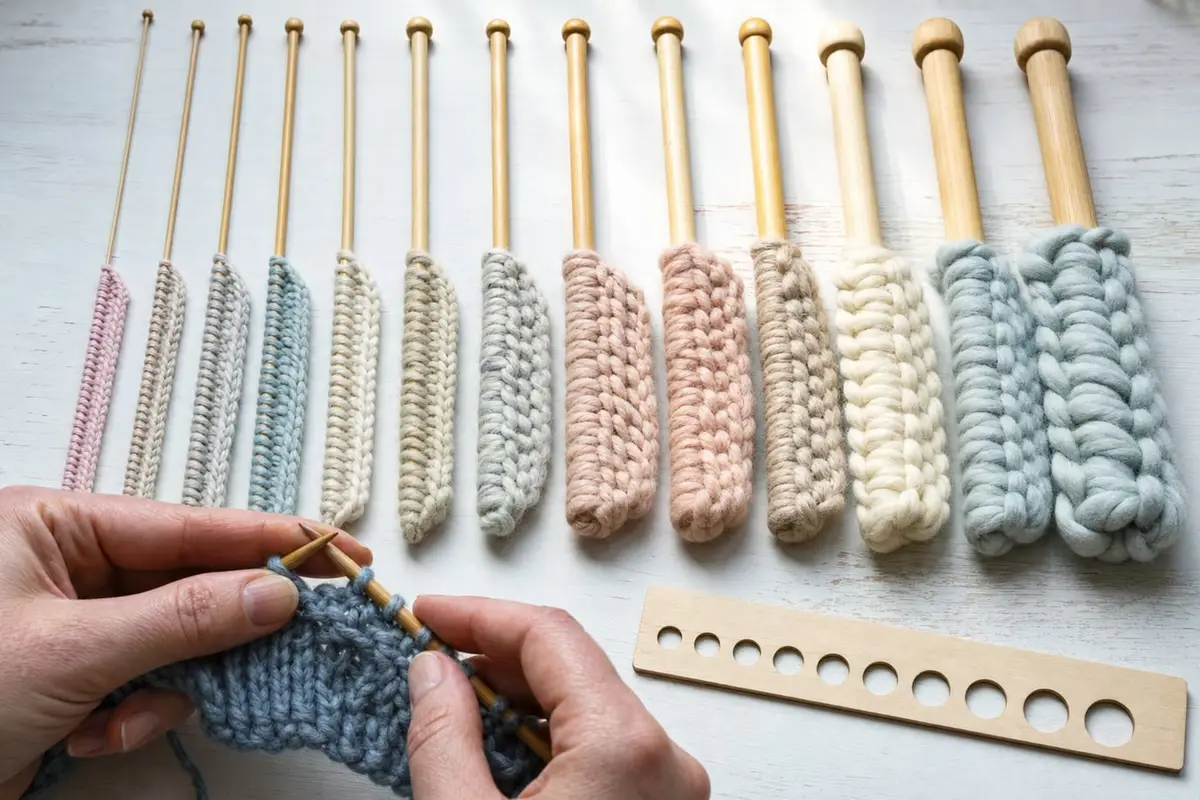
According to the Craft Yarn Council's 2018 chart, a US 6 needle is 4 mm, US 7 is 4.5 mm, US 8 is 5 mm, US 9 is 5.5 mm and US 10 is 6 mm. Choose the size on your yarn label, US 7 to 9 for medium (4) worsted, then adjust after a gauge swatch.
Knitting needle size — A knitting needle's size is its diameter, given in millimeters and, in the United States, as a number such as US 8 for 5 mm; the Craft Yarn Council's 2018 guidelines advise relying on the millimeter size, which is the accurate measurement.
Some links on this page are affiliate links: if you buy through them, we may earn a commission at no extra cost to you. It never changes our rankings. As an Amazon Associate I earn from qualifying purchases. Affiliate policy
Knitting needles are sized by diameter, in millimeters and, in the United States, by a number: US 6 is 4 mm, US 8 is 5 mm and US 10½ is 6.5 mm in the Craft Yarn Council’s 2018 chart. The two systems do not map one to one: US 6 covers both 4 and 4.25 mm, US 9 both 5.25 and 5.5 mm, and 3 mm and 7 mm have no US number at all, which is why the council advises relying on millimeters. For a Medium (4) worsted, the council recommends US 7 to 9 (4.5 to 5.5 mm), for a gauge of 16 to 20 stitches per 4 inches in stockinette. This page gives the full chart, the size for each yarn weight, and how to choose between straight, circular, double-pointed and interchangeable needles in bamboo, aluminum or steel.
If you already crochet
| In crochet | In knitting |
|---|---|
| hooks sized by letter and millimeter, e.g. I-9 = 5.5 mm | needles sized by number and millimeter, e.g. US 8 = 5 mm |
| one hook per size | one pair of straights, one circular or a set of DPNs per size |
| 5.5 to 6.5 mm (I-9 to K-10½) for Medium (4) worsted | US 7 to 9 (4.5 to 5.5 mm) for the same yarn |
| steel hooks numbered in reverse for thread | very fine needles numbered 000 to 3 for lace and sock yarn |
| gauge in single crochet (UK double crochet) per 4 in | gauge in stockinette stitches per 4 in |
Quick reference
| You use | Needles to start with | For comparison in crochet |
|---|---|---|
| Light (3) DK, e.g. a cotton DK | US 5 to 7 (3.75 to 4.5 mm) | 4.5 to 5.5 mm hook (7 to I-9) |
| Medium (4) worsted, e.g. Red Heart Super Saver | US 7 to 9 (4.5 to 5.5 mm), often US 8 (5 mm) | 5.5 to 6.5 mm hook (I-9 to K-10½) |
| Bulky (5) chunky | US 9 to 11 (5.5 to 8 mm) | 6.5 to 9 mm hook (K-10½ to M-13) |
| Super Bulky (6), e.g. Lion Brand Wool-Ease Thick & Quick | US 11 to 17 (8 to 12.75 mm) | 9 to 15 mm hook (M-13 to Q) |
| Material, with examples | Feel | Who it suits |
|---|---|---|
| Bamboo or wood, e.g. Clover Takumi | warm, slightly grippy | beginners whose stitches slip; slippery acrylic |
| Aluminum, e.g. Boye | smooth, fast, strong | knitters with even tension; grippy wool |
| Stainless steel, e.g. ChiaoGoo interchangeable tips | very slick, pointed | experienced knitters, lace |
Needles and hooks for the same yarn are not the same size: knitting uses thinner needles than the hook a crocheter would pick. Ranges from the Craft Yarn Council’s 2018 guidelines; your label and pattern come first.
Who needs which needles
- Absolute beginners: one pair of US 8 (5 mm) straights, about 9 or 10 inches, for a garter stitch scarf in Medium (4) worsted.
- Crocheters adding knitting: the same, plus your crochet hook to rescue dropped stitches.
- Hat and sweater knitters: a 16-inch circular for hats and a 29-inch or longer circular for bodies, in the size the pattern gives.
- Sock knitters: double-pointed needles or a long circular in US 1 to 3 (2.25 to 3.25 mm) for Super Fine (1) sock yarn.
- Not ideal for beginners: very slick steel tips, very short circulars and sizes below US 4 (3.5 mm), which make the first stitches harder to see.
The knitting needle size chart
From the Craft Yarn Council’s Standards & Guidelines (2018). Sizes marked “none” have no US equivalent in the council’s chart.
| Millimeters | US size | Typical yarn (CYC 2018) |
|---|---|---|
| 1.50 mm | 000 | Lace (0) |
| 1.75 mm | 00 | Lace (0) |
| 2 mm | 0 | Lace (0) |
| 2.25 mm | 1 | Lace (0) to Super Fine (1) |
| 2.75 mm | 2 | Super Fine (1) |
| 3 mm | none | Super Fine (1) |
| 3.125 and 3.25 mm | 3 | Super Fine (1) to Fine (2) |
| 3.50 mm | 4 | Fine (2) |
| 3.75 mm | 5 | Fine (2) to Light (3) |
| 4 and 4.25 mm | 6 | Light (3) |
| 4.50 mm | 7 | Light (3) to Medium (4) |
| 5 mm | 8 | Medium (4) |
| 5.25 and 5.50 mm | 9 | Medium (4) to Bulky (5) |
| 5.75 and 6 mm | 10 | Bulky (5) |
| 6.50 mm | 10½ | Bulky (5) |
| 7 mm | none | Bulky (5) |
| 8 mm | 11 | Bulky (5) to Super Bulky (6) |
| 9 mm | 13 | Super Bulky (6) |
| 10 mm | 15 | Super Bulky (6) |
| 12.50 and 12.75 mm | 17 | Super Bulky (6) to Jumbo (7) |
| 15 mm | 19 | Jumbo (7) |
| 19 mm | 35 | Jumbo (7) |
| 25 mm | 50 | Jumbo (7) |
Needle size by yarn weight
| Yarn weight (CYC) | Yarn names | Needles | Knit gauge in stockinette (per 4 in) |
|---|---|---|---|
| 1 Super Fine | sock, fingering, baby | US 1 to 3 (2.25 to 3.25 mm) | 27 to 32 stitches |
| 2 Fine | sport, baby | US 3 to 5 (3.25 to 3.75 mm) | 23 to 26 stitches |
| 3 Light | DK, light worsted | US 5 to 7 (3.75 to 4.5 mm) | 21 to 24 stitches |
| 4 Medium | worsted, afghan, Aran | US 7 to 9 (4.5 to 5.5 mm) | 16 to 20 stitches |
| 5 Bulky | chunky, craft, rug | US 9 to 11 (5.5 to 8 mm) | 12 to 15 stitches |
| 6 Super Bulky | bulky, roving | US 11 to 17 (8 to 12.75 mm) | 7 to 11 stitches |
The council labels these ranges guidelines only. Lion Brand’s beginner guide adds the practical rule: worsted usually calls for US 7 to 9, but the label tells you for sure.
Needle types
KnitPro’s 2022 guide describes the four main types:
- Straight (single-pointed) needles, ideal for knitting back and forth on flat projects such as scarves and dishcloths.
- Fixed circular needles, two tips joined by a flexible cable. They knit in the round, for hats and sweaters, depending on the cable length, and can also knit flat.
- Interchangeable sets, tips in many sizes that screw onto cables of different lengths, suitable for almost every round project.
- Double-pointed needles (DPNs), sold in sets of four or five, for small round projects such as socks, mittens and the crowns of hats.
Tin Can Knits explains that a needle’s size actually means its diameter, the same for every type.
Materials
KnitPro calls aluminum the most widely used and the strongest material, and notes that bamboo is particularly popular with new knitters because it is affordable and pleasant to use. Wood is quiet and warm, acrylic and plastic are light and inexpensive, and carbon needles are light and flexible. In general, smoother materials such as metal make stitches slide faster, while bamboo and wood grip the yarn a little more, which helps when stitches tend to slip off.
How to choose your needles
- Read the yarn label for the recommended size.
- Follow the pattern if it gives a size; it was chosen to reach a gauge.
- Swatch. The Craft Yarn Council’s rule: if your swatch is larger than the pattern’s gauge, go down a size; if smaller, go up.
- Pick the type for the project: straights or a circular for flat pieces, a circular for hats and sweaters, DPNs or a long circular for small rounds.
- Pick a material you enjoy: bamboo or wood if your stitches slip, metal if you want speed.
First needles to buy
A pair of US 8 (5 mm) straight needles in bamboo or wood suits most first projects in worsted yarn. A US 8 circular needle of about 16 inches lets you knit a first hat; a 29-inch circular can knit flat pieces as well. Our comparison of the best knitting needles for beginners lists one option of each type, and our yarn weight chart explains the yarn categories.
Key facts
- The Craft Yarn Council's 2018 needle chart lists 2.25 mm as US 1, 3.25 mm as US 3, 3.75 mm as US 5, 4 mm as US 6, 4.5 mm as US 7, 5 mm as US 8, 5.5 mm as US 9, 6 mm as US 10, 6.5 mm as US 10½, 8 mm as US 11, 9 mm as US 13 and 10 mm as US 15.Craft Yarn Council, Standards & Guidelines for Crochet and Knitting, 2018
- The same 2018 yarn weight table recommends US 5 to 7 (3.75 to 4.5 mm) needles for Light (3) yarn, US 7 to 9 (4.5 to 5.5 mm) for Medium (4), US 9 to 11 (5.5 to 8 mm) for Bulky (5) and US 11 to 17 (8 to 12.75 mm) for Super Bulky (6).Craft Yarn Council, Standards & Guidelines for Crochet and Knitting, 2018
- KnitPro's 2022 needle guide says single-pointed needles suit flat projects knit back and forth, fixed circulars suit round projects depending on cable length, interchangeables suit almost every round project, and double-pointed needles suit small round projects such as socks.KnitPro, Find the Best Knitting Needles, 2022
- The same 2022 KnitPro guide calls aluminum the most widely used and strongest needle material, and says bamboo is particularly popular with new knitters because it is affordable and pleasant to use.KnitPro, Find the Best Knitting Needles, 2022
FAQ
What size knitting needles should a beginner use?
For medium (4) worsted yarn, the usual beginner choice, US 7 to 9 (4.5 to 5.5 mm). A pair of US 8 (5 mm) straight needles about 9 or 10 inches long is a common first pair. Always check the size printed on your yarn label.
What size is a US 8 knitting needle in mm?
5 mm, according to the Craft Yarn Council's chart. Nearby sizes are US 7 at 4.5 mm and US 9 at 5.5 mm. Some US numbers cover two metric sizes, such as US 6 for 4 and 4.25 mm, so check the millimeters on the package.
Should beginners use straight or circular needles?
Straight needles are simplest for flat projects like scarves and dishcloths. Circular needles do everything straights do, knitted back and forth, and also knit in the round for hats; many knitters switch to circulars early because the cable holds the weight of the work.
Are bamboo or metal needles better for beginners?
Many beginners prefer bamboo or wood, which grip the yarn slightly so stitches do not slide off. Aluminum and other metal needles are faster and stronger, which experienced knitters often prefer. KnitPro notes that bamboo is particularly popular with new knitters.