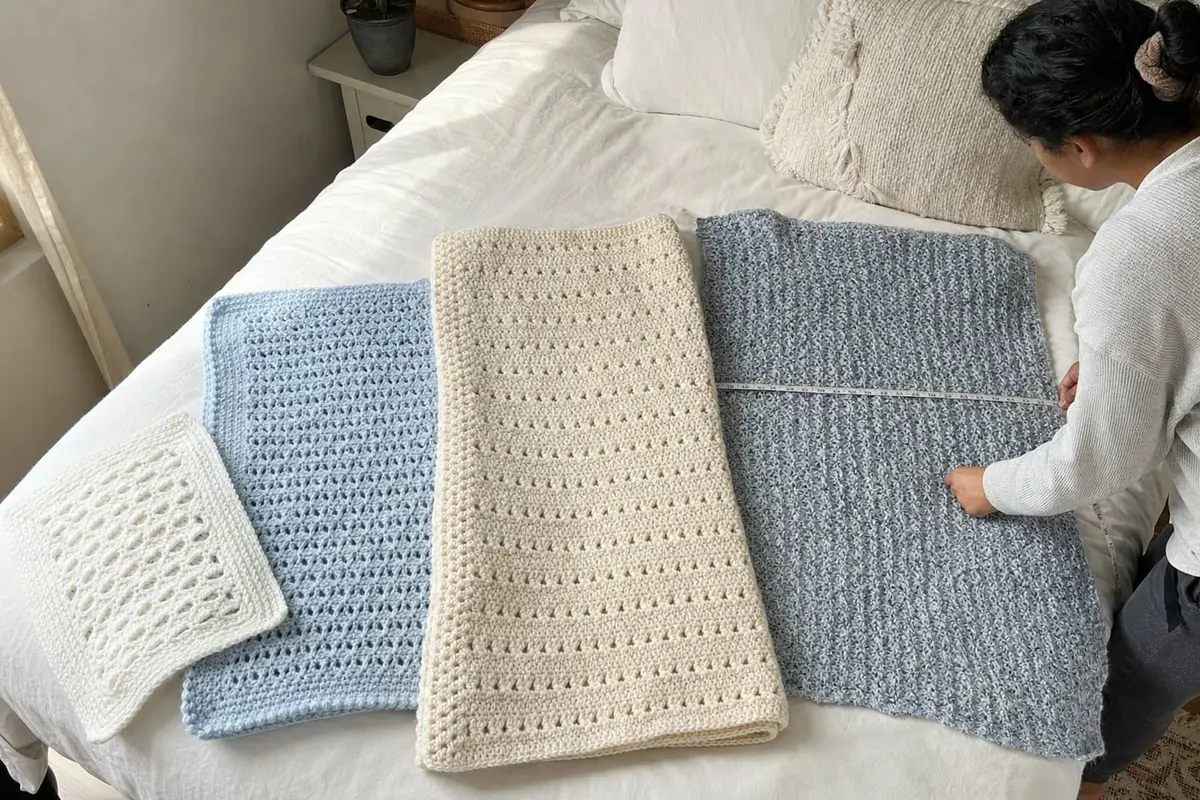
There is no industry standard, but Sarah Maker's 2023 chart gives common targets: about 30 by 36 inches for a stroller blanket, 42 by 52 for a baby blanket, 50 by 50 to 60 by 72 for a throw, 66 by 90 for a twin and 88 by 92 for a queen. Choose by use, then check the pattern's gauge.
Throw blanket — A throw is a medium-size blanket meant for a sofa or an armchair rather than a bed; crochet designers give throws sizes from about 50 by 50 inches to 60 by 72 inches.
Some links on this page are affiliate links: if you buy through them, we may earn a commission at no extra cost to you. It never changes our rankings. As an Amazon Associate I earn from qualifying purchases. Affiliate policy
Before buying yarn for a blanket, decide how big it should be. That choice sets the yarn quantity, the time it takes and whether it will do its job, a stroller blanket that fits the stroller, a throw that covers a person on the sofa, a bedspread that reaches the floor. This guide gathers the sizes designers use, explains why they differ and helps you pick one.
The size chart
There is no industry standard for blanket sizes: the Craft Yarn Council’s 2018 Standards & Guidelines contain body-measurement charts for garments, but no blanket table. The figures below come from Sarah Maker’s dated 2023 chart, with the ranges other designers use alongside. All sizes are in inches, width by length.
| Blanket | Sarah Maker (2023) | Range across designers | Typical use |
|---|---|---|---|
| Lovey | 12 x 12 | 10 x 10 to 14 x 14 | comfort square for a baby |
| Security | 14 x 18 | 14 x 18 to 18 x 18 | small comfort blanket |
| Preemie | 18 x 24 | 18 x 24 to 28 x 28 | very small babies |
| Car seat | 20 x 24 | about 20 x 24 | fits over a car seat |
| Stroller | 30 x 36 | 30 x 36 | stroller and outings |
| Receiving | 40 x 40 | 24 x 24 to 40 x 40 | wrapping a newborn |
| Baby, average | 42 x 52 | about 25 x 32 to 42 x 52 | general baby blanket |
| Crib | 45 x 60 | 36 x 54 to 45 x 60 | crib use |
| Swaddle | 48 x 48 | 44 x 44 to 48 x 48 | square swaddle |
| Toddler | 36 x 48 | 30 x 42 to 42 x 52 | toddler bed or play |
| Lapghan | 36 x 48 | 36 x 36 to 36 x 48 | over the knees in a chair |
| Throw | 50 x 50 to 60 x 72 | about 48 x 60 to 60 x 72 | sofa or armchair |
| Twin | 66 x 90 | 66 x 90 to 69 x 90 | twin bed |
| Full or double | 80 x 90 | 80 x 90 to 84 x 90 | full bed |
| Queen | 88 x 92 | 88 x 92 to 90 x 100 | queen bed |
| King | about 104 x 92 | 104 x 92 to 108 x 100 | king bed |
The ranges come from Sarah Maker, Oombawka Design and The Crochet Crowd. Sarah Maker herself notes that baby sizes are general averages and that individual designers and patterns vary; her king size also appears as 106 by 90 in her text, an example of how loosely these sizes are defined.
Yarn, hook and yardage by size
| Blanket | Typical yarn (CYC weight) | Hook | Approximate yardage |
|---|---|---|---|
| Baby blanket | soft Medium (4) acrylic or cotton | 5 to 5.5 mm (H-8 to I-9) | about 500 to 700 yd in worsted (Lion Brand, 2026) |
| Lapghan | Medium (4) worsted | 5.5 to 6.5 mm (I-9 to K-10½) | about 1,000 yd in worsted (Lion Brand, 2026) |
| Throw | Medium (4) worsted, or Super Bulky (6) for speed | 5.5 to 6.5 mm, or 9 to 15 mm (M-13 to Q) | about 1,200 to 2,000 yd in worsted, or 500 to 800 yd in super bulky (Lion Brand, 2026) |
| Twin and larger | Medium (4) or Bulky (5) | 5.5 to 9 mm | follow the pattern’s figure for each size |
The two Lion Brand articles behind these figures give different throw yardages, 1,200 to 1,600 yards in one and 1,500 to 2,000 in the other, which shows how much stitch choice changes yarn use: a dense single crochet (UK double crochet) fabric uses more yarn than an open double crochet (UK treble) or granny stitch. Our guide to crochet stitches for blankets compares the common stitches by density, speed and yarn use. Hook ranges follow the Craft Yarn Council’s 2018 guidelines; follow your yarn label.
Why the sizes differ
- Drape or no drape. Bed sizes can cover only the top of the mattress or hang down the sides. The Crochet Crowd lists both: a queen of 60 by 80 inches on top of the mattress, or 90 by 95 with drape. Sarah Maker’s bed sizes include 12 to 16 inches of drop.
- Pillow tuck. Sarah Maker suggests adding about 16 to 20 inches of length to tuck a bedspread under the pillows.
- Regional habits and stitch patterns. Many patterns are built on a repeat, so their finished size lands near, not exactly on, a round number.
How to choose a size
- Start from the use. A stroller, a crib, a sofa or a bed: measure the real object if you can.
- Pick the smallest size that does the job. Every extra inch adds yarn and hours, and a first blanket that gets finished is better than a large one that does not.
- For a bed, decide on drape. Measure the mattress, add the drop you want on each side and, if you like, a pillow tuck.
- Check the pattern. If a pattern offers several sizes, its yardage per size is more reliable than any general estimate.
For a first blanket, a baby blanket or a lapghan is the realistic choice; a throw is a good second project.
From size to yarn and stitches
To hit a size, make a swatch in your stitch and yarn, measure how many stitches and rows fit in 4 inches, then multiply. If your swatch is looser than the pattern’s gauge, the blanket comes out larger than expected, as Sarah Maker notes; she also suggests crocheting a larger swatch of about 10 by 10 inches, unraveling it and measuring the yarn to estimate the total for a custom size.
As an order of magnitude, Lion Brand’s 2026 guide puts a standard adult throw at about 1,500 to 2,000 yards in worsted, or 500 to 800 yards in super bulky yarn. Our comparison of the best yarn for crochet blankets gives yardage per skein for each pick, and our guide to crocheting a blanket walks through the whole project.
Baby blankets and safety
The Crochet Crowd notes that baby-sized blankets must not be left with a baby unsupervised. Choose soft, machine-washable yarns for baby items, avoid long fringes and loose embellishments, and keep stitches tight enough that small fingers cannot catch in them.
Granny square blankets
For a blanket made of squares, divide the target size by the size of one finished, blocked square. Sarah Maker’s free granny square blanket, for example, joins 48 six-inch squares for about 38 by 50 inches before the border. Our granny square tutorial explains how the squares are built.
Key facts
- Sarah Maker's 2023 crochet blanket size chart lists a stroller blanket at 30 by 36 inches, a receiving blanket at 40 by 40, an average baby blanket at 42 by 52, a crib blanket at 45 by 60 and a lapghan at 36 by 48.Sarah Maker, Crochet Blanket Sizes Guide (Sarah Stearns), 2023
- The same 2023 chart lists throws from 50 by 50 inches (square) to 60 by 72 (oversized), a twin at 66 by 90, a full or double at 80 by 90 and a queen at 88 by 92, with bed sizes including 12 to 16 inches of drop.Sarah Maker, Crochet Blanket Sizes Guide (Sarah Stearns), 2023
- The Craft Yarn Council's 2018 Standards & Guidelines include body-measurement size charts for garments but no blanket or afghan size table, so blanket sizes are designers' conventions rather than an industry standard.Craft Yarn Council, Standards & Guidelines for Crochet and Knitting, 2018
- In the Craft Yarn Council's 2014 study of 3,178 knitters and crocheters, baby blankets made up 32% of charity projects, and baby blankets and afghans were among the favorite projects.Craft Yarn Council, research one-sheet, 2014
FAQ
What size is a crochet throw blanket?
Usually between about 50 by 50 inches and 60 by 72 inches. Sarah Maker's chart lists a square throw at 50 by 50, small at 52 by 60, medium at 54 by 66 and oversized at 60 by 72. Choose a size that covers a person sitting on your sofa.
What size is a crochet baby blanket?
Sizes vary widely between designers. Sarah Maker gives 30 by 36 inches for a stroller blanket, 40 by 40 for a receiving blanket, 42 by 52 for an average baby blanket and 45 by 60 for a crib. Other charts give smaller baby sizes, so follow your pattern.
How big should a crochet blanket be for a queen bed?
Charts differ: about 88 by 92 inches in Sarah Maker's chart, 90 by 95 in The Crochet Crowd's chart with drape and 90 by 100 in Oombawka Design's. Measure the mattress, add the drop you want on each side, and add length for a pillow tuck if needed.
How do I make a crochet blanket a custom size?
Make a swatch in your stitch, measure how many stitches and rows fit in 4 inches, then multiply to reach your target width and length. Adjust the stitch count to the pattern's repeat, and estimate yarn from a larger swatch, as Sarah Maker suggests.