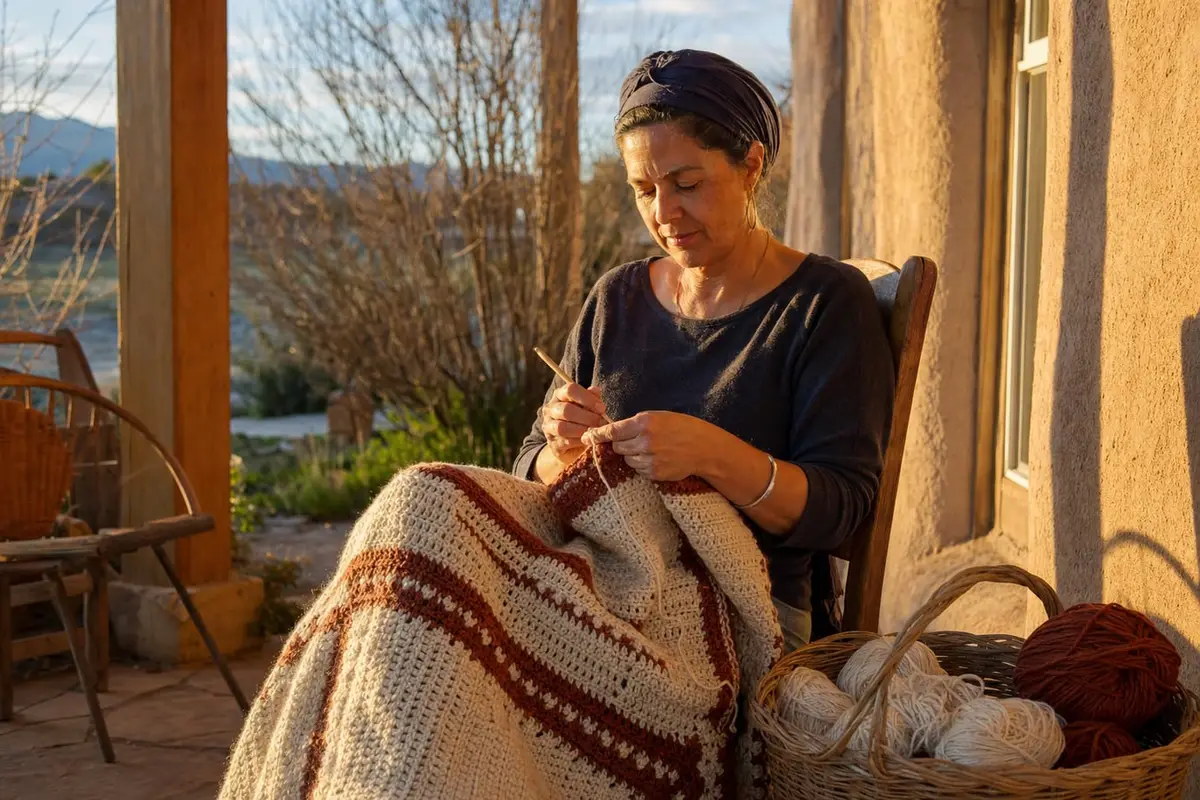
Following Sarah Maker's 2023 beginner guide, crochet a first blanket as one rectangle in an easy stitch such as half double or double crochet. Use a smooth medium (4) or bulkier yarn with the hook its label recommends, plan the size and yardage, count stitches every row, then finish with a single crochet border, three stitches in each corner.
Crochet blanket — A crochet blanket is a large piece of crocheted fabric, worked either in one piece in rows or from motifs such as granny squares joined together, usually finished with a border; throws, baby blankets and bed-size afghans are the common types.
Some links on this page are affiliate links: if you buy through them, we may earn a commission at no extra cost to you. It never changes our rankings. As an Amazon Associate I earn from qualifying purchases. Affiliate policy
A blanket is the project most new crocheters dream of, and it is more achievable than it looks: a rectangle, one stitch, many rows. What makes it succeed or stall is the planning. This guide walks through the decisions in order, from stitch and yarn to the last row of the border. We explain the method and link to designers’ free patterns rather than publishing a pattern of our own.
At a glance
| Decision | Beginner choice | Source |
|---|---|---|
| Construction | one-piece rectangle in rows | Sarah Maker (2023) |
| Stitch | half double crochet (hdc; UK half treble) or double crochet (dc; UK treble) | Sarah Maker (2023); Lion Brand (2026) |
| Yarn | smooth Medium (4) worsted, or Super Bulky (6) for speed | Lion Brand (2026); Craft Yarn Council (2018) |
| Hook | the label’s size: about 5.5 to 6.5 mm (I-9 to K-10½) for medium, 9 to 15 mm (M-13 to Q) for super bulky | Craft Yarn Council (2018) |
| Yardage for an adult throw | about 1,500 to 2,000 yd worsted, or 500 to 800 yd super bulky | Lion Brand (2026) |
| Start | foundation chain, or foundation single crochet for a stretchier edge | Sigoni Macaroni (2019) |
| Finish | single crochet border, 3 sc in each corner | Lion Brand (2026) |
1. Choose the construction and the stitch
For a first blanket, Sarah Maker recommends a one-piece rectangle in an easy stitch, half double crochet, double crochet or moss stitch, rather than granny squares. A rectangle has no joining and no counting of motifs; you work the same row again and again, which is exactly how tension becomes even. Lion Brand’s 2026 guide suggests double crochet for a first blanket, roughly twice the height of single crochet, so the blanket grows quickly. Single crochet works too but makes a denser, heavier fabric and takes longer. If the stitches are new, practice them first with our guide to basic crochet stitches; to weigh warmth, drape, speed and texture before you commit, our comparison of crochet stitches for blankets puts eight common choices side by side.
2. Choose the yarn and the hook
Use a smooth yarn in a solid, light or medium color so you can see the stitches. Two weights suit a first blanket:
- Medium (4) worsted, the most common choice: soft, washable, widely available. The Craft Yarn Council’s 2018 guidelines recommend a 5.5 to 6.5 mm (I-9 to K-10½) hook for it.
- Super Bulky (6), for speed: Sarah Maker notes that bulkier yarns work up much faster. The council’s range is 9 to 15 mm (M-13 to Q), though some chenille blanket yarns put a smaller hook on their label; follow the label.
Acrylic is affordable and machine washable; Lion Brand’s 2026 guide notes that wool blends add warmth and that cotton is breathable but heavier. Our comparison of the best yarn for crochet blankets applies these criteria to specific yarns.
3. Plan the size and the yardage
Decide what the blanket is for: a baby blanket, a lapghan, a throw for the sofa or a bed cover. There is no single industry standard, but common sizes run from about 30 by 36 inches for a stroller blanket to around 50 by 60 inches for a throw; our guide to crochet blanket sizes compares them.
For yardage, use the pattern’s figure when you follow one. Otherwise, Lion Brand’s 2026 guide gives an order of magnitude for an adult throw: about 1,500 to 2,000 yards of worsted, or 500 to 800 yards of super bulky. Buy all your yarn at once if it has dye lots, plus a little extra for the border.
4. Make a swatch and calculate the width
Crochet a swatch of about 4 by 4 inches in your stitch, measure how many stitches fit in 4 inches, and multiply to find how many stitches your width needs. A swatch also tells you whether you like the fabric: if it is stiff, go up a hook size; if it is loose and holey, go down one. The Craft Yarn Council’s rule is the same for any project: a swatch larger than the target means a smaller hook, a smaller swatch a larger hook.
5. Start the foundation
The usual start is a foundation chain followed by the first row of stitches. Sigoni Macaroni points out the main drawback: a foundation chain is always a little tighter than the rows above it, so the bottom edge of a blanket can pull in. Two fixes:
- Work the chain with a larger hook, then switch back to your blanket hook for the first row.
- Use a chainless foundation, foundation single crochet or foundation double crochet, which builds the chain and the first row at once and matches the stretch of the fabric. It takes some practice, and it saves counting a very long chain.
6. Work the rows and keep the edges straight
Turn at the end of each row, chain the turning chain for your stitch, and work across. Sigoni Macaroni’s first rule for straight edges is to count your stitches. The second is to be consistent with the turning chain: if it counts as a stitch, skip the first stitch of the row; if it does not, work into the very first stitch. Put a stitch marker in the first and last stitch of each row until the edges look even. If the count drifts, our guide to fixing common crochet mistakes shows how to find the problem.
7. Join new skeins
A blanket uses several skeins. Lion Brand’s tip is to join a new ball at the edge of a row whenever you can, so the join hides in the border. If you must join mid-row, work a couple of stitches with the old and new yarn held together, and treat them as single stitches on the next row. Leave tails of about 6 inches to weave in.
8. Add a border
A border straightens the edges and frames the blanket. Lion Brand’s 2026 border guide gives the rules: start with a round of single crochet, work 1 sc per row of single crochet, 2 sc per row of half double crochet and 3 sc per row of double crochet along the sides, and 3 stitches in each corner. If the border ripples, you have too many stitches; if it curls or pulls in, too few. One or two rounds of single crochet are enough for a first blanket.
9. Weave in the ends and block
Weave in every tail with a yarn needle, changing direction once or twice so it cannot slip out, and trim close. A light blocking, washing or steaming according to the yarn label and laying the blanket flat to dry, evens out the stitches and the edges.
Free beginner blanket patterns
These patterns are free to read on their designers’ sites:
| Pattern | Designer | Level stated | Stitches | Yarn and hook | Size |
|---|---|---|---|---|---|
| Chunky Striped Throw Blanket | Sarah Maker | Beginner to Easy | hdc, hdc in back loop | Super Bulky, Lion Brand Wool-Ease Thick & Quick, 12 mm hook | 48 x 54 in |
| Chunky Crochet Blanket for Beginners | Sigoni Macaroni | first-time blanket | ch, hdc | Super Bulky (6), one 547-yard skein, 11.5 mm hook | 36 x 46 in |
| Free Crochet Ripple Baby Blanket | Sarah Maker | Beginner to Easy | hdc, increases and decreases | Medium (4), I-9 (5.5 mm) hook | 30 x 36 in |
| Easy Moss Blanket | Bella Coco Crochet | suitable for beginners | moss stitch (written in UK terms, US toggle) | super chunky, 8 mm hook | about 39 x 45 in |
| Granny Square Blanket | Sarah Maker | Easy | granny clusters, joined squares | Medium (4), J-10 (6 mm) hook | 38 x 50 in before border |
The Bella Coco pattern is written in UK terms: its “double crochet” is a US single crochet. Our page on US vs UK crochet terms explains the conversion.
How long will it take?
Time depends on size, yarn and speed, but yarn weight matters most. Lion Brand’s 2026 guide estimates that a worsted throw takes two to three times longer than the same pattern in super bulky yarn. If you want to finish within a few weeks, choose a baby blanket or lapghan in super bulky or bulky yarn; if you enjoy the process and want a lighter, drapier result, worsted is worth the extra rows. Either way, working a set number of rows each day keeps a large project moving.
Choosing colors
For a first blanket, one or two solid colors keep the focus on even stitches; stripes add interest without extra technique, since you only change color at the end of a row. Light and medium shades make stitches easier to count than very dark ones.
A second blanket: granny squares
Once a rectangle feels easy, a granny square blanket teaches working in the round and joining motifs. Start with our granny square tutorial, make one square to check your gauge, then follow a designer’s blanket pattern.
Key facts
- Sarah Maker's 2023 guide recommends a simple one-piece rectangle in an easy stitch such as half double crochet, double crochet or moss stitch for a first blanket, and notes that blankets in bulkier yarns work up more quickly than those in thinner yarns.Sarah Maker, How to Crochet a Blanket (Sarah Stearns), 2023
- Lion Brand's 2026 blanket yarn guide estimates about 1,500 to 2,000 yards of worsted yarn, or about 500 to 800 yards of super bulky yarn, for a standard adult throw, and says a worsted throw takes two to three times longer than the same pattern in super bulky.Lion Brand, Crochet Blanket Yarn Recommendations for Cozy Results, 2026
- Lion Brand's 2026 border guide says a foundation round of single crochet is essential to prevent rippling, with 1 sc per sc row, 2 sc per hdc row and 3 sc per dc row along the sides and 3 stitches in each corner.Lion Brand, Finish Crochet Blanket Borders Fast, 2026
- Sigoni Macaroni's 2019 tutorial on chainless foundations explains that a foundation chain is always a little tighter than the rows worked above it, while a foundation single crochet edge matches the rest of the fabric in stretch.Sigoni Macaroni, Chainless Foundation Crochet Stitches, 2019
FAQ
What is the easiest blanket to crochet for a beginner?
A one-piece rectangle worked in rows of a single easy stitch, such as half double or double crochet, in a smooth medium or super bulky yarn. It has no shaping and no joining, and the repetition builds even tension. A granny square blanket is a good second blanket.
How much yarn do I need for a crochet blanket?
It depends on size, stitch and yarn weight. Lion Brand's 2026 guide estimates about 1,500 to 2,000 yards of worsted, or 500 to 800 yards of super bulky, for an adult throw. Check the pattern's yardage and buy all the yarn at once if it has dye lots.
How long does it take to crochet a blanket?
It varies with size, yarn and speed. Bulkier yarns are much faster: Lion Brand notes that a worsted throw takes two to three times longer than the same pattern in super bulky yarn. A baby blanket in bulky yarn is a realistic first project.
How do I keep the edges of my blanket straight?
Count your stitches at the end of every row, work into the very first and last stitch correctly for your turning chain convention, and put a stitch marker in the first and last stitch. A border and light blocking at the end straighten small irregularities.
Sources
- Sarah Maker: How to Crochet a Blanket + Free Pattern (2023, updated 2024)
- Lion Brand: Crochet Blanket Yarn Recommendations (2026)
- Lion Brand: Free Crochet Blanket Patterns for Every Skill Level (2026)
- Lion Brand: Finish Crochet Blanket Borders Fast (2026)
- Lion Brand: Tips for Joining a New Ball of Yarn (2011, updated 2021)
- Sigoni Macaroni: Chainless Foundation Crochet Stitches (2019, updated 2022)
- Sigoni Macaroni: How to Crochet Straight Edges (2023)
- Craft Yarn Council: Standards & Guidelines for Crochet and Knitting (PDF, 2018)
Related reading
- Crochet Stitches for Blankets: How to Choose the Best One
- Blanket Yarn for Crochet: Chenille, Worsted, Wool Blend or Jumbo?
- Crochet Blanket Sizes: A Chart from Lovey to King, and How to Choose
- How to Crochet a Granny Square: Structure, Corners and Fixes
- Why Is My Crochet Curling? Fixing Common Crochet Mistakes