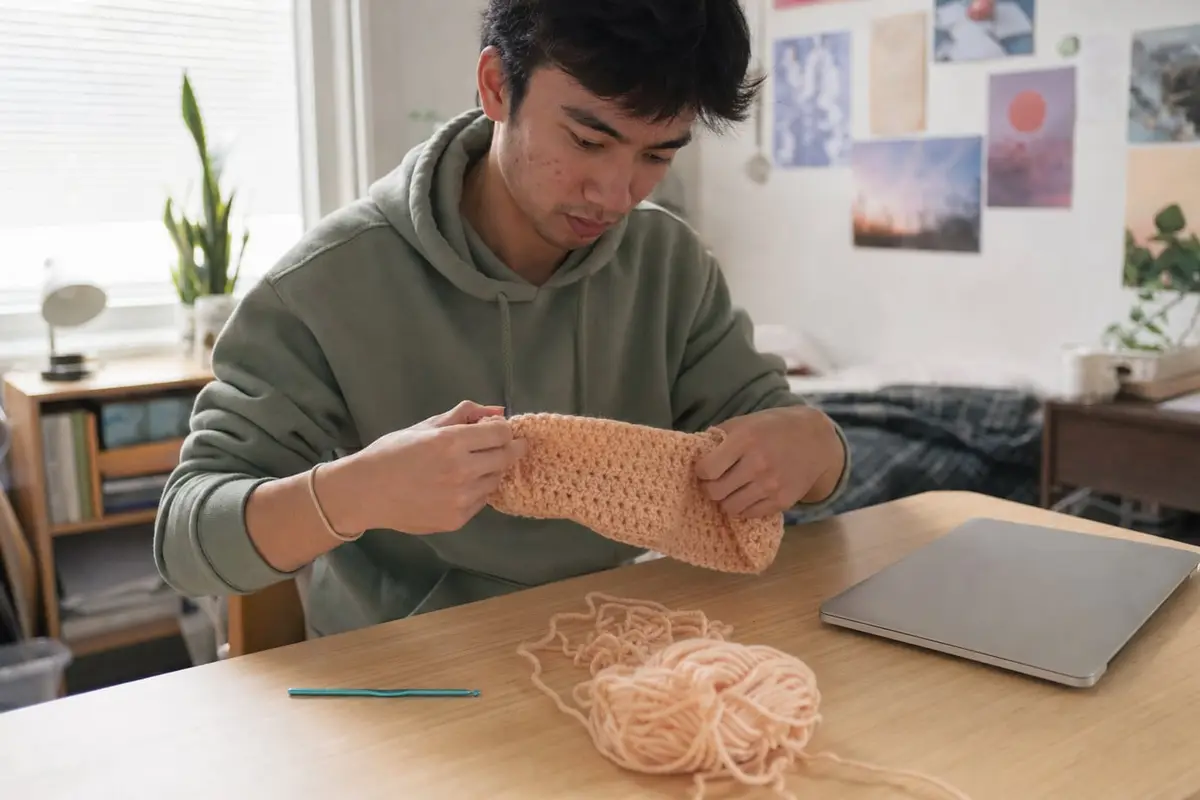
According to Lion Brand's 2026 beginner guide, crochet usually curls because the foundation chain is tighter than the stitches worked into it: chain with a larger hook, then switch back. Edges that wander come from stitches added or skipped at row ends, so count stitches after every row and frog back to the last correct row.
Frogging — Frogging is the crochet and knitting term for ripping out stitches to undo work, named, as Sarah Maker explains, after the sound of 'rip it, rip it', which resembles a frog's 'ribbit'; undoing one stitch at a time is called tinking.
Some links on this page are affiliate links: if you buy through them, we may earn a commission at no extra cost to you. It never changes our rankings. As an Amazon Associate I earn from qualifying purchases. Affiliate policy
Every crocheter’s first pieces curl, lean, grow or shrink. These are not signs that you cannot crochet; they are a handful of predictable mistakes, each with a simple fix. This guide lists them by symptom, explains the cause and gives the fix, with the sources behind each one.
At a glance
| Symptom | Usual cause | Fix |
|---|---|---|
| Bottom edge curls or pulls in | foundation chain tighter than the stitches | chain with a hook one or two sizes larger, or use a foundation single crochet |
| Whole piece curls | stitches too tight | go up one hook size, e.g. from 5 mm (H-8) to 5.5 mm (I-9) |
| Piece gets wider | extra stitches at row ends, often into the turning chain | count stitches every row; mark first and last stitch |
| Piece gets narrower | skipped first or last stitch | same, and check your turning chain convention |
| Wavy or rippling border | too many border stitches | remove stitches or go down a hook size |
| Border curls or pulls in | too few border stitches | add stitches or go up a hook size |
| Wrong size overall | gauge differs from the pattern | swatch, then change hook size |
Turning chain conventions at a glance
| Stitch (US, with UK name) | Usual turning chain | Counted as a stitch? | Where the first stitch goes |
|---|---|---|---|
| Single crochet, sc (UK double crochet) | ch 1 | no (Lion Brand, 2026) | into the very first stitch |
| Half double crochet, hdc (UK half treble) | ch 2 | depends on the pattern | follow the pattern’s note |
| Double crochet, dc (UK treble) | ch 3 | often yes | into the second stitch; last stitch into the top of the turning chain |
Most crooked edges come from mixing these conventions. When in doubt, the pattern’s note wins. For tension problems in a medium (4) worsted, the Craft Yarn Council’s 2018 range of 5.5 to 6.5 mm (I-9 to K-10½) is the place to start before going up or down a size.
Curling: the foundation chain
The most common reason a first piece curls is a tight chain. Lion Brand’s 2026 beginner guide puts it plainly: if your chain buckles or curls instead of lying flat, it is usually too tight. The fix is to work the chain with a larger hook, then switch back to your project hook for the first row. Sigoni Macaroni adds that a foundation chain is always a little tighter than the stitches worked above it, which is why some crocheters prefer a chainless foundation such as foundation single crochet.
If the whole piece curls, not just the bottom edge, your stitches are tight overall. Rather than forcing yourself to crochet more loosely, go up one hook size; our hook size chart lists the next sizes in millimeters and US letters.
Edges that are not straight
Crooked edges almost always come from adding or skipping stitches at the ends of rows. The cause is usually the turning chain. In single crochet, Lion Brand notes that the turning chain is never a stitch, so the first stitch of the row goes into the very first stitch. In taller stitches, many patterns count the turning chain as the first stitch, so you skip the first stitch of the row and work your last stitch into the top of the previous turning chain. Mixing the two conventions adds or loses one stitch per row.
The fix has three parts:
- Count every row. Lion Brand’s guide says counting at the end of every row catches nearly every problem.
- Mark the edges. Put a stitch marker in the first and last stitch of each row until your edges look right.
- Follow the pattern’s note on whether the turning chain counts. Designers differ; their note wins.
Sigoni Macaroni lists the other causes of uneven edges: inconsistent tension on the first and last stitch, color changes and simple miscounts. If your count is right but the edges still wander, tension is the likely cause; it improves with practice, and blocking straightens what remains.
The stitch count keeps changing
If your piece grows or shrinks steadily, you are adding or losing a stitch in the same place each row, usually at one edge. If it changes randomly, you are occasionally working two stitches into one or skipping one in the middle. Remember that, as Lion Brand points out, the loop on your hook is never counted as a stitch.
When the count is off, find the last row where it was right. Lion Brand’s guide notes that when counts drift a lot, frogging back to the last correct row is faster and less frustrating than trying to compensate in later rows.
Frogging and tinking
Sarah Maker defines frogging as ripping out stitches to undo your work, named after the sound of “rip it, rip it”, which resembles a frog’s “ribbit”. To frog, take the hook out and gently pull the working yarn until you reach the row you want to keep, then put the hook back into the live loop, taking care not to twist it. Tinking, “knit” spelled backward, means undoing one stitch at a time, which is safer when the mistake is only a few stitches back.
Not every mistake needs fixing. Sarah Maker’s advice is that small mistakes that do not change the stitch count can usually be left, while a mistake that changes the count, or one that bothers you, is worth frogging.
Borders that ripple or curl
Borders follow their own rule. Lion Brand’s 2026 border guide says a wavy border has too many stitches and a border that curls or pulls in has too few. Adjust the number of stitches along each side, or change hook size for the border only. Its rule of thumb for blankets is 1 single crochet per row of single crochet, 2 per row of half double crochet and 3 per row of double crochet, with 3 stitches in each corner.
Wrong size: tension and gauge
If a finished piece is much larger or smaller than the pattern says, the gauge differs. The Craft Yarn Council’s 2018 guidelines give the fix: make a swatch, compare it with the pattern’s gauge, use a smaller hook if your swatch is larger and a larger hook if it is smaller. US “gauge” is called “tension” in UK and Canadian patterns.
Practice that prevents mistakes
Most of these problems disappear with a few habits: a looser foundation chain, a stitch count at the end of every row, markers on the edges and one consistent grip on the hook. Our beginner’s guide to crochet covers them from the first stitch, and our guide to crocheting a blanket applies them to a large project.
Key facts
- Lion Brand's 2026 beginner guide says a chain that buckles or curls instead of lying flat is usually too tight, and recommends switching to a larger hook for the chain only, then returning to the project hook.Lion Brand, How to Crochet: A Step-by-Step Guide for Beginners, 2026
- The same 2026 guide says that counting stitches at the end of every row catches nearly every common problem, and that when counts drift a lot, frogging back to the last correct row is faster than trying to fix the math going forward.Lion Brand, How to Crochet: A Step-by-Step Guide for Beginners, 2026
- Sarah Maker's 2023 explainer defines frogging as ripping out or undoing a project, from the sound 'rip it, rip it', and advises frogging when a mistake changes the stitch count, while small mistakes that do not can usually be left.Sarah Maker, Frogging (Sarah Stearns), 2023
- Lion Brand's 2026 border guide says a border that curls or pulls in has too few stitches, while a wavy border has too many.Lion Brand, Finish Crochet Blanket Borders Fast, 2026
FAQ
Why is my crochet curling up?
Most often the foundation chain is tighter than the stitches worked into it, so the bottom edge pulls in and the fabric curls. Work the chain with a hook one or two sizes larger, or use a foundation single crochet. Tight stitches overall can cause curling too: go up a hook size.
Why is my crochet getting wider or narrower?
You are adding or skipping stitches, usually at the ends of rows: working into the turning chain when it does not count, or missing the last stitch. Count stitches after every row and mark the first and last stitch with stitch markers.
What does frogging mean in crochet?
Frogging means pulling out stitches to undo your work, from the sound of 'rip it, rip it', which resembles a frog's 'ribbit'. You remove the hook and pull the yarn until you reach the row where the mistake is, then put the hook back in the live loop.
Should I fix every crochet mistake?
No. A small mistake that does not change the stitch count or the shape is often invisible in the finished piece. Fix mistakes that change the count, the edges or the size, or any that bother you, as Sarah Maker advises.
Sources
- Lion Brand: How to Crochet, A Step-by-Step Guide for Beginners (2026)
- Lion Brand: Single Crochet Stitch for Beginners (2026)
- Lion Brand: Finish Crochet Blanket Borders Fast (2026)
- Sarah Maker: Frogging (2023)
- Sigoni Macaroni: How to Crochet Straight Edges (2023)
- Craft Yarn Council: Crochet 911
- Craft Yarn Council: Standards & Guidelines for Crochet and Knitting (PDF, 2018)