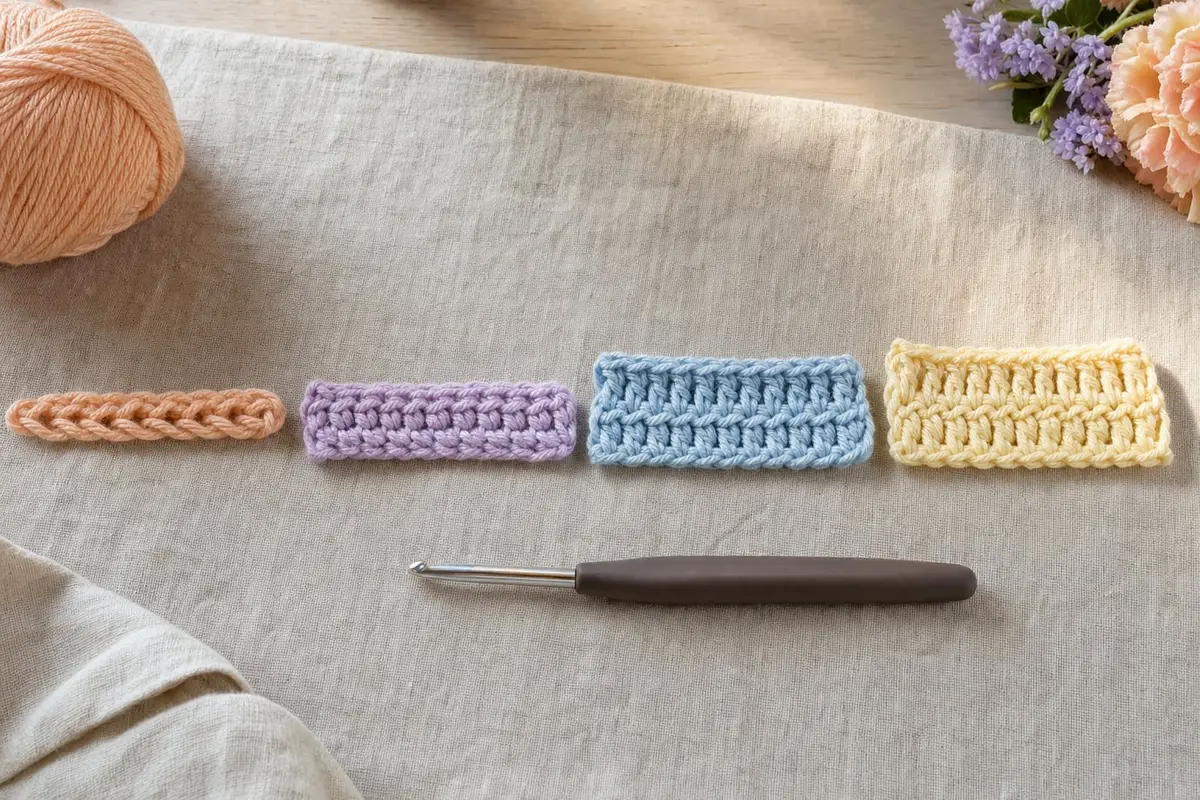
According to the Craft Yarn Council's Standards & Guidelines (2018), the basic US crochet stitches are chain (ch), slip stitch (sl st), single crochet (sc), half double crochet (hdc) and double crochet (dc). UK patterns call the last three double crochet, half treble and treble. Each taller stitch adds one yarn over.
Basic crochet stitches — In the Craft Yarn Council's Standards & Guidelines (2018), the basic crochet stitches are the chain, slip stitch, single crochet, half double crochet and double crochet, abbreviated ch, sl st, sc, hdc and dc in US patterns.
Some links on this page are affiliate links: if you buy through them, we may earn a commission at no extra cost to you. It never changes our rankings. As an Amazon Associate I earn from qualifying purchases. Affiliate policy
Five stitches cover most beginner patterns. They share the same movements, insert the hook, yarn over, pull up a loop, yarn over, pull through, and differ mainly in height. Here they are at a glance, with the Craft Yarn Council’s US abbreviations, the UK names from the council’s conversion table and the usual turning chain:
| Stitch (US) | Abbreviation | UK name | Loops on hook before finishing | Usual turning chain | Typical use |
|---|---|---|---|---|---|
| Chain | ch | chain | 1 | none | foundation, chain spaces |
| Slip stitch | sl st | slip stitch (ss) | 2, pulled through at once | none | joining rounds, edges |
| Single crochet | sc | double crochet (dc) | 2 | ch 1, not counted | amigurumi, bags, dishcloths |
| Half double crochet | hdc | half treble (htr) | 3, pulled through at once | ch 2 | hats, scarves, blankets |
| Double crochet | dc | treble (tr) | 3, worked off two at a time | ch 3, often counted | granny squares, blankets, shawls |
Learn them in this order, on a smooth medium weight (4) yarn with a 5 to 5.5 mm hook (H-8 or I-9): each one adds a single step to the previous one. All names below are US terms; the UK name is given in each section.
Chain (ch)
The chain is the foundation of most flat pieces and the building block of turning chains and chain spaces.
- Start with a slip knot on the hook.
- Yarn over.
- Pull the yarn through the loop on the hook. One chain made.
Keep chains loose and even. Count the V shapes on the front of the chain, not the loop on the hook. Our beginner’s guide to crochet covers holding the hook and making the slip knot.
Slip stitch (sl st)
Sarah Maker calls the slip stitch the shortest of all crochet stitches. It adds almost no height, so it is used to join rounds, to move across a row without building it up, and for neat edges.
- Insert the hook into the stitch.
- Yarn over and pull the loop through the stitch and through the loop on the hook in one movement.
In UK terms it keeps the same name, slip stitch, but the Craft Yarn Council lists its UK abbreviation as ss rather than sl st.
Single crochet (sc)
The single crochet makes a dense, sturdy fabric, used for amigurumi, dishcloths and bags.
- Insert the hook into the stitch.
- Yarn over and pull up a loop. Two loops on the hook.
- Yarn over and pull through both loops.
UK name: double crochet (dc). Turning chain: usually ch 1, which does not count as a stitch.
Our page on the single crochet stitch goes further: how the stitch forms, why its turning chain is a single chain, the usual counting mistakes and where to find free expert lessons.
Half double crochet (hdc)
Sarah Maker places the half double crochet between the other two: taller than a single crochet, shorter than a double crochet. It works up faster than single crochet while staying fairly solid, which makes it popular for hats and blankets.
- Yarn over before inserting the hook.
- Insert the hook into the stitch, yarn over and pull up a loop. Three loops on the hook.
- Yarn over and pull through all three loops at once.
UK name: half treble (htr). Turning chain: usually ch 2.
Our page on the half double crochet explains why the stitch finishes through all three loops at once, what its third loop and the camel stitch are, and how the ch 2 turning chain is counted.
Double crochet (dc)
The double crochet is about twice the height of a single crochet. It builds fabric quickly and gives an open, flexible texture, used in granny squares, blankets and shawls.
- Yarn over, then insert the hook into the stitch.
- Yarn over and pull up a loop. Three loops on the hook.
- Yarn over and pull through two loops. Two loops remain.
- Yarn over and pull through the last two loops.
UK name: treble (tr). Turning chain: usually ch 3, which often counts as the first double crochet of the row.
The double crochet stitch page covers the extra yarn over, the ch 3 turning chain that often counts as a stitch, and how to keep the edges straight.
Turning chains: how high, and do they count?
At the start of each row, you chain enough stitches to reach the height of the stitch you are about to work. Moogly gives the usual numbers: ch 1 for single crochet, ch 2 for half double and ch 3 for double crochet. Lion Brand’s second lesson uses the same turning chains of two and three.
Whether that chain counts as a stitch is a convention that varies. Sigoni Macaroni counts the ch 3 of a double crochet row but not the ch 1 of a single crochet row; other designers count none of them and work the first stitch into the base of the chain. Neither is wrong. What matters is to follow the pattern’s notes, and to count your stitches at the end of each row so the edges stay straight.
US and UK names at a glance
| US term (abbreviation) | UK term (abbreviation) | Usual turning chain |
|---|---|---|
| Chain (ch) | Chain (ch) | none |
| Slip stitch (sl st) | Slip stitch (ss) | none |
| Single crochet (sc) | Double crochet (dc) | ch 1 |
| Half double crochet (hdc) | Half treble (htr) | ch 2 |
| Double crochet (dc) | Treble (tr) | ch 3 |
| Treble crochet (tr) | Double treble (dtr) | ch 4 |
The stitch correspondences come from the Craft Yarn Council’s abbreviations page. Lion Brand sums it up: the stitches are the same, only the names change. Our US vs UK crochet terms page explains how to tell which system a pattern uses.
Which stitch for which project
Each stitch gives a different fabric, which is why patterns choose them on purpose:
- Single crochet makes the densest, firmest fabric, with very small gaps. It suits amigurumi, where stuffing must not show, as well as bags, baskets and sturdy dishcloths.
- Half double crochet is a middle ground: faster than single crochet, still fairly solid, with a soft texture. Hats, scarves and blankets often use it.
- Double crochet grows fastest and gives a more open, flexible fabric that drapes. Blankets, shawls and granny squares rely on it.
- Slip stitch is rarely used to build fabric on its own; it joins, finishes and moves the yarn.
If a pattern lets you choose, a taller stitch finishes a large piece sooner, and a shorter one gives a warmer, firmer result.
How to practice the five stitches
Make one swatch per stitch on the same chain, for example 16 chains and 10 rows each, with the same yarn and hook. Laying them side by side shows the difference in height and texture better than any description, and counting the stitches of each row trains the habit that keeps edges straight. When the three main stitches feel comfortable, learn the magic ring to work in the round.
If you prefer to learn from a printed reference, a stitch dictionary shows each stitch with photos and charts; our comparison of crochet books for beginners includes one.
Key facts
- The Craft Yarn Council's 2018 term table maps US single crochet (sc) to UK double crochet (dc), half double crochet (hdc) to half treble (htr), double crochet (dc) to treble (tr) and treble (tr) to double treble (dtr).Craft Yarn Council, Standards & Guidelines for Crochet and Knitting, 2018
- For Medium (4) yarn, the Craft Yarn Council's 2018 Standard Yarn Weight System recommends a 5.5 to 6.5 mm (I-9 to K-10½) crochet hook and a gauge of 11 to 14 single crochet stitches per 4 inches.Craft Yarn Council, Standards & Guidelines for Crochet and Knitting, 2018
- Sarah Maker's 2024 double crochet tutorial describes the stitch as about twice the height of a single crochet, taller than a half double crochet and shorter than a treble.Sarah Maker, How to Double Crochet (Sarah Stearns), 2024
FAQ
What is the easiest crochet stitch for beginners?
Single crochet is the usual first stitch after the chain. It is short, dense and easy to count, so mistakes are easy to spot. Half double crochet comes next, and double crochet builds fabric fastest once your tension is even.
What is the difference between single and double crochet?
A single crochet is worked by pulling up a loop and finishing in one step. A double crochet starts with a yarn over before you insert the hook and finishes in two steps, so it is about twice as tall and makes a looser, more flexible fabric.
Does the turning chain count as a stitch?
It depends on the pattern. A chain 1 at the start of a single crochet row is usually not counted, while a chain 3 at the start of a double crochet row often counts as the first stitch. Designers differ, so read the pattern notes.
Why do UK patterns call single crochet a double crochet?
The US and UK systems use different names for the same stitches: what a US pattern calls single crochet, a UK pattern calls double crochet, and each taller stitch shifts by one name in the same way. The stitches themselves are identical, so check which terms a pattern uses before you start.
Sources
Related reading
- Half Double Crochet (hdc): How to Work the Three-Loop Stitch
- How to Crochet: A Step-by-Step Guide for Beginners
- US vs UK Crochet Terms: Conversion Chart and How to Tell Them Apart
- Magic Ring Crochet: How to Make an Adjustable Ring, Step by Step
- Single Crochet Stitch: How to Single Crochet for Beginners
- Double Crochet Stitch: Steps, Turning Chain and Common Mistakes
- Crochet Books for Beginners: 5 Picks by What They Teach