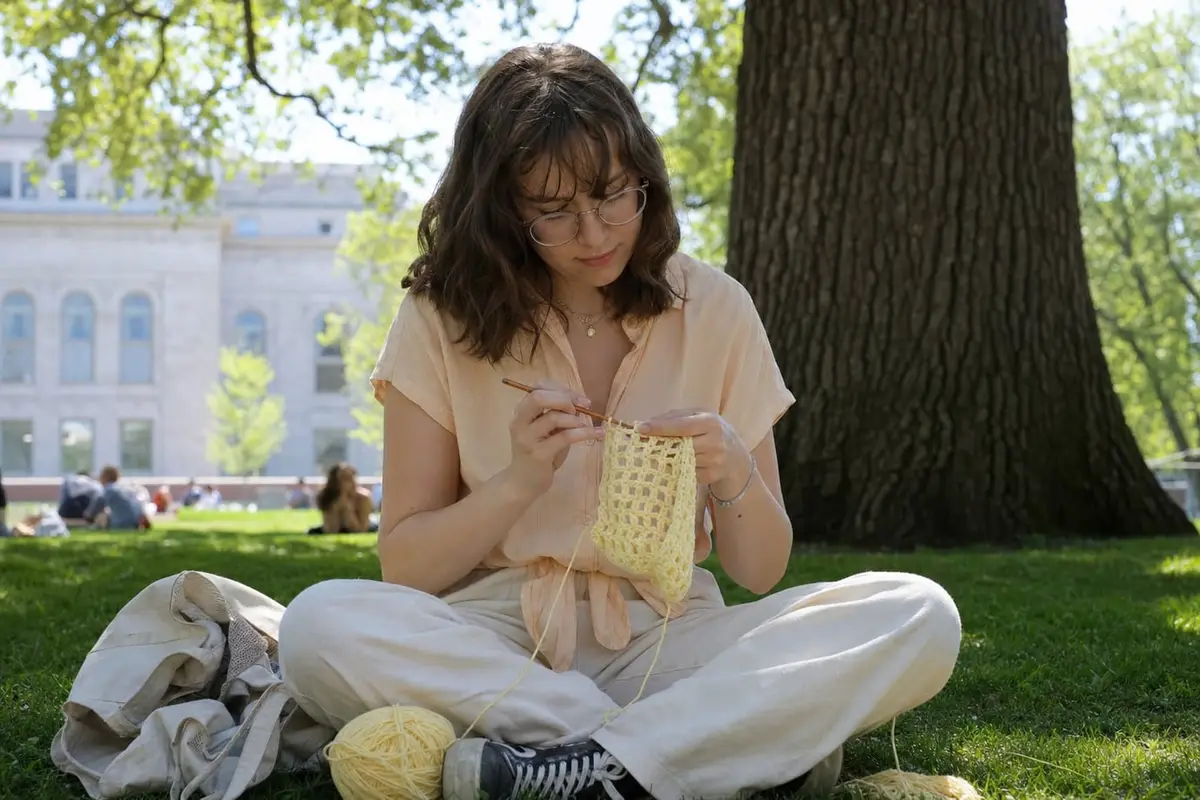
To double crochet (dc), yarn over, insert the hook, yarn over and pull up a loop, then yarn over and pull through two loops, twice. Sarah Maker (2024) puts the stitch at about twice the height of a single crochet; the Craft Yarn Council's 2018 term table lists it as a UK treble.
Double crochet stitch — The double crochet stitch, abbreviated dc in US patterns, is a tall crochet stitch that begins with a yarn over before the hook enters the work and finishes in two steps, each pulling the yarn through two loops, making a fabric faster and more flexible than single crochet.
Some links on this page are affiliate links: if you buy through them, we may earn a commission at no extra cost to you. It never changes our rankings. As an Amazon Associate I earn from qualifying purchases. Affiliate policy
Double crochet is the taller cousin of the stitch most beginners learn first. It adds one yarn over at the start and one extra pull at the end, and in return it builds fabric much faster, which is why patterns for blankets, shawls and granny squares so often rely on it. This page explains the double crochet stitch: what it is, how it forms, why its turning chain is three chains long, and which mistakes show up first. It deepens our overview of basic crochet stitches and builds on the single crochet stitch; it gives no pattern, and the credited free lessons at the end show the stitch in motion.
At a glance
| Double crochet | |
|---|---|
| Abbreviation (US) | dc |
| UK name | treble (tr) |
| Chart symbol | a T with a diagonal bar across the stem |
| Height | tall: about twice a single crochet, taller than a half double crochet |
| Loops on the hook before finishing | 3, then pulled through two at a time |
| Yarn overs per stitch | 3 (one before inserting the hook) |
| Usual turning chain | ch 3, often counted as the first stitch |
| Turning chains compared | single crochet ch 1, half double crochet ch 2, double crochet ch 3 |
| Fabric | open and flexible, with good drape |
| Practice yarn and hook | smooth Medium (4) worsted yarn, cotton or acrylic, with a 5.5 to 6.5 mm (I-9 to K-10½) hook (Craft Yarn Council, 2018) |
| Good for | blankets, shawls, scarves, granny squares |
Terms are US throughout, like the rest of this site. The risk is the UK pattern that says “double crochet” and means a stitch about half as tall.
What the double crochet stitch is
A double crochet is a tall stitch worked in two finishing steps. The Craft Yarn Council describes it as a taller stitch than single crochet, formed by a yarn over, which means wrapping the yarn from back to front before the hook goes into the work. Sarah Maker, in her tutorial updated in 2024, measures it at about twice the height of a single crochet and places it between the half double crochet and the treble crochet; in charts she says it appears as a long T with a diagonal cross bar. In patterns it is written dc, and in the middle of a row it is often grouped (clusters, shells) rather than worked alone.
The name is the source of the confusion, because the same words label different stitches on each side of the Atlantic. Our US vs UK crochet terms page gives the whole conversion, and the Craft Yarn Council’s 2018 table is the reference.
The US and UK trap
US single crochet is UK double crochet, and US double crochet is UK treble. A UK pattern that asks for double crochet and is worked in the taller US stitch produces a piece much larger and looser than the designer intended. Lion Brand’s lesson says it plainly: the stitches are the same, only the names are different. The stitch list at the start of a pattern, or an abbreviations note, tells you which system is in use.
How to double crochet: the movement
In US terms, the stitch works the same into a chain, a row or a round:
- Yarn over before you insert the hook, wrapping the yarn from back to front.
- Insert the hook into the next stitch (under both top loops when working into a row), yarn over and pull up a loop. Three loops are now on the hook.
- Yarn over and pull through the first two loops. Two loops remain.
- Yarn over and pull through the last two loops. One loop remains: that is one double crochet.
Compared with the single crochet, there are two differences: a yarn over before the hook goes in, and a finish in two pulls instead of one. Sarah Maker, Moogly and the Craft Yarn Council all describe this same sequence.
The first stitch into the foundation chain
The height is also why the start differs. Tutorials ask you to work the first double crochet into the fourth chain from the hook, which leaves three chains standing at the start of the row. The Craft Yarn Council and Sarah Maker both do this. The three chains left behind stand in for the first stitch, which is why tutorials count the starting chain differently: Lion Brand chains 12 for a swatch of 10 stitches, while Sarah Maker chains 16 for 13 “true” double crochets plus the turning chain. Read the starting chain of any pattern with that in mind.
In a reply to a reader on her double crochet page, Moogly adds a tip that applies to every stitch: how you enter a chain is a matter of preference, but when you work into a stitch, go through both top loops unless instructed otherwise.
Turning and why the chain is ch 3
At the end of the row you chain three and turn. A turning chain exists to bring the yarn up to the height of the next stitch. The Craft Yarn Council explains that the chain of 3 gives the same height as a double crochet and counts as the first double crochet of the following row, so the first new stitch goes into the second stitch. At the far end of the row, the last stitch goes into the top of the previous turning chain, which Sarah Maker warns is easy to miss.
The same logic explains why the other stitches use shorter chains: a single crochet only needs one, a half double crochet two, a double crochet three. Sigoni Macaroni’s table counts the ch 3 of a double crochet row as a stitch, and the ch 1 and ch 2 of shorter stitches as not counted. It is a convention, though, and Sarah Maker notes that some patterns chain 2 for double crochet or do not count the chain at all. Moogly says that if the chain counts as a stitch, you treat it as one in the next row, and if not, you ignore it. The pattern notes always win.
What double crochet is used for
Sarah Maker describes double crochet as a solid fabric with good drape that is not too dense or stiff, and recommends it when you need a fabric that works up quickly. She lists sweaters, baby blankets and scarves, and afghans, granny squares and coasters. The pattern behind these choices:
- Large flat pieces. A taller stitch covers more area per stitch, so blankets and throws grow faster than in single crochet. Our guide on how to crochet a blanket shows where it fits.
- Drape. The fabric is looser and moves more, which suits shawls, scarves and sweaters.
- Motifs and textures. Sarah Maker names granny squares, the lemon peel and shell stitches, herringbone double crochet, front and back post variations (cables, waffle and basketweave textures) and ribbing worked in the back loop only.
- Less common for toys. The fabric is looser than single crochet, and Sarah Maker notes that single crochet is the stitch often used in doll and amigurumi patterns, so shaped, stuffed pieces usually favor the shorter single crochet.
Common mistakes and how to fix them
- Rows that grow. Working a new stitch into the first stitch when the turning chain already counts adds a stitch every row. Skip that first stitch, as the Craft Yarn Council’s lesson says.
- Rows that shrink. Missing the last stitch, the one into the top of the turning chain, loses a stitch every row. Sarah Maker advises counting often.
- Rippling or buckling. Moogly’s answer to a reader is that rippling usually means accidental increases, two or more stitches worked into the same stitch. Count after each row.
- A gap at the start of each row. Sarah Maker suggests chaining two instead of three to reduce the hole, but only where the pattern does not call for three. Check the notes first.
- Slanting edges and loose loops. Loose or uneven tension makes tall stitches lean or gape. Our pages on holding a crochet hook and on fixing common crochet mistakes cover grip, yarn hold and tension.
How to practice
A swatch is a practice piece, not a pattern. Chain enough to leave room for the turning chain at the start, work double crochet across with each row ending in the top of the turning chain, and keep going until the edges are straight. Count the stitches at the end of every row and compare them with the first row; an unchanged count is the goal, not speed. Use a smooth, light Medium (4) yarn and a hook from our size chart; the Craft Yarn Council recommends a 5.5 to 6.5 mm (I-9 to K-10½) hook for that weight, and our guide to yarn weights explains the numbers on the label. Mastering the single crochet first makes the extra yarn over feel like a small step.
If a pattern asks for double crochet in the round, it may start with a magic ring; Moogly’s magic circle tutorial says she would work 6 stitches into the ring for single crochet but likely about 12 for double crochet, because taller stitches need more of them.
Where to learn from the experts
The lessons below are free, written and filmed by the people credited, and show the movement better than any description can.
- Craft Yarn Council: Double Crochet, a short written lesson from the body that sets the US standards.
- Lion Brand: Learn to Crochet, Lesson 2, the half double and double crochet, with the US and UK terms.
- Sarah Maker: How to Double Crochet, a photo tutorial with increases, decreases and common mistakes.
- Moogly: the double crochet video, with right-handed and left-handed versions and a focus on counting.
To see how the stitches fit together, return to basic crochet stitches; to read the abbreviations in a real pattern, see how to read a crochet pattern; and if you have not yet worked a single crochet, start with the single crochet stitch and how to crochet.
Key facts
- The Craft Yarn Council's 2018 term table lists the US double crochet (dc) as treble (tr) in the UK, while the US single crochet is the UK double crochet, so the name double crochet means a different stitch on each side of the Atlantic.Craft Yarn Council, Standards & Guidelines for Crochet and Knitting, 2018
- Sarah Maker's tutorial, updated in 2024, describes the double crochet as about twice the height of a single crochet, taller than a half double crochet and shorter than a treble, with a ch 3 turning chain that often counts as the first stitch of the row.Sarah Maker, How to Double Crochet (Sarah Stearns), 2024
- Sarah Maker adds that some patterns call for only two chains as a double crochet turning chain, and that some do not count the turning chain as a stitch, so the pattern's own notes decide.Sarah Maker, How to Double Crochet (Sarah Stearns), 2024
- Lion Brand's second lesson, updated in 2023, uses the American terms and notes that the British names for these stitches differ while the stitches are the same: only the names change.Lion Brand, Learn to Crochet Lesson 2: Half-Double and Double (Liza Eckert), 2023
- Moogly's double crochet lesson page, updated in 2020, answers a reader that a fabric that ripples usually has accidental increases, two or more stitches worked into the same stitch, and recommends counting the stitches after every row.Moogly, How to Crochet: Double Crochet Stitches (Tamara Kelly), 2020
FAQ
How do you double crochet?
Yarn over, insert the hook into the next stitch, yarn over and pull up a loop, so three loops are on the hook. Then yarn over and pull through two loops, and yarn over and pull through the last two. One loop remains and the stitch is done.
Is double crochet easier than single crochet?
It is not harder, but it has more steps. Sarah Maker calls it very similar to single crochet with a couple of extra steps. Most beginners learn single crochet first because its two-step motion is easy to see and count, then add the yarn over at the start.
Does the turning chain count as a stitch in double crochet?
Often yes. The Craft Yarn Council's lesson counts the ch 3 as the first double crochet of the next row, so the first new stitch goes into the second stitch. Some patterns chain 2 or do not count the chain, so follow the notes of the pattern you are using.
What is the UK name for double crochet?
Treble crochet (tr). A US double crochet and a UK treble are the same stitch, while a UK double crochet is a US single crochet. Check which terms a pattern uses before you start, since mixing them changes the size of the piece.
Why do my double crochet rows get wider or narrower?
Usually the turning chain. If it counts as a stitch and you also work a new stitch into the first stitch, the row gains one; if the last stitch is skipped instead of going into the top of the turning chain, the row loses one. Count every row against the first.
Sources
- Craft Yarn Council: Standards & Guidelines for Crochet and Knitting (PDF, 2018)
- Craft Yarn Council: Double Crochet
- Craft Yarn Council: Crochet Chart Symbols
- Sarah Maker: How to Double Crochet Stitch (DC) for Beginners (2021, updated 2024)
- Lion Brand: Learn to Crochet, Lesson 2: Half-Double and Double
- Moogly: How to Crochet: Double Crochet Stitches (video)
- Moogly: All About Turning Chains
- Moogly: The Magic Circle
- Sigoni Macaroni: Does the Turning Chain Count as a Stitch?
Related reading
- Half Double Crochet (hdc): How to Work the Three-Loop Stitch
- Basic Crochet Stitches: Chain, Single, Half Double and Double
- Single Crochet Stitch: How to Single Crochet for Beginners
- How to Crochet: A Step-by-Step Guide for Beginners
- Magic Ring Crochet: How to Make an Adjustable Ring, Step by Step
- How to Hold a Crochet Hook: Pencil Grip, Knife Grip and Yarn
- How to Read a Crochet Pattern: Abbreviations, Repeats and Counts
- Crochet Hook Size Chart: US Letters, Millimeters and How to Choose
- Yarn Weight Chart: The 8 Yarn Weights Explained for Crochet
- US vs UK Crochet Terms: Conversion Chart and How to Tell Them Apart
- How to Crochet a Blanket: A Beginner's Plan from Yarn to Border