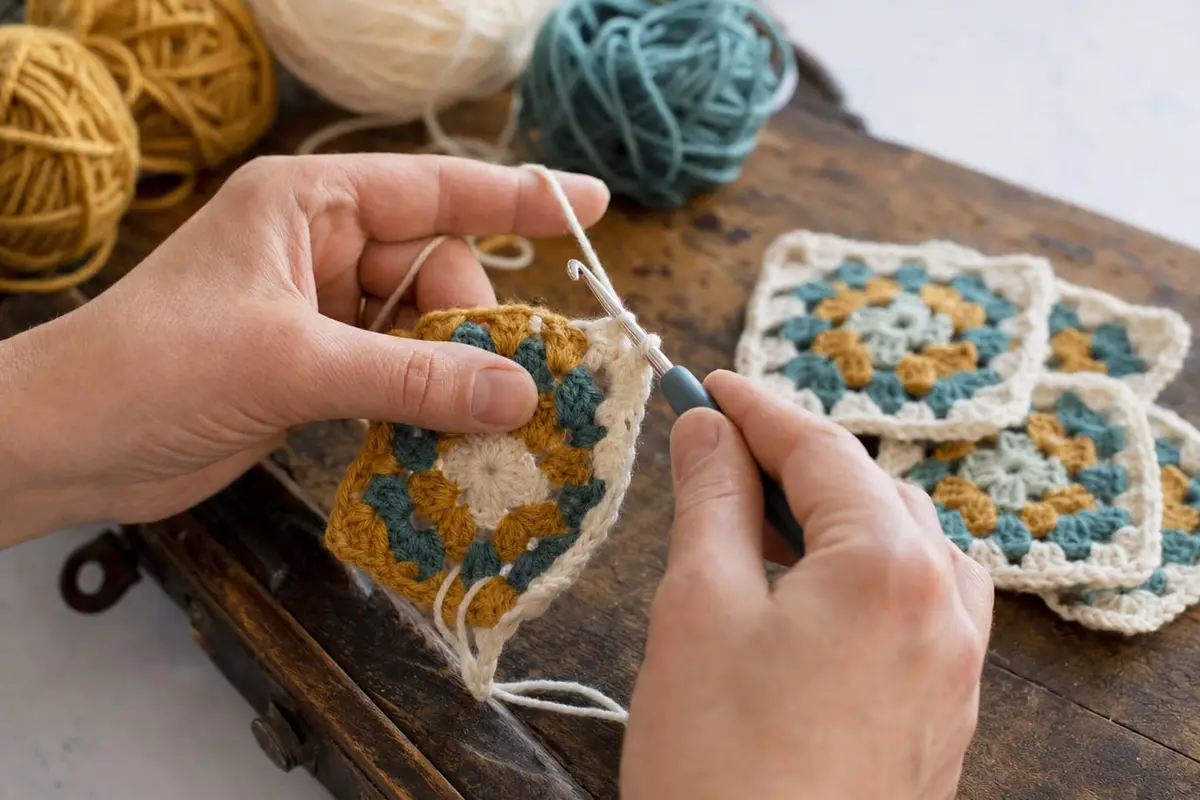
According to Lion Brand's 2026 guide, a granny square is worked in rounds from the center outward, in clusters of three double crochet (UK treble) separated by chain spaces. Each round adds a cluster per side and two clusters with a chain space in each corner. Sarah Maker (2020) turns the square each round so it does not twist.
Granny square — A granny square is a crochet motif worked in rounds from the center outward, made of clusters of three double crochet separated by chain spaces, with a pair of clusters and a chain space at each of its four corners.
Some links on this page are affiliate links: if you buy through them, we may earn a commission at no extra cost to you. It never changes our rankings. As an Amazon Associate I earn from qualifying purchases. Affiliate policy
The granny square is the most famous motif in crochet: a small square built in rounds from the center, made of little clusters of stitches with gaps between them. Squares become coasters, bags, cardigans and, above all, blankets. This tutorial explains how the square is built and what to watch for, so you understand each round instead of copying it; for the exact instructions, follow a designer’s pattern, such as the free tutorials credited below.
At a glance
| Element | What it is | Detail |
|---|---|---|
| Cluster | 3 double crochet (dc; UK treble) worked into the same space | the building block of every round |
| Side space | chain space between two clusters on a side | often 1 chain, or none in the classic version |
| Corner | two clusters with a chain space between them | ch 3 (Sarah Maker) or ch 2 (B.Hooked, Simply Yarn) |
| Start | magic ring, or a short chain joined into a ring | Sarah Maker prefers the magic ring |
| Growth | each round adds one cluster per side | the square grows evenly in all four directions |
| Yarn and hook | smooth Medium (4) worsted with a 5 mm (H-8) hook | as in Sarah Maker’s classic square |
How the square is built
A granny square starts with a ring. In the first round, four groups of three double crochet go into the ring, separated by chain spaces: those spaces become the four corners. From then on, each round follows the same logic:
- Into each corner space, work a cluster, a chain space and another cluster, so the corner turns 90 degrees.
- Into each side space between clusters of the previous round, work one cluster.
- Join the end of the round to its start with a slip stitch, then move to the next space to begin the next round.
Each round therefore adds one cluster per side, and the square grows evenly. Lion Brand’s 2026 guide describes the result: a square worked in rounds from the center outward, with clusters of three double crochet separated by chain spaces. Because every round repeats the same pattern, once you understand one, you can make squares of any size.
Starting the square
Sarah Maker’s classic square begins with a magic ring, which closes the center completely, and counts the chain 3 at the start of each round as the first double crochet of the first cluster. Simply Yarn’s tutorial offers a chain-4 ring as an alternative. A chain ring is easier at first but leaves a small hole in the middle; either is fine for a blanket.
Two corner conventions
Designers do not all use the same corner. Sarah Maker uses a chain 3 between the two corner clusters, while B.Hooked and Simply Yarn use a chain 2, written (3 dc, ch 2, 3 dc) in US terms. A chain 3 gives a slightly roomier, sharper corner; a chain 2 a tighter one. Both are correct. What matters is to use the same one in every square of a project, so that all the squares come out the same size.
Watch the terminology too: UK patterns write the cluster as “3 tr” (treble), because a US double crochet is a UK treble in the Craft Yarn Council’s conversion table. Our US vs UK crochet terms page explains why.
Why squares twist, and how to stop it
B.Hooked explains the most common granny square problem: crochet stitches lean slightly, usually away from your hook hand, and because a square is worked in rounds without turning, the lean builds up into a spiral. The fix, used in Sarah Maker’s pattern too, is to turn the square over at the end of each round and work the next round in the other direction. B.Hooked adds that blocking helps mainly on small squares and cannot fully straighten a twisted one, so turning is the real fix.
Other common problems
- Uneven corners: Lion Brand notes that they usually mean a corner chain space was skipped. Count four corners every round.
- Cupped or ruffled squares: clusters packed too tightly or too loosely. Lion Brand suggests going up half a millimeter in hook size when clusters cup.
- Wobbly edges: Simply Yarn notes that they can easily be corrected with blocking.
- Squares of different sizes: usually a tension change between sessions. Block every square before joining.
Joining squares
Lion Brand lists four common joins: join-as-you-go, where each new square is attached during its last round; a flat slip stitch seam; a single crochet join, which makes a visible ridge; and a whip stitch sewn with a yarn needle. For a blanket, Sarah Maker blocks each square first so sizes match, then seams the rows before the columns. Weave in ends as you finish each square, not at the end, or the final assembly becomes a long chore.
Free granny square tutorials
| Tutorial | Designer | Terms | Corners |
|---|---|---|---|
| Easy Crochet Granny Square Pattern | Sarah Maker (2020, updated 2024) | US | chain 3, turned each round |
| Learn How to Crochet a Basic Granny Square | Bella Coco Crochet (2024) | UK, US toggle | chain 3 |
| How to Make a Crochet Granny Square | Matt Spiers, Simply Yarn (2025) | UK | chain 2 |
| Fix Your Twisting Granny Squares | B.Hooked (2024) | US | chain 2, flipped each round |
From one square to a blanket
Make one square, block it and measure it: that size decides how many squares a blanket needs. Sarah Maker’s free granny square blanket uses 48 six-inch squares for about 38 by 50 inches before the border. Our guides to crocheting a blanket and to crochet blanket sizes help you plan the rest.
Key facts
- Sarah Maker's 2020 classic granny square, written in US terms with worsted yarn and an H (5 mm) hook, starts from a magic ring, uses clusters of 3 double crochet with chain-3 corners, and counts the beginning chain 3 as a double crochet.Sarah Maker, Easy Crochet Granny Square Pattern (Sarah Stearns), 2020
- B.Hooked's 2024 tutorial and Simply Yarn's 2025 tutorial use chain-2 corners, written (3 dc, ch 2, 3 dc) in US terms, so both chain-2 and chain-3 corners are common conventions.B.Hooked, The Simple Solution that will Fix your Twisting Granny Squares, 2024
- B.Hooked explained in 2024 that granny squares twist because crochet stitches lean slightly and the square is never turned, and that turning the square at the end of each round fixes it; blocking cannot fully straighten a twisted square.B.Hooked, The Simple Solution that will Fix your Twisting Granny Squares, 2024
- Lion Brand's 2026 granny square guide lists four common ways to join squares: join-as-you-go, a flat slip stitch seam, a single crochet join and a whip stitch.Lion Brand, 12 Granny Square Patterns to Try, 2026
FAQ
Is a granny square good for beginners?
Yes, once you know the chain, slip stitch and double crochet. It is small, repetitive and teaches working in the round and counting clusters. Moogly's designer Tamara Kelly notes that it can take a few tries before the structure clicks, which is normal.
Why is my granny square twisting?
Crochet stitches lean slightly, and when you work round after round without turning, the lean adds up into a spiral. Turning the square over at the end of each round, as Sarah Maker and B.Hooked recommend, cancels it out.
Should the corners be chain 2 or chain 3?
Both are standard. Chain-3 corners, as in Sarah Maker's pattern, give a slightly roomier, sharper corner; chain-2 corners, as in B.Hooked's and Simply Yarn's tutorials, give a tighter one. Keep the same convention in every square of a project so they match.
How many granny squares do I need for a blanket?
Divide the blanket's width and length by the size of one finished, blocked square. For example, Sarah Maker's granny square blanket uses 48 six-inch squares for about 38 by 50 inches before the border. Make and measure one square before you buy all the yarn.
Sources
- Sarah Maker: Easy Crochet Granny Square Pattern (2020, updated 2024)
- Bella Coco Crochet: Learn How to Crochet a Basic Granny Square (2024)
- Simply Yarn: How to Make a Crochet Granny Square (Matt Spiers, 2025)
- B.Hooked: The Simple Solution that will Fix your Twisting Granny Squares (2024)
- Lion Brand: 12 Granny Square Patterns to Try (2026)
- Sarah Maker: How to Crochet a Granny Square Blanket (2023)