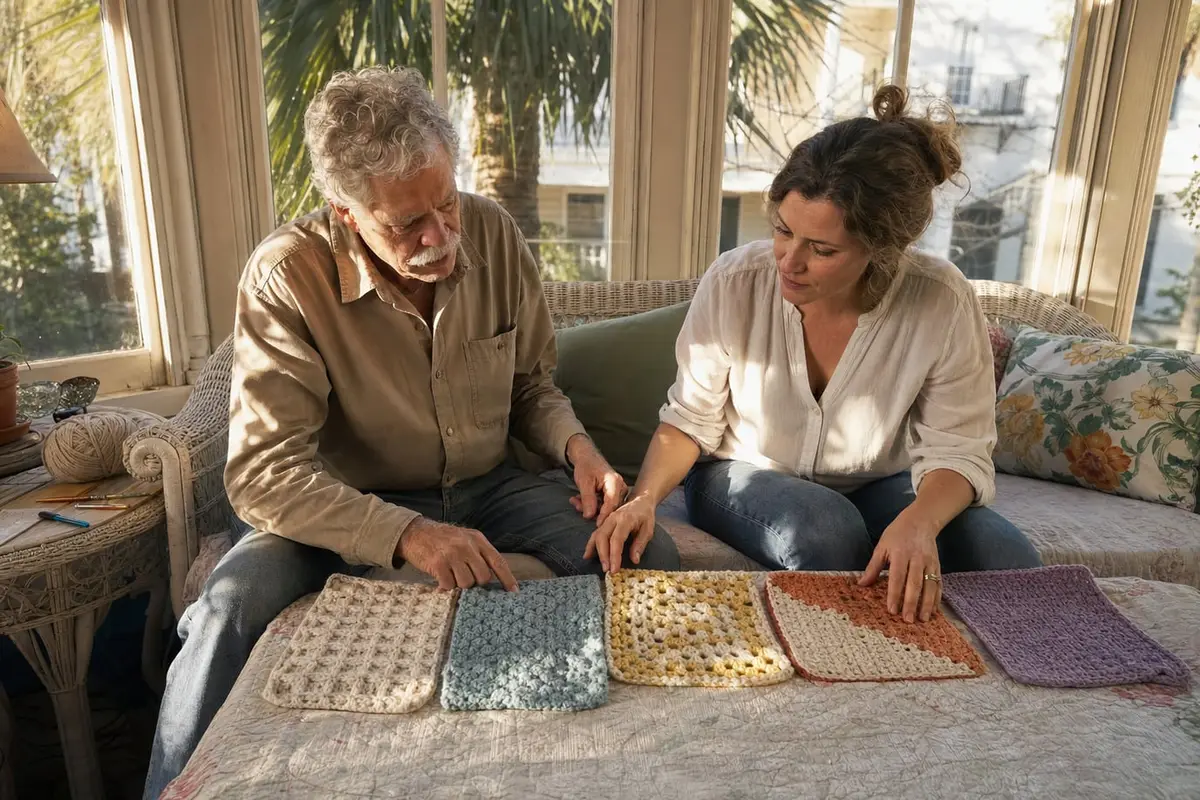
The best crochet stitch for a blanket depends on its use. Lion Brand's 2026 guide calls double crochet the most recommended, since it works up roughly twice as fast as single crochet, and half double crochet a denser, warmer choice. Sarah Maker (2024) points to moss stitch for drape and waffle stitch for thick texture.
Crochet stitch pattern — A crochet stitch pattern is a repeat of basic stitches, such as chains, single, half double and double crochet, sometimes with post stitches or clusters, worked over a set stitch multiple, for example a multiple of 3 plus 2, that gives a blanket its texture, density and drape.
Some links on this page are affiliate links: if you buy through them, we may earn a commission at no extra cost to you. It never changes our rankings. As an Amazon Associate I earn from qualifying purchases. Affiliate policy
A blanket is hundreds of repeats of the same stitch, so the stitch decides almost everything: how warm the blanket is, how it hangs over a sofa, how many hours it takes and how much yarn it eats. This page compares the stitches designers recommend most for blankets, explains how to choose one for a baby blanket, a throw or a first attempt, and ends with borders. It explains the choice, not the pattern: for each textured stitch we link to the free tutorial of the designer who wrote it.
The comparison table
Every row below comes from a named source. Where no source rates a property, the cell says so rather than guessing. Speed compares stitches in the same yarn and hook; a bulkier yarn speeds up all of them.
| Stitch | Built from | Density and drape | Speed | Yarn use | Difficulty | Look |
|---|---|---|---|---|---|---|
| Single crochet (sc) | sc only | densest, firm, no gaps | slowest of the basic stitches | not rated: swatch it | first stitch to learn | flat and tight |
| Half double crochet (hdc) | hdc only | denser and warmer than dc, more drape than sc | between sc and dc | not rated: swatch it | beginner | soft, flat; ribbing in the third loop |
| Double crochet (dc) | dc only | solid with good drape | fast: about twice the height of sc | not rated: swatch it | beginner | plain, classic |
| Moss (linen) stitch | sc and ch 1 | lies flat, drapes without being lacy | slower than plain dc | not rated | beginner-friendly | woven, same on both sides |
| Granny stripe | 3-dc clusters | open, small holes, less warm | easy and quick | not rated | easy | rows of clusters, made for color |
| Waffle stitch | dc and front post dc | thick and squishy | slower than plain dc | high: yarn-hungry | confident beginner | raised grid, reversible |
| Basketweave | front and back post dc | soft, cozy texture | slower than plain dc | not rated | needs post stitches | woven blocks, reversible |
| Corner to corner (C2C) | tiles of 3 dc | fairly dense, small holes between tiles | not rated | good for scraps | first two rows are the hard part | diagonal tiles, pixel pictures |
Sources by row: single crochet, Sarah Maker’s single crochet tutorial (2024); half double crochet, Lion Brand (2026) and Moogly; double crochet, Lion Brand (2026) and Sarah Maker (2024); moss stitch, Sarah Maker (2024) and Lion Brand (2026); granny stripe, Sarah Maker (2024); waffle, Sarah Maker (2024) and Lion Brand (2026); basketweave, Sarah Maker’s roundup (2024) and Lion Brand (2026); C2C, Sarah Maker (2024).
What the table leaves open
Yarn use is the hardest property to rate fairly. It changes with yarn, hook and tension, so a general ranking of the basic stitches would be a guess. Lion Brand’s 2026 guide suggests the reliable method: crochet and wash a small swatch, weigh it, calculate the yardage per square inch, then scale up to your blanket size. The only firm rule the sources agree on is that thick textured stitches such as waffle take more yarn than plain ones.
The three basic stitches: the safe choices
Most blankets are worked in one of the three basic stitches, and the differences between them are mostly height.
- Double crochet is the default. Lion Brand’s 2026 blanket guide calls it the most commonly recommended stitch, because its height means fewer rows and faster progress than single crochet. Sarah Maker’s roundup calls it one of the simplest stitches for blankets, quick and solid, and usable with virtually any yarn.
- Half double crochet is the warm option. Lion Brand calls it denser and warmer than double crochet and good for cold-climate throws, slower to work but better at blocking drafts. Moogly adds that it has much more drape than single crochet. Sarah Maker’s own free chunky blanket uses it, partly in the back loop for a ribbed look.
- Single crochet makes the densest fabric. It suits small, firm pieces better than large ones, since a full throw takes many more rows. Lion Brand’s yarn guide recommends single or half double crochet with chenille, where complex stitches blur and the plush yarn should carry the look.
If the basic stitches are new, our pages on the single crochet stitch, the half double crochet and the double crochet stitch explain each movement, and basic crochet stitches shows how they compare.
Textured and open stitches: when the look matters
Stitch patterns combine the basic stitches in a repeat, which is why each one needs a specific stitch multiple. Lion Brand’s blanket guide warns that to widen a blanket you add chains in multiples of that repeat, not any number, or the pattern breaks partway across the row.
- Moss stitch, also called linen, granite or woven stitch, alternates single crochet and chain 1. Sarah Maker calls it beginner-friendly and says it lies flat, looks good on both sides, and drapes without being too lacy or open.
- Granny stripe works rows of three-double-crochet clusters into the spaces between the clusters below. Sarah Maker calls it easy and quick, perfect for color, and notes in her roundup that its small holes make it not quite as warm as other stitches.
- Waffle stitch alternates double crochet and front post double crochet to raise a grid. Sarah Maker rates it for a confident beginner and says it is reversible; Moogly notes that some versions put an extra background stitch between the post stitches, a multiple of 4 plus 2 instead of 3 plus 2.
- Basketweave blocks front and back post double crochet into a woven pattern. Sarah Maker’s roundup calls it reversible, soft and especially good for baby blankets.
- Corner to corner (C2C) builds diagonal rows of small tiles, each made of three double crochets. Sarah Maker says the size is easy to adjust, that it suits pixel-style pictures and scrap yarn, and that the hardest part is the first two rows.
Two cautions from Lion Brand’s 2026 guides: textured stitches slow you down, and bulky yarns flatten stitch definition, so a stitch chosen for its texture shows best in a smoother, thinner yarn.
How to choose by use
| Use | Stitches the sources point to | Why |
|---|---|---|
| First blanket | double crochet, half double crochet, moss stitch | Sarah Maker’s first-blanket advice; one stitch repeated builds even tension |
| Warm sofa throw | half double crochet, waffle stitch | Lion Brand: they trap more air and block drafts |
| Drapey throw | double crochet, moss stitch | Sarah Maker: good drape; Lion Brand suggests going up one hook size for more drape |
| Baby blanket | basketweave, double crochet, half double crochet | Sarah Maker and Lion Brand list them for baby blankets |
| Lighter blanket for mild weather | granny stripe | Sarah Maker: small holes, not quite as warm |
| Scrap yarn and color | granny squares, C2C, granny stripe | Lion Brand and Sarah Maker: squares and C2C use up small amounts; the granny stripe is made for color changes |
| Plush chenille yarn | single crochet, half double crochet | Lion Brand: the yarn’s texture hides complex stitches |
For a first blanket
Sarah Maker recommends a simple rectangle in half double crochet, double crochet or moss stitch. Lion Brand’s pro tip is to save the heavily textured stitches for the second or third blanket: a new stitch, unfamiliar tension and a large yardage at once make a first project hard to finish. Our guide to crocheting a blanket walks through the whole plan, from swatch to border.
For a baby blanket
Choose the yarn first. Lion Brand’s 2026 yarn guide says baby blankets need soft, machine-washable fibers, acrylic or cotton blends, and that untreated wool is generally avoided. Then pick a stitch: Sarah Maker suggests basketweave for baby blankets, and lists half double crochet among the stitch’s uses for them. Our page on blanket sizes gives baby sizes and a few precautions.
For a throw that has to be warm
Pick a dense stitch in a warm fiber. Lion Brand’s guide says half double crochet and waffle stitch trap more air than open stitches, and its yarn guide adds that wool blends add warmth while staying machine washable. Our comparison of the best yarn for crochet blankets applies these criteria to specific yarns, and yarn weights explained decodes the numbers on the label.
Borders: the last stitch decision
A border is worth planning with the stitch, because it fixes uneven edges. The Craft Yarn Council’s edging lesson notes that single crochet is commonly used for edging, with 3 stitches in each corner stitch. Lion Brand’s 2026 border guide adds the rule that keeps edges flat: work a foundation round of single crochet first, with 1 sc per single crochet row, 2 per half double row and 3 per double crochet row along the sides.
- Match the border to the body. Lion Brand advises a plain, quiet border such as single crochet or moss stitch for a textured blanket like waffle or ripple, and more decoration, shells or bobbles, for a plain double crochet or granny blanket.
- Read the edge. Sarah Maker and Lion Brand agree: a wavy, ruffled border has too many stitches; a curling or cupping border has too few.
- Corners. Lion Brand suggests 3 stitches in each corner on thicker worsted blankets, or a chain 2 or chain 3 space for a sharper, flatter corner on finer pieces.
Sarah Maker’s list of 27 crochet borders links to free edging tutorials, from crab stitch to shells.
Where to learn the stitches
These free tutorials are written by the designers credited, with photos and, for some, video:
- Sarah Maker: 45 crochet stitches for blankets, with a short guide to choosing.
- Sarah Maker: moss stitch, granny stripe, waffle stitch and corner to corner.
- Moogly: the waffle stitch video tutorial.
- Lion Brand: free crochet blanket patterns sorted by skill level, and the blanket border guide.
If you would rather build a blanket from motifs, start with our granny square tutorial, and check the hook for your yarn on our hook size chart.
Key facts
- Lion Brand's 2026 blanket pattern guide calls double crochet the default work-up-fast stitch, roughly twice the height of single crochet, and describes half double crochet as a denser, warmer fabric than double crochet, good for cold-climate throws.Lion Brand Yarn, Free Crochet Blanket Patterns for Every Skill Level, 2026
- The same 2026 Lion Brand guide says waffle stitch is cozy and textured but slower and yarn-hungry compared with plain double crochet, and advises saving heavily textured stitches for a second or third blanket.Lion Brand Yarn, Free Crochet Blanket Patterns for Every Skill Level, 2026
- Sarah Maker's roundup of 45 blanket stitches, updated in 2024, names the granny stripe and double crochet as easy, moss (linen) stitch as modern, waffle and basketweave as textured, and double crochet and the blanket stitch as fast.Sarah Maker, 45 Crochet Stitches for Blankets (Sarah Stearns), 2024
- Sarah Maker's waffle stitch tutorial, updated in 2024, describes a reversible, thick fabric made of double crochet and front post double crochet on a multiple of 3 plus 2, which takes more yarn than other basic stitches.Sarah Maker, How to Crochet Waffle Stitch (Sarah Stearns), 2024
- Lion Brand's 2026 border guide calls a foundation round of single crochet essential to prevent rippling, with 1 sc per single crochet row, 2 per half double row and 3 per double crochet row along the sides.Lion Brand Yarn, Finish Crochet Blanket Borders Fast, 2026
FAQ
What is the best crochet stitch for a blanket?
There is no single best stitch. Double crochet is the most often recommended because it is simple and grows fast; Lion Brand's 2026 guide calls it roughly twice the height of single crochet. Half double crochet is warmer, moss stitch drapes and lies flat, and waffle stitch gives thick texture.
What is the warmest crochet stitch for a blanket?
Dense stitches. Lion Brand's 2026 guide says half double crochet and textured stitches such as waffle trap more air and make a warmer fabric than open stitches like treble crochet. Sarah Maker adds that the granny stripe, with its small holes, is not quite as warm as other stitches.
What is the fastest crochet stitch for a blanket?
Plain double crochet is the usual answer: it is tall and simple, so a blanket needs fewer rows. Lion Brand's guide notes that treble crochet is faster by row count but leaves a looser, more open fabric. Bulky yarn speeds up any stitch.
What is the easiest blanket stitch for a beginner?
Sarah Maker suggests a rectangle in half double crochet, double crochet or moss stitch for a first blanket, and lists the granny stripe among easy stitches. Lion Brand advises leaving heavily textured stitches such as waffle or basketweave for a second or third blanket.
Which crochet stitches use the most yarn?
Thick, textured stitches. Sarah Maker says waffle stitch takes more yarn than basic stitches, and Lion Brand calls it yarn-hungry next to plain double crochet. To estimate your own blanket, Lion Brand suggests washing and weighing a swatch, then calculating the yardage per square inch.
What is the best border for a crochet blanket?
Start with a round of single crochet, which Lion Brand calls essential to prevent rippling, with 3 stitches in each corner. Then add one decorative round if you like: a plain border suits a textured blanket, while shells or bobbles suit a plain one.
Sources
- Lion Brand: Free Crochet Blanket Patterns for Every Skill Level (2026)
- Lion Brand: Finish Crochet Blanket Borders Fast (2026)
- Lion Brand: Crochet Blanket Yarn Recommendations (2026)
- Sarah Maker: 45 Crochet Stitches for Blankets (2023, updated 2024)
- Sarah Maker: How to Crochet Waffle Stitch (2022, updated 2024)
- Sarah Maker: Crochet Moss Stitch (2021, updated 2024)
- Sarah Maker: Granny Stripe Stitch (2023, updated 2024)
- Sarah Maker: Corner to Corner (C2C) Crochet (2022, updated 2024)
- Sarah Maker: 27 Crochet Borders and Edgings (2022, updated 2024)
- Sarah Maker: How to Crochet a Blanket (2023, updated 2024)
- Sarah Maker: How to Single Crochet (2021, updated 2024)
- Sarah Maker: How to Double Crochet (2021, updated 2024)
- Moogly: Waffle Stitch Tutorial (2022)
- Moogly: Half Double Crochet (hdc) video lesson
- Craft Yarn Council: Crochet Edgings
Related reading
- How to Crochet a Blanket: A Beginner's Plan from Yarn to Border
- Crochet Blanket Sizes: A Chart from Lovey to King, and How to Choose
- Blanket Yarn for Crochet: Chenille, Worsted, Wool Blend or Jumbo?
- Half Double Crochet (hdc): How to Work the Three-Loop Stitch
- Double Crochet Stitch: Steps, Turning Chain and Common Mistakes
- Single Crochet Stitch: How to Single Crochet for Beginners
- How to Crochet a Granny Square: Structure, Corners and Fixes
- Yarn Weight Chart: The 8 Yarn Weights Explained for Crochet
- Basic Crochet Stitches: Chain, Single, Half Double and Double
- Crochet Hook Size Chart: US Letters, Millimeters and How to Choose