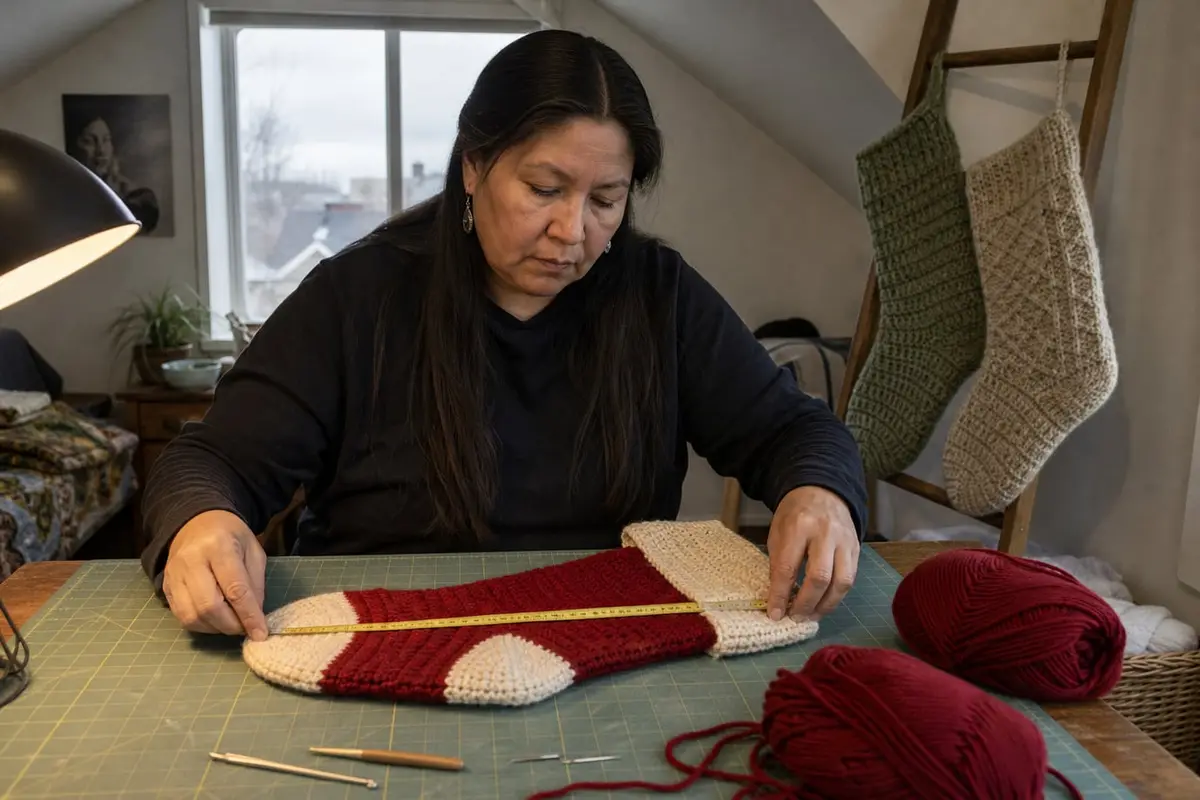
A crochet Christmas stocking measures about 15 to 20 inches long and 5.5 to 9 inches wide laid flat in the seven free patterns we checked. At a standard 17 by 7 inches, worsted yarn takes roughly 240 to 440 yards, a range we calculated from those patterns; bulky yarn takes less.
Crochet Christmas stocking — A crochet Christmas stocking is a holiday stocking made with a crochet hook, usually in worsted or bulky yarn and about 15 to 20 inches long: a cuff, a leg, a heel, a foot and a toe, worked in one piece in the round, from the toe up, or as two flat panels sewn together, with a loop to hang it.
Some links on this page are affiliate links: if you buy through them, we may earn a commission at no extra cost to you. It never changes our rankings. As an Amazon Associate I earn from qualifying purchases. Affiliate policy
A crochet Christmas stocking is a larger version of a mini ornament, and the question that decides the project is not the stitch: it is how big to make it, how much yarn to buy, and how to build it. This guide answers those three, with a table of real sizes and yardages from seven free patterns and a yarn calculator whose arithmetic is shown. It does not give the pattern itself: every stocking below is made from its designer’s page, and the guide links to each one.
At a glance: seven free stockings, with the numbers their designers publish
| Pattern | Yarn weight (CYC category) | Hook | Size laid flat | Yarn stated | How it is built |
|---|---|---|---|---|---|
| Cozy Cottage, Pattern Paradise (2017) | Bulky (5) | 6 mm (J-10) | 5.5 x 15 in | about 150 yd | top down; cuff in rows, body in rounds |
| Country Cottage, small, The Turtle Trunk (2020) | Medium (4) | 5.5 mm (I-9) | about 15 x 6 in | 200 yd | toe up |
| Country Cottage, large, The Turtle Trunk | Bulky (5) | 6.5 mm (K-10½) | about 17 x 7 in | 250 yd | toe up |
| Argyle, A Crocheted Simplicity (updated 2026) | Medium / worsted (4) | 5.5 mm (I-9) | 7 x 17 in | 240 yd | top down in the round, heel in rows |
| Buffalo Plaid, A Crocheted Simplicity (updated 2026) | Medium / worsted (4) | 6 mm (J-10) and 5.5 mm (I-9) | 6.5 x 18 in | 330 yd | top down in the round, heel in short rows |
| Malia, Yarn + Chai | Medium (4) | 5 mm (H-8) | 9 x 16.5 in (folded cuff) | 370 yd | two flat panels, seamed |
| Olivette, Jennifer Renaud (2024) | Medium / worsted (4) | 5 mm (H-8) and 4 mm (G-6) | 6.75 x 17 in | 400 to 420 yd | seamless, top down, short-row heel |
| Comfort and Joy, Rich Textures Crochet (2019) | Medium / worsted (4), Aran listing | 6 mm (J-10) | 7.5 x 20 in | 400 to 500 yd | not described on the listing |
Sizes and yardages are the designers’ own, as printed on each pattern page; where a pattern lists several colors, the yardage is their sum. Sizes exclude the hanging loop. Hook letters follow the Craft Yarn Council’s US chart; letters vary by brand, so trust the millimeters stamped on the hook. This guide uses US terms: US single crochet (sc) is the UK double crochet (dc), so check which terms a pattern uses before you start.
How big should a crochet Christmas stocking be?
Aim for about 15 to 20 inches long and 5.5 to 9 inches wide, laid flat. All seven patterns above fall in that range, and 17 inches is the most common length, in three of them. These are designers’ choices, not a standard, so decide by use: a stocking meant to hold gifts needs the larger sizes; a smaller one suits a child’s stocking or a decoration.
Do not worry about matching the designer’s gauge to the stitch. Jennifer Renaud notes that gauge “isn’t as critical” for her Buffalo Plaid stocking, and Pattern Paradise calls it “not critical for this project”. Check the finished size instead: lay the stocking flat as you work and measure it against the length and width you want. Stitch gauge matters more for a size you must hit exactly, such as a family set that should match.
How much yarn does a crochet Christmas stocking need?
Multiply the stocking’s area by the yards per square inch published patterns use, then convert to grams and skeins. Every pattern states its own yardage, and that figure wins; the calculator below is for planning a stocking from a size, or checking a pattern that gives no yardage.
The method, step by step:
- Area. Length multiplied by width, laid flat, in inches. A 17 x 7 inch stocking is 119 square inches.
- Yards. Multiply the area by the yards per square inch for your yarn weight (table below), once for the low end and once for the high end.
- Grams. Divide the yards by the yards per gram on your yarn label. The labels in the patterns above work out at about 1.6 to 1.8 yards per gram for worsted yarn (170 yards per 100 grams on Lion Brand’s Vanna’s Choice, 200 yards per 127 grams on Red Heart With Love Metallic); the table uses 1.7.
- Skeins. Divide the yards by the yards in one skein and round up.
The yards-per-square-inch figures come from the patterns in the first table, each divided by its own width times length:
| Pattern | Area (sq in) | Yards stated | Yards per sq in |
|---|---|---|---|
| Cozy Cottage (bulky) | 82.5 | about 150 | 1.8 |
| Country Cottage, large (bulky) | 119 | 250 | 2.1 |
| Country Cottage, small (medium) | 90 | 200 | 2.2 |
| Argyle (worsted) | 119 | 240 | 2.0 |
| Malia (medium) | 148.5 | 370 | 2.5 |
| Buffalo Plaid (worsted) | 117 | 330 | 2.8 |
| Comfort and Joy (worsted) | 150 | 400 to 500 | 2.7 to 3.3 |
| Olivette (worsted, cabled) | 114.75 | 400 to 420 | 3.5 to 3.7 |
For medium and worsted yarn, the range is 2.0 to 3.7 yards per square inch, with a middle value of about 2.7. For bulky yarn, only two patterns state yardage, at 1.8 and 2.1. The highest value belongs to the cabled stocking and the lowest to a plain stitch, so textured stitches, cables and colorwork push a stocking toward the top of the range.
Yarn per size, calculated
| Size (laid flat) | Area | Worsted (4), yards: low / middle / high | Worsted (4), grams at 1.7 yd/g | Bulky (5), yards |
|---|---|---|---|---|
| Small, 15 x 6 in | 90 sq in | 180 / 240 / 330 | 105 / 140 / 195 | 160 to 190 |
| Standard, 17 x 7 in | 119 sq in | 240 / 320 / 440 | 140 / 190 / 260 | 210 to 250 |
| Large, 20 x 7.5 in | 150 sq in | 300 / 410 / 560 | 175 / 240 / 325 | 270 to 315 |
Rounded to the nearest 5 grams or 10 yards. The bulky column uses the two published bulky patterns (1.8 to 2.1 yards per square inch) and has no gram column, because the grams per skein of bulky yarn vary by brand and none of the patterns state them. For a standard worsted stocking, a middle estimate of 320 yards is two skeins of 170 yards (the Vanna’s Choice label above); the high end of 440 yards is three.
As a cross-check kept out of the calculation, Peach & Paige’s Berry Beautiful Stocking is 47 by 15 cm (about 18.5 by 5.9 inches) and lists 150 grams of worsted yarn, which is about 2.3 yards per square inch at 1.7 yards per gram: inside the range. This is our arithmetic on seven patterns, not a designer’s figure, so treat it as a planning range. Sarah Maker’s roundup gives a lower general estimate, about 200 yards for an average stocking, and tells readers to check each pattern: it is below most of the stated yardages above, which is a reason to buy a little more yarn than the minimum.
Which construction should you choose?
There are four ways to build a stocking, and each changes the order in which you meet the shaping.
| Method | How it works | Examples among the patterns | Good to know |
|---|---|---|---|
| Top down in the round | Starts at the cuff, goes down the leg in rounds, shapes the heel, then the foot and toe | Argyle, Buffalo Plaid, Olivette | No side seam. The cuff is often worked flat, seamed, and attached to the top (Argyle) |
| Toe up | Starts with the toe, works up the foot and leg, ends with the cuff | Country Cottage, Dreamy (five sections: toe, instep, heel, leg, cuff) | Same shaping, reversed; you finish at the cuff |
| Two flat panels | Two rows-only panels, seamed along the sides and bottom, with a ribbed top | Malia (easy-ish) | The simplest stitches and no heel to shape, but a seam to sew |
| Joined motifs | Granny squares or hexagons joined into the stocking shape | Sarah Maker lists a 13-granny-square stocking and a 17-hexagon one | Many ends to weave in; good for leftover yarn |
If you can do single crochet and half double crochet, a top-down pattern is a fair first stocking, because the leg is plain rounds. Our guides to single crochet and half double crochet explain the stitches these patterns lean on. If shaping a heel worries you, choose the two-panel method.
The parts of a stocking
- Cuff: a band at the top, usually ribbing worked in the back loops of half double crochet; in Argyle and Buffalo Plaid it is worked flat, seamed into a ring and attached.
- Leg: the long tube, where color and texture show.
- Heel: the turn of the foot. In the patterns checked here it is worked flat, in rows or short rows, which is why a top-down stocking switches between rows and rounds.
- Foot and toe: worked in rounds and decreased to close; Buffalo Plaid’s toe is a continuous spiral.
- Hanging loop: a chained or crocheted loop, sewn inside the back (Argyle) or attached to the cuff (Cozy Cottage).
If a pattern’s abbreviations or symbols are unfamiliar, our guide to reading a crochet pattern covers them.
Which yarn and hook for a crochet Christmas stocking?
Worsted weight is the common choice. Sarah Maker calls it the most popular yarn for stockings and says it is durable; the same roundup says bulky yarn works up more quickly, which is why The Turtle Trunk offers a bulky version. The hooks in these patterns run from 4 to 6.5 mm: 5 mm for Malia and Dreamy, 5.5 and 6 mm for Argyle and Buffalo Plaid, 6 mm for Comfort and Joy and bulky Cozy Cottage, 5.5 mm for the small Country Cottage and 6.5 mm for its large bulky size, and 5 mm with a 4 mm hook for Olivette.
The Craft Yarn Council’s 2018 standards recommend 5.5 to 6.5 mm (I-9 to K-10½) for medium (4) yarn and 6.5 to 9 mm for bulky (5), a range these patterns mostly fit, while some designers go smaller for a firmer fabric. See yarn weights explained and the hook size chart for the full tables.
Where can you find a free crochet stocking pattern?
Each page below is the designer’s own, with materials, sizes and steps. They are free to read at the time of writing.
- Jennifer Renaud, A Crocheted Simplicity: Argyle and Buffalo Plaid, both top down in worsted yarn, and her Olivette cabled stocking on Ravelry.
- Ali Wholihan, The Turtle Trunk: Country Cottage Stocking, toe up, in two sizes.
- Pattern Paradise: Cozy Cottage Christmas Stocking, bulky yarn.
- Yarn + Chai: Malia Christmas Stocking, two flat panels.
- Kinga Erdem, My Hobby Is Crochet: Dreamy Christmas Stocking, toe up in five sections.
- Rich Textures Crochet: Comfort and Joy Stocking, the largest of the group.
- Collections: Sarah Maker’s 25 free stocking patterns and Oombawka Design’s roundup of one-piece stocking patterns.
How do you finish and hang a crochet stocking?
Weave in every end before you attach the cuff or loop, and sew the loop on firmly. A stocking is a container, not a decoration, so test the hanger or hook with the stocking empty before anyone fills it. If you want a smaller version for the tree, our guide to crochet Christmas ornaments lists a mini stocking by Peach & Paige. For a set of small handmade presents to put in it, see our crochet gift ideas.
Key facts
- Jennifer Renaud's free Argyle Christmas Stocking, updated in August 2026, measures 7 inches wide by 17 inches long laid flat and uses 240 yards of worsted (4) yarn in two colors (160 yards red, 80 yards white), worked from the top down in the round with a heel worked in rows.A Crocheted Simplicity, Argyle Christmas Stocking (Jennifer Renaud), 2026
- Jennifer Renaud's Olivette Cabled Christmas Stocking, published in November 2024, is seamless, worked in one piece from the top down with a short-row heel, measures 6.75 by 17 inches laid flat and calls for 400 to 420 yards of worsted yarn.Ravelry, Olivette Cabled Christmas Stocking (Jennifer Renaud), 2024
- The Turtle Trunk's Country Cottage Stocking, published in December 2020, is worked from the toe up and comes in two sizes: about 17 by 7 inches in bulky (5) yarn using 250 yards, and about 15 by 6 inches in medium (4) yarn using 200 yards.The Turtle Trunk, Country Cottage Stocking (Ali Wholihan), 2020
- Sarah Maker's 2024 roundup of 25 free crochet Christmas stocking patterns calls worsted weight the most popular and durable choice for stockings, says bulky yarn works up more quickly, and estimates that an average-size stocking takes about 200 yards, while telling readers to check each pattern.Sarah Maker, 25 Free Crochet Christmas Stocking Patterns (Sarah Stearns), 2024
- The Craft Yarn Council's 2018 standards recommend a 5.5 to 6.5 mm (I-9 to K-10½) crochet hook for Medium (4) worsted yarn and a 6.5 to 9 mm hook for Bulky (5) yarn, and advise relying on the millimeter size marked on the hook because US letters and numbers vary by company.Craft Yarn Council, Standards & Guidelines for Crochet and Knitting, 2018
FAQ
How big is a crochet Christmas stocking?
Between about 15 and 20 inches long and 5.5 to 9 inches wide laid flat in the seven free patterns checked here, with 17 inches the most common length. There is no standard: each designer chooses, so measure a stocking you already own, or the space on your mantel, and match that.
How much yarn do you need for a crochet Christmas stocking?
For a standard 17 by 7 inch stocking in worsted yarn, plan on roughly 240 to 440 yards (about 140 to 260 grams), by our calculation from seven published patterns. Plain stitches sit near the low end, and cables or textured stitches near the high end. A pattern's own yardage always beats this estimate.
What is the easiest way to crochet a Christmas stocking?
Two flat panels in rows, sewn together, avoid shaping a heel in the round; Yarn + Chai's Malia stocking is built this way and labeled easy-ish. Top-down patterns such as Jennifer Renaud's Argyle stocking have no side seam but add a heel, which is worked in rows.
Can you crochet a stocking in one piece?
Yes. Jennifer Renaud's Argyle, Buffalo Plaid and Olivette stockings are worked from the cuff down in the round with a heel worked flat in rows, and Kinga Erdem's Dreamy stocking is worked from the toe up. In some of them the cuff is made separately and sewn on.
What yarn is best for a crochet Christmas stocking?
Worsted weight, according to Sarah Maker, who calls it the most popular and durable choice. Bulky yarn works up more quickly, which is why several designers use it, such as The Turtle Trunk's large Country Cottage stocking at 250 yards. Gauge matters less than the finished size.
Sources
- Craft Yarn Council: Standards & Guidelines for Crochet and Knitting (PDF, 2018)
- A Crocheted Simplicity: Argyle Christmas Stocking (Jennifer Renaud, updated 2026)
- A Crocheted Simplicity: Buffalo Plaid Christmas Stocking (Jennifer Renaud, updated 2026)
- Ravelry: Olivette Cabled Christmas Stocking (Jennifer Renaud, 2024)
- Ravelry: Comfort and Joy Stocking (Rich Textures Crochet, 2019)
- The Turtle Trunk: Country Cottage Stocking (Ali Wholihan, 2020)
- Pattern Paradise: Cozy Cottage Christmas Stocking (2017)
- Yarn + Chai: Malia Christmas Stocking
- My Hobby Is Crochet: Dreamy Christmas Stocking (Kinga Erdem, 2018)
- Sarah Maker: 25 Free Crochet Christmas Stocking Patterns (2022, updated 2024)
- Oombawka Design Crochet: One-Piece Crochet Christmas Stocking Patterns
Related reading
- Crochet Christmas Ornaments 2026: Ideas by Level and Free Patterns
- Crochet Gift Ideas: 12 Quick Projects to Make and Give
- Half Double Crochet (hdc): How to Work the Three-Loop Stitch
- How to Read a Crochet Pattern: Abbreviations, Repeats and Counts
- Yarn Weight Chart: The 8 Yarn Weights Explained for Crochet
- Crochet Hook Size Chart: US Letters, Millimeters and How to Choose