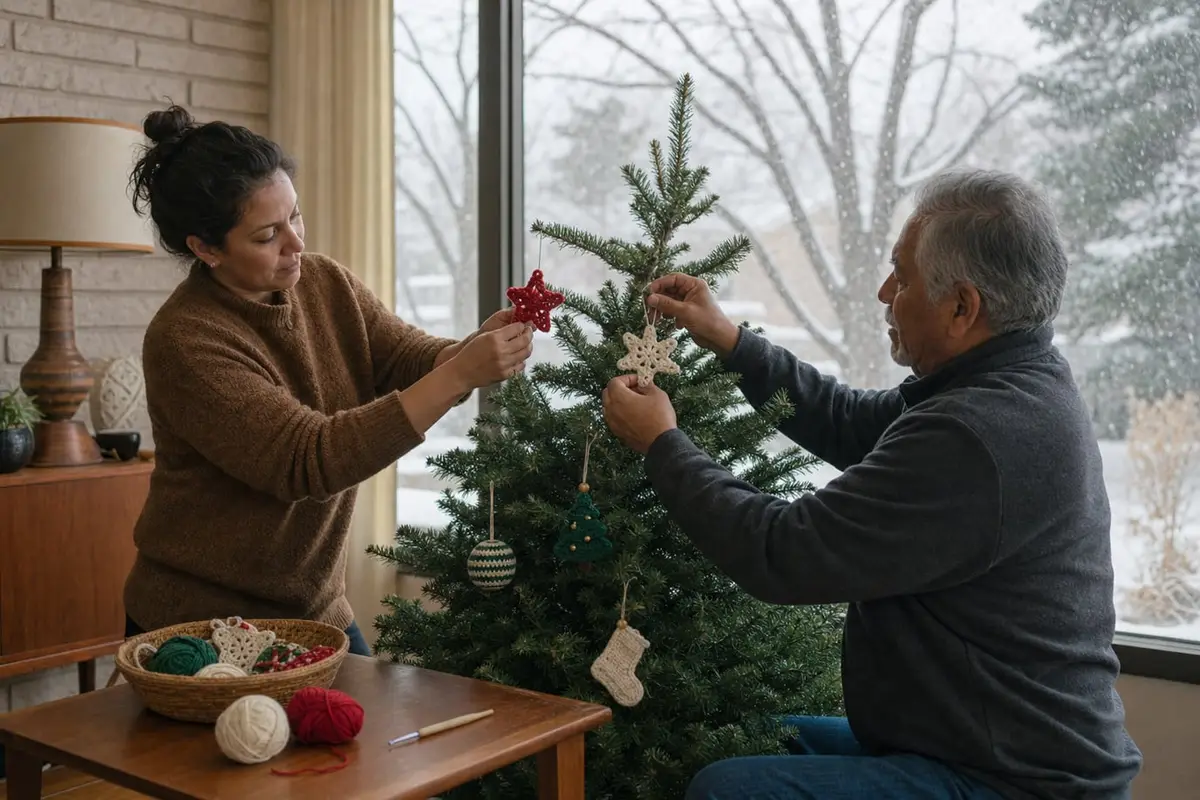
Crochet Christmas ornaments come in five families: flat trees and stars, covers worked over plastic baubles, thread snowflakes, mini stockings and small stuffed amigurumi. The easiest, Morine's Shop's flat tree in chain and half double crochet, takes about 15 minutes in DK yarn by its designer's estimate; snowflakes need size 10 thread, a steel hook and starch.
Crochet ornament — A crochet Christmas ornament is a small decoration crocheted to hang on a tree, usually in worsted, DK or fingering yarn or in cotton thread: a flat shape such as a tree or star, a cover worked over a plastic bauble, a lace snowflake stiffened with starch or glue, or a stuffed mini amigurumi with a hanging loop.
Some links on this page are affiliate links: if you buy through them, we may earn a commission at no extra cost to you. It never changes our rankings. As an Amazon Associate I earn from qualifying purchases. Affiliate policy
A crochet ornament is the smallest finished project you can make, and one of the most forgiving: Sarah Maker’s 2024 roundup of free ornament patterns notes that size matters so little that most patterns do not require you to match the gauge. This guide sorts the main kinds of ornaments by level, explains the yarn, hook and finishing each one needs, and links to the designers’ own free patterns. It explains the choices, not the pattern: every ornament below is made from its designer’s page.
At a glance
| Ornament | Yarn | Hook | Level and stated size or time | Free pattern |
|---|---|---|---|---|
| Flat tree | DK (3), acrylic | 4 mm (G-6) | beginner; about 5 x 2.5 in; about 15 minutes | Morine’s Shop |
| Bobble star | worsted or Aran | 5 mm (H-8) | “very easy”; about 3.5 in | Truly Crochet |
| Bauble cover | medium (4) | 4.5 mm (7) | beginner; over an 80 mm plastic ornament | Sigoni Macaroni |
| Fine bauble cover | fingering cotton | 2.5 mm | easy; over an 8 in circumference ball | Annie Design Crochet |
| Mini stuffed bauble | scrap cotton, DK to fingering | 2.75 mm (C-2) | about 2 to 3 cm across | Thoresby Cottage |
| Stuffed star | sport or DK, about 30 yd | 4 mm (G-6) | two halves joined and stuffed | Crochet For You |
| Mini stocking | worsted (4) | 5.5 and 6 mm (I-9, J-10) | mini version about 22 x 10 cm | Peach & Paige |
| Tree with a face | sport (2) | 2.5 mm | intermediate; about 4 in; under 30 minutes | Crochet with Yarnhild |
| Christmas pudding | worsted (4) | 3.5 mm (E-4) | about 3 in tall | PlanetJune |
| Lace snowflake | size 10 crochet thread | steel size 7 | stiffened after blocking | Snowcatcher |
Sizes, times and levels are the designers’ own; the US letter in brackets is the Craft Yarn Council equivalent of the metric size. Every pattern above that states its terminology uses US terms, where single crochet (sc) is the UK double crochet (dc).
Choose by level
If you have just learned the basic stitches, start flat. Morine’s Shop’s 15-minute tree uses only chains and half double crochet, then is assembled on a strand of yarn threaded with beads. A cover worked over a plastic bauble is the other easy route, because the ball gives the shape: Sigoni Macaroni’s beginner ornament is two circles started from a magic circle and sewn together around an 80 mm fillable ornament.
If you can work in the round, try a star or a smaller bauble. Truly Crochet’s Christmas star builds its points from bobble stitches, and Annie Design Crochet’s Christmas baubles, by Carmen Heffernan, add a spike stitch for the pattern. A magic ring closes the center of most of these pieces without a hole.
If you have made a small amigurumi, the stuffed ornaments follow the same rules: tight single crochet in continuous rounds, a stitch marker, firm stuffing. Crochet For You’s stuffed star joins two embroidered halves around fiberfill; PlanetJune’s Christmas pudding by June Gilbank is about 3 inches tall in worsted yarn on a 3.5 mm hook; Yarnhild’s tree with a face is labeled intermediate and uses 6 mm safety eyes. Our amigurumi for beginners tutorial explains the technique.
If you like fine work, thread snowflakes are the classic. They take patience, a steel hook and a stiffening step, but a single ball of thread makes dozens.
Yarn and hook: why ornaments break the label rules
For blankets and garments, the yarn label’s hook range is a sensible start. Ornaments are different: they need to hold a shape, so designers often go below the label. The Craft Yarn Council’s 2018 standards recommend 5.5 to 6.5 mm (I-9 to K-10½) for medium (4) yarn; Truly Crochet’s star uses 5 mm with worsted or Aran yarn, and PlanetJune’s pudding uses 3.5 mm. A tighter fabric hides stuffing and keeps points crisp.
| Material | Craft Yarn Council category | Recommended hook (CYC 2018) | Typical ornaments |
|---|---|---|---|
| Size 10 crochet thread | Lace (0) | steel 6, 7, 8 (1.6 to 1.4 mm) | snowflakes, lace stars |
| Fingering and sock yarn | Super Fine (1) | 2.25 to 3.25 mm (B-1 to E-4) | small baubles, mini amigurumi |
| Sport | Fine (2) | 3.5 to 4.5 mm (E-4 to 7) | trees with faces, elves, gnomes |
| DK and light worsted | Light (3) | 4.5 to 5.5 mm (7 to I-9) | flat trees, stuffed stars |
| Worsted and Aran | Medium (4) | 5.5 to 6.5 mm (I-9 to K-10½) | stars, bauble covers, stockings |
Two details trip up new thread crocheters. Steel hooks run backward: the Council’s table notes that the higher the number, the smaller the hook, and that numbering varies by brand, so a size 7 steel hook appears at 1.65 mm in one row of its chart and 1.5 mm in another. Thread is similar: the smaller the number, the thicker the thread, and the most common sizes are 3, 5, 10, 20 and 30. Our hook size chart and yarn weights explained give the full tables.
For fiber, cotton is the usual choice for ornaments that will be starched: Itchin4Stitchin’s stiffening guide says natural fibers such as cotton work best and acrylic may need more coats. Acrylic is fine for stuffed pieces and covers. Metallic thread adds shine: Thoresby Cottage tops its mini bauble with gold Lurex or embroidery floss, held double if it is thin.
Snowflakes: thread, blocking and stiffening
A crochet snowflake is soft and curled when it comes off the hook. It becomes flat and crisp in two steps: blocking, then stiffening. Snowcatcher, the snowflake site of Deborah Atkinson, whose free Coquette Snowflake calls for size 10 crochet thread and a size 7 steel hook, describes painting the finished snowflake with water-soluble school glue thinned with a few drops of water and letting it dry at least 24 hours.
Stiffening methods compared
| Method | How it is mixed | What the sources say |
|---|---|---|
| Spray starch | ready to use, one or more coats | The Purple Poncho: one coat for light stiffening, a second for more; dry overnight |
| Liquid fabric starch | equal parts starch and water | Itchin4Stitchin: same soak, blot, shape and dry steps |
| White school glue | equal parts glue and water, or thinner | Itchin4Stitchin: strong and durable, good for heavier ornaments; Snowcatcher: water-soluble glue |
| Commercial fabric stiffener | follow the label | Itchin4Stitchin: long-lasting; work in a well-ventilated room |
| Cornstarch | 3 tablespoons per cup of water | Itchin4Stitchin: easy, less likely than sugar to attract pests |
| Sugar water | equal parts sugar and water, simmered | Itchin4Stitchin: cheap and effective, but can attract ants in humid climates |
The process, step by step
- Cover a board. A corkboard or foam board under plastic wrap or wax paper, so the piece does not stick.
- Soak and blot. Itchin4Stitchin soaks snowflakes for 1 to 2 minutes, then blots off the excess without distorting the shape. Too much solution left on the piece is the usual cause of a sticky finish.
- Pin to shape. Pin every point with rustproof or stainless steel pins; The Purple Poncho recommends stainless pins because others can rust and mark the thread. Snowcatcher advises not to reuse blocking pins for sewing afterward.
- Dry slowly. Itchin4Stitchin allows 24 to 48 hours depending on humidity, away from direct heat or sun.
- Store dry and flat. Moisture can soften a stiffened piece, so pack snowflakes flat in a box between seasons.
Stiffened pieces are decorations, not something to wash: water undoes starch and water-soluble glue. Keep the stiffening mixtures and the drying board out of reach of young children and pets, and follow the label of any commercial product.
Mini amigurumi ornaments
Stuffed ornaments, from puddings and gnomes to reindeer and trees with faces, are small amigurumi with a hanging loop. Sarah Maker’s ornament roundup lists several, with yarn from fingering to worsted; her tree roundup adds amigurumi trees in continuous rounds. The technique is the one our what is amigurumi guide describes, scaled down.
Two points matter more for ornaments than for a shelf toy. First, small parts: an ornament on a low branch is within reach of toddlers and pets, so for those homes embroider the eyes instead of using plastic safety eyes, as designers such as PlanetJune advise for toys for babies, and sew every part on firmly. Second, weight: a dense stuffed piece in worsted yarn can bend a thin branch, so smaller pieces in fingering or sport yarn hang better.
If you would rather start from a kit with everything included, our comparison of amigurumi kits covers four of them, from video-led kits to a next-step project.
Trees, stockings and granny squares
Flat and three-dimensional trees are the largest family of crochet ornaments. Sarah Maker’s tree roundup lists 25 free patterns and says most are good for beginners, from a 3.5 inch tree in single crochet to tabletop trees. One of them, the vintage granny square tree, stacks six granny squares of different sizes and folds the edges up into branches: a way to turn a stitch you already know into a decoration.
Mini stockings make ornaments and gift holders at once. Peach & Paige’s Berry Beautiful Stocking comes in a standard and a mini size, about 22 by 10 cm, in worsted yarn, and its designer notes that gauge is not important for a decoration. Sarah Maker’s stocking roundup lists 25 more, and suggests bulky yarn when you want one to work up quickly.
Hanging loops and finishing
- Hanging loop. Many patterns end with a chain loop worked from the last stitch. Morine’s tree hangs from the yarn threaded through its beads, Thoresby Cottage sews a metallic topper on its mini bauble, and a ribbon or metallic thread loop works on any piece.
- Ends. Weave every end in several directions before stiffening or stuffing; a tail that works loose shows on a small piece.
- Embroidery. Faces, stripes and stars are added with a yarn needle after the crochet; Crochet For You embroiders each star half before joining them.
- Weight check. Hang the finished ornament on a branch before making a set, to check that it does not tip or slide off.
Making a set, and giving one
A set of matching ornaments is quicker than it looks once the first one is done, and it makes an easy present. Our crochet gift ideas include a section on Christmas gifts with realistic times for each project. Make one ornament first to time yourself, then plan the rest; batching the same step, all the bases, then all the finishing, keeps a set consistent.
Where to find more free patterns
These collections link to the designers’ own pages, with photos and materials:
- Sarah Maker: 25 free crochet Christmas ornament patterns, 25 tree patterns and 25 stocking patterns, each with a suggested yarn.
- Moogly: Tamara Kelly’s 10 free crochet Christmas ornament patterns, updated for the 2024 season.
- Snowcatcher: Deborah Atkinson’s snowflake designs in crochet thread, with finishing notes.
New to the stitches these patterns use? Our guide to basic crochet stitches compares chain, single, half double and double crochet, the four stitches behind almost every ornament on this page.
Key facts
- Morine's Shop's free 15-Minute Christmas Tree, published in 2021, uses only chain and half double crochet in DK yarn with a 4 mm hook, is labeled beginner and measures about 5 inches long and 2.5 inches wide.Morine's Shop, 15-Minute Crochet Christmas Tree (Morine), 2021
- The Craft Yarn Council's 2018 standards place 10-count crochet thread in the Lace (0) category, with steel hooks 6, 7 and 8 (1.6 to 1.4 mm), and note that steel hooks run backward: the higher the number, the smaller the hook.Craft Yarn Council, Standards & Guidelines for Crochet and Knitting, 2018
- Sigoni Macaroni's free beginner Christmas ornament, updated in 2023, is two pieces worked in rounds from a magic circle in medium (4) yarn with a 4.5 mm hook, then sewn together around an 80 mm fillable plastic ornament.Sigoni Macaroni, How to Crochet a Christmas Ornament for Beginners, 2023
- Itchin4Stitchin's 2025 stiffening guide lists five methods for crochet snowflakes: sugar water, fabric starch, commercial stiffener, white glue and water at equal parts, and cornstarch at 3 tablespoons per cup of water; it warns that sugar can attract ants in humid climates.Itchin4Stitchin, How to Stiffen Crochet Snowflakes, 2025
- Sarah Maker's 2024 roundup of 25 free crochet Christmas ornament patterns says ornaments are forgiving about yarn choice and that, because size matters little, most patterns do not require you to match the gauge.Sarah Maker, 25 Free Crochet Christmas Ornament Patterns (Sarah Stearns), 2024
FAQ
What is the easiest crochet Christmas ornament for a beginner?
A flat tree or a cover worked over a plastic bauble. Morine's Shop's tree uses only chain and half double crochet and takes about 15 minutes by its designer's estimate; Sigoni Macaroni's beginner bauble is two circles from a magic ring sewn around an 80 mm plastic ornament.
What yarn and hook should I use for crochet ornaments?
Most ornament patterns use worsted (4), DK (3) or fingering yarn, often with a slightly smaller hook than the label suggests so the shape stays firm. Lace snowflakes use size 10 crochet thread, which the Craft Yarn Council places in Lace (0), with steel hooks 6 to 8 (1.6 to 1.4 mm).
How do you stiffen crochet snowflakes and ornaments?
Block the piece, soak it in liquid starch, a fabric stiffener or white school glue diluted with water, blot it, then pin it flat on a board covered with plastic wrap or wax paper with rustproof pins. Itchin4Stitchin allows 24 to 48 hours to dry, depending on humidity.
Can I use sugar water to stiffen crochet ornaments?
It works, but Itchin4Stitchin warns that sugar can attract ants in humid climates and suggests a commercial stiffener, cornstarch or starch instead. Whatever you use, store stiffened ornaments dry and flat between seasons.
Are crochet ornaments safe around babies and pets?
Treat them as decorations, not toys. Plastic safety eyes, beads and glued parts can come loose, and stiffened pieces contain glue or starch. For an ornament that small hands or pets can reach, embroider the eyes, sew every part on firmly and hang it high.
How long does it take to crochet a Christmas ornament?
Designers' estimates range from about 15 minutes for Morine's Shop's flat tree to under 30 minutes for Yarnhild's tree with a face. Stuffed, embroidered or thread pieces take longer, and a stiffened snowflake needs one to two days to dry.
Sources
- Craft Yarn Council: Standards & Guidelines for Crochet and Knitting (PDF, 2018)
- Sarah Maker: 25 Free Crochet Christmas Ornament Patterns (2022, updated 2024)
- Sarah Maker: 25 Free Crochet Christmas Tree Patterns (2022, updated 2024)
- Sarah Maker: 25 Free Crochet Christmas Stocking Patterns (2022, updated 2024)
- Morine's Shop: 15-Minute Crochet Christmas Tree (2021)
- Truly Crochet: Christmas Star Ornament (2019)
- Crochet For You: Crochet Stars Christmas Ornament (Erangi Udeshika)
- Sigoni Macaroni: How to Crochet a Christmas Ornament for Beginners (2021, updated 2023)
- Annie Design Crochet: Free Christmas Baubles Pattern (Carmen Heffernan, 2018)
- Thoresby Cottage: Mini Christmas Bauble
- Snowcatcher: snowflake patterns (Deborah Atkinson)
- Peach & Paige: Berry Beautiful Stocking (2021)
- Crochet with Yarnhild: Christmas Tree Ornament (2019, updated 2026)
- PlanetJune: Christmas Pudding (June Gilbank, 2007)
- Itchin4Stitchin: How to Stiffen Crochet Snowflakes (2024, updated 2025)
- The Purple Poncho: How to Starch Your Crochet (2019, updated 2022)
- Moogly: 10 Free Crochet Christmas Ornament Patterns (Tamara Kelly, updated 2024)
Related reading
- Crochet Gift Ideas: 12 Quick Projects to Make and Give
- Magic Ring Crochet: How to Make an Adjustable Ring, Step by Step
- Basic Crochet Stitches: Chain, Single, Half Double and Double
- Half Double Crochet (hdc): How to Work the Three-Loop Stitch
- How to Crochet a Granny Square: Structure, Corners and Fixes
- The Best Amigurumi Crochet Kits, Compared on Contents and Level
- Amigurumi for Beginners: The Techniques to Learn, Step by Step
- Crochet Hook Size Chart: US Letters, Millimeters and How to Choose
- Yarn Weight Chart: The 8 Yarn Weights Explained for Crochet