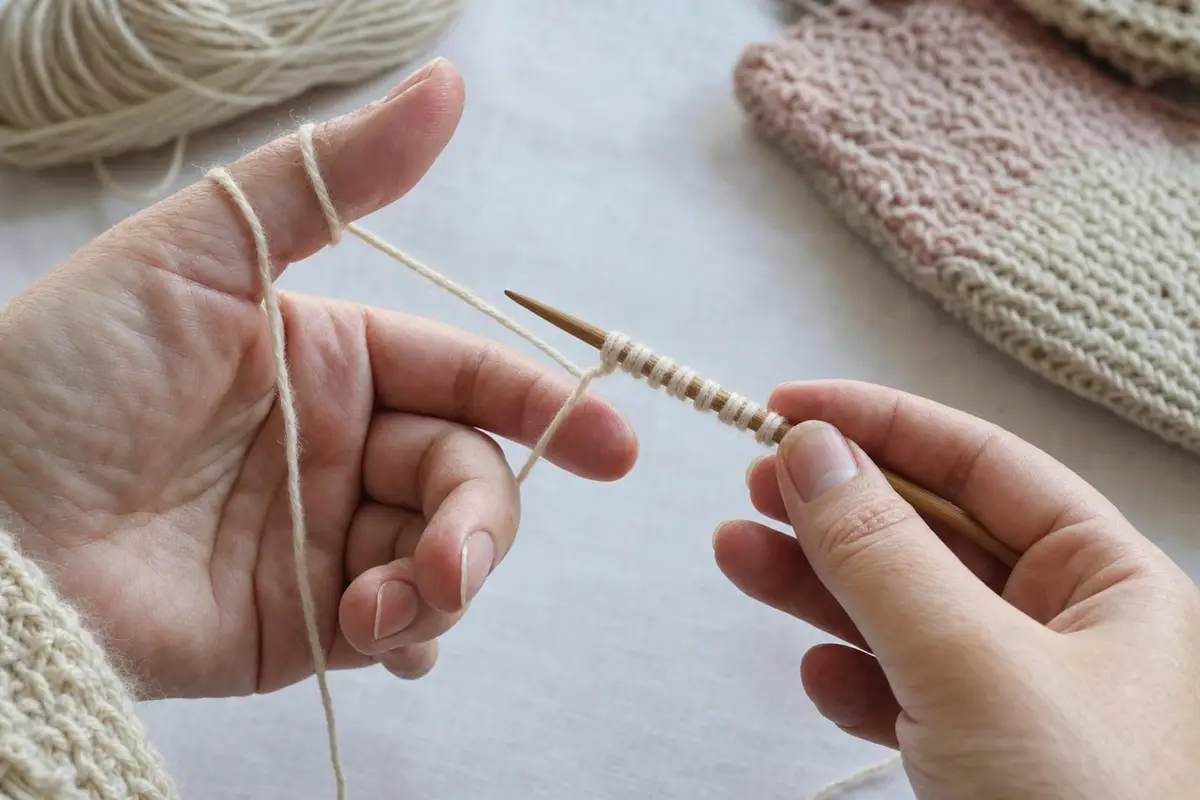
To cast on, put the first row of loops on a needle. Cassie May's 2022 comparison names the backward loop the easiest, the knitted cast-on the best first method to learn, the cable cast-on a firmer version and the long-tail a stretchy all-purpose edge. For long-tail, Knit Picks (2009) suggests a tail about three times the finished width.
Cast on — Casting on (abbreviated CO) is the way a knitter creates the first row of loops on a needle, the foundation that every following row is worked from; common methods include the backward loop, knitted, cable and long-tail cast-ons.
Some links on this page are affiliate links: if you buy through them, we may earn a commission at no extra cost to you. It never changes our rankings. As an Amazon Associate I earn from qualifying purchases. Affiliate policy
Every knitting project starts with a cast-on (CO in the Craft Yarn Council’s abbreviations, the counterpart of BO, bind off, which Canadian patterns call cast off). Four methods cover almost everything a beginner needs: the backward loop, which Kate Atherley limits to about 10 to 15 stitches; the knitted cast-on, which Cassie May of Little Red Window teaches first; the cable cast-on, a firm rope-like edge KarenDawn Designs recommends for buttonholes; and the long-tail, the stretchy all-purpose edge, for which Knit Picks suggests a tail of about 36 inches for a 10-inch-wide piece. Practice them on a smooth Medium (4) worsted with US 8 (5 mm) needles, the size the Craft Yarn Council’s 2018 chart pairs with 5 mm.
Quick reference
| Item | Detail |
|---|---|
| Abbreviation | CO (cast on); its opposite is BO, bind off, called cast off in Canadian patterns (Craft Yarn Council, 2018) |
| Practice setup | smooth Medium (4) worsted, e.g. Lion Brand or Red Heart acrylic, on US 8 (5 mm) needles such as Clover Takumi bamboo straights |
| Practice count | 20 stitches for a swatch; 10 to 15 at most with the backward loop (Kate Atherley) |
| Long-tail length | about 3 times the finished width (Knit Picks) to 4 times (KnitPro), or one wrap per stitch plus about 10 in |
| Tight edge fix | cast on with a needle one size larger, e.g. US 9 (5.5 mm) for a US 8 project |
| Tools by brand, examples | Clover Takumi bamboo straights in US 8, Boye aluminum straights, a Clover Takumi 29-inch circular for wide pieces |
| Who should learn long-tail first | knitters planning hats and sweaters, where a stretchy edge matters |
| Who should learn the knitted cast-on first | absolute beginners making a garter stitch scarf or dishcloth |
| For crocheters | the knitted cast-on reuses the knit stitch, much as a crochet chain is the start of crochet |
If you already crochet
| In crochet | In knitting | Note |
|---|---|---|
| foundation chain (ch) | cast on (CO) | both create the first row; a tight start is the classic problem in both |
| first row of single crochet (sc; UK double crochet) | first row of knit stitches | in garter stitch, every row is knit |
| fasten off | bind off (BO), cast off in Canadian patterns | Craft Yarn Council (2018) |
| 5.5 mm (I-9) hook for Medium (4) worsted | US 8 (5 mm) needles for the same yarn | both within the council’s 2018 ranges |
| one live loop on the hook | every stitch of the row live on the needle | why knitting can drop stitches |
At a glance
| Method | Ease | Edge | Stretch | Best for |
|---|---|---|---|---|
| Backward loop | easiest | loose, unstable | high, but uneven | a few stitches, adding stitches mid-row |
| Knitted cast-on | very easy, uses the knit stitch | neat | some | a first cast-on, scarves and dishcloths |
| Cable cast-on | easy once you know the knitted cast-on | firm, rope-like | little | garments, blankets, buttonholes |
| Long-tail | a little harder to learn | neat, tidy | stretchy | all-purpose: hats, sweaters, most projects |
Ratings summarize Cassie May (2022), Kate Atherley (2021) and KarenDawn Designs (2021). For practice, use a smooth Medium (4) worsted and US 8 (5 mm) needles.
Backward loop cast-on
- Make a slip knot on the needle.
- With the working yarn coming from the front, loop it around your thumb.
- Insert the needle up through the loop on your thumb and slide it onto the needle; tighten gently.
- Repeat for each stitch.
Cassie May calls it the easiest cast-on by far and fantastic for adding stitches in the middle of a row, but not great for casting on a large number of stitches. Kate Atherley notes that its stitches are not yet anchored or very stable and advises using it for no more than about 10 to 15 stitches.
Knitted cast-on
- Make a slip knot on the left needle.
- Knit into it: insert the right needle, wrap the yarn and pull a loop through, but do not drop the old stitch.
- Place the new loop onto the left needle, twisting it slightly so it sits like the others.
- Knit into the newest stitch and repeat.
Cassie May finds it very easy and teaches it to beginners first, because it rehearses the knit stitch. KarenDawn Designs describes it as fairly firm with a slight stretch, and really easy for a beginner to learn.
Cable cast-on
The cable cast-on starts like the knitted cast-on, but you insert the right needle between the last two stitches instead of into the last one. Kate Atherley explains that it is named for its edge, which looks like a twisted rope, and calls it handsome and substantial, a little bit firm without being inflexible, a terrific start for garments and blankets. KarenDawn Designs adds that it is very firm with little stretch and perfect for buttonholes. Avoid it for edges that must stretch, such as hat brims.
Long-tail cast-on
- Pull out a long tail: see below for how long.
- Make a slip knot on the needle, with the tail over your thumb and the working yarn over your index finger, both held in your left hand.
- Bring the needle up through the loop on your thumb, over the yarn on your index finger, and back down through the thumb loop.
- Drop the loop off your thumb and snug the new stitch. Repeat.
It is often called the slingshot cast-on because of the hand position. Cassie May calls it nice and stretchy and a great all-purpose method, but a little more difficult to learn at first; KnitPro notes that many knitters learned it as their first cast-on, and that variations such as the German twisted cast-on add stretch.
How long a tail for the long-tail cast-on
Sources give different estimates:
- Knit Picks (2009): roughly three times the width of the finished piece, about 36 inches for a 10-inch-wide piece, including 6 inches for weaving in.
- KnitPro (2023): at least four times the final width.
- The wrap method (KnitPro): wrap the yarn around the needle once for each stitch you need, unwind it, and add about 10 inches.
If you run out of tail before the last stitch, pull the stitches off, measure a longer tail and start again; it happens to everyone.
Which cast-on to learn first
Designers disagree. Cassie May starts beginners with the knitted cast-on; KnitPro notes that many knitters learn the long-tail first; All About Ami’s beginner hat uses the long-tail. A practical path: learn the knitted cast-on for your first dishcloth or scarf, then the long-tail for your first hat. Add the cable cast-on when a pattern calls for it.
Common cast-on problems
- The edge is too tight: cast on with a needle one size larger, then switch to the pattern’s size for the first row.
- The edge is too loose or uneven: keep the same tension on each loop, and avoid the backward loop for a long edge.
- The stitch count is off: count the cast-on stitches twice before the first row.
Next steps
Continue with our guide to knitting for beginners for the knit and purl stitches, and use the knitting needle size chart to choose needles for your yarn.
Key facts
- Cassie May of Little Red Window wrote in 2022 that the backward loop is by far the easiest cast-on but not great for many stitches, that the knitted cast-on is very easy and the one she teaches beginners first, and that the long-tail is stretchy and all-purpose but a little harder to learn.Little Red Window, The Complete Guide to Comparing Easy Knitting Cast On Methods (Cassie May), 2022
- Knit Picks' 2009 long-tail tutorial says the tail should be roughly three times the width of the finished piece, giving the example of a 36-inch tail for a 10-inch-wide piece, including 6 inches for weaving in.Knit Picks Tutorials, Long Tail Cast On, 2009
- KnitPro's 2023 long-tail tutorial suggests a tail of at least four times the project's final width, or wrapping the yarn once around the needle per stitch plus about 10 inches, and says many knitters learned long-tail as their first cast-on.KnitPro, How to do the Long Tail Cast On, 2023
- Kate Atherley wrote in Modern Daily Knitting in 2021 that the cable cast-on, named for its rope-like edge, is firm without being inflexible and a terrific start for garments and blankets, while the backward loop's stitches are not yet anchored and suit only about 10 to 15 stitches.Modern Daily Knitting, Skill Builder: Two Cast-ons (Kate Atherley), 2021
FAQ
What is the easiest cast on for beginners?
The backward loop is the easiest to make, but its loose stitches are hard to knit into and it suits only a few stitches. The knitted cast-on is the one many teachers start with, because it uses the same movement as the knit stitch and gives a neat, slightly stretchy edge.
How long should the tail be for a long-tail cast on?
Estimates vary: Knit Picks suggests about three times the finished width, KnitPro at least four times. Another method is to wrap the yarn around the needle once per stitch you need, then add about 10 inches. Leaving too much is better than running out.
Which cast on is the stretchiest?
Among the four common methods, the long-tail is the stretchy all-purpose choice. The knitted cast-on has a little stretch and the cable cast-on very little. For very stretchy edges such as hat brims, variants such as the German twisted cast-on add more give.
Does the cast on count as a row?
It depends on the method and the pattern. The long-tail cast-on creates a row of stitches that some knitters count as the first row; the knitted and cable cast-ons usually do not. Follow your pattern's instructions for the first row.