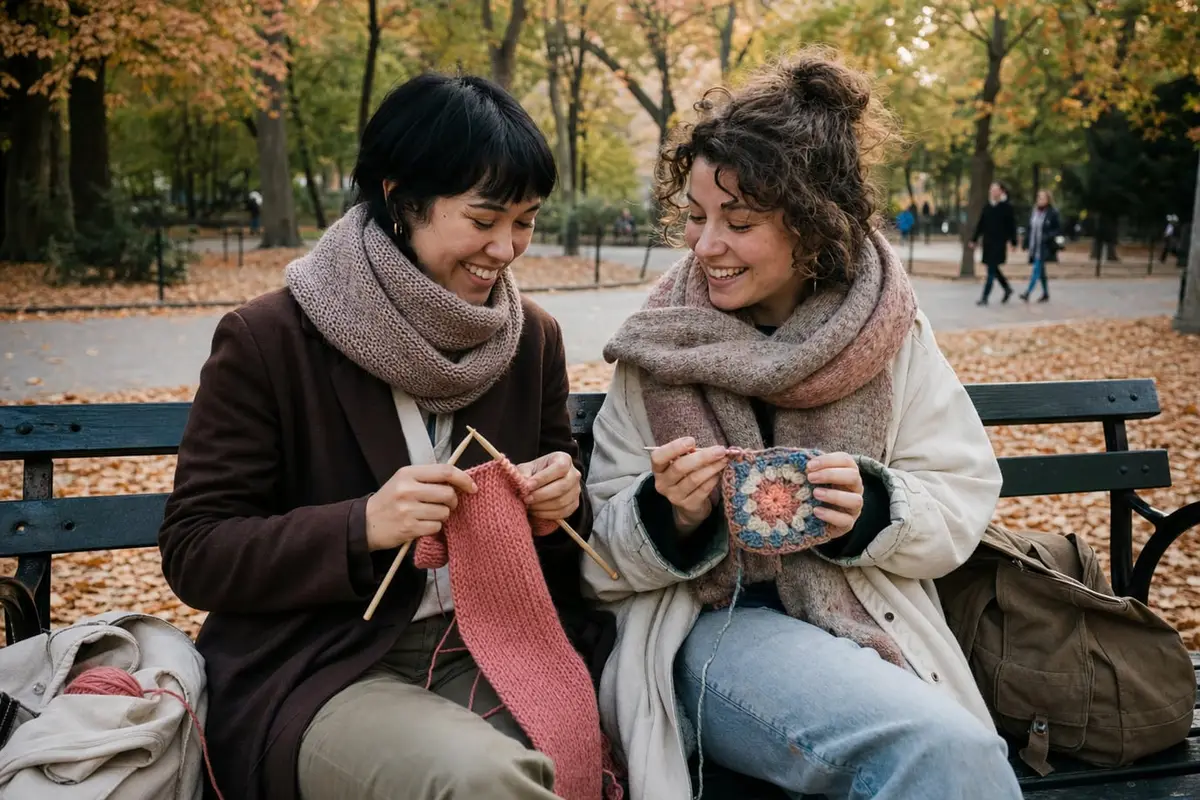
According to Knitty's 2025 guide, knitting keeps all its live stitches on two needles, while crochet works one live loop at a time with a single hook. Knitting usually makes thinner, drapier, stretchier fabric; crochet makes thicker, more structured fabric, is generally faster and almost always uses more yarn for a similar project.
Knitting — Knitting is a way of making fabric from yarn with two or more needles, by pulling loops through the live stitches held on a needle; unlike crochet, every stitch of the current row stays live on the needle until it is worked.
Some links on this page are affiliate links: if you buy through them, we may earn a commission at no extra cost to you. It never changes our rankings. As an Amazon Associate I earn from qualifying purchases. Affiliate policy
Knitting and crochet both turn yarn into fabric with simple tools, and many people do both. They build that fabric in different ways, which changes how it looks, drapes and stretches, how fast it grows and how much yarn it uses. In the Craft Yarn Council’s 2014 study of 3,178 US knitters and crocheters, 48% said they mainly crochet, 32% mainly knit and 20% do both equally. This page compares the two on facts, then on the opinions experienced makers hold about which to learn first.
For crocheters thinking of knitting
If you already crochet, much of what you know transfers: the Craft Yarn Council’s weight categories, swatching for gauge (called tension in UK and Canadian patterns) and pattern reading work the same way. What changes is the tool and the hand movement. For a medium (4) worsted such as Red Heart Super Saver, you would crochet with a 5.5 mm (I-9) hook but knit on US 7 to 9 needles (4.5 to 5.5 mm), typically a US 8 (5 mm) pair; your crochet hook remains useful to pick up dropped stitches. The first knitting stitch to learn is the knit stitch, worked on every row as garter stitch, the equivalent of practicing single crochet (UK double crochet) in rows.
At a glance
| Knitting | Crochet | |
|---|---|---|
| Tools | two needles (or a circular needle) | one hook |
| Live stitches | the whole row, held on the needle | one loop on the hook |
| Typical first stitch | knit stitch, in garter stitch | chain, then single crochet (UK double crochet) |
| Fabric | thinner, drapier, more stretch | thicker, more structured, less stretch |
| Speed | generally slower | generally faster (Knitty, 2025) |
| Yarn use | less for a similar project | more for a similar project (Knitty, 2025) |
| Medium (4) worsted tools | US 7 to 9 needles (4.5 to 5.5 mm) | 5.5 to 6.5 mm hook (I-9 to K-10½) |
| Strong suits | sweaters, socks, shawls, drapey garments | amigurumi, baskets, bags, blankets, motifs |
| Dropped stitches | possible, and can unravel a column | not possible: only one live loop |
The tool sizes for medium (4) worsted yarn come from the Craft Yarn Council’s 2018 Standards & Guidelines.
How each builds fabric
As Julia Madill explains in Knitty’s 2025 guide, knitting keeps its live stitches lined up on a needle: every stitch of the current row is waiting to be worked, and the next row pulls new loops through them. Crochet works with just one live stitch at a time: each stitch is finished before the next begins, so nothing has to sit on a needle.
That single difference explains most of the others. Knitting’s long rows of live stitches can drop and unravel if a needle slips out; crochet cannot drop a stitch. Crochet can also turn corners, work into any stitch in any direction and build three-dimensional shapes easily, which is why granny squares and amigurumi are crochet’s territory.
Fabric: drape, stretch and thickness
Knitty’s guide sums up the fabric differences: knit fabric is generally thinner than crochet fabric made with the same yarn, crochet stitches are more locked in place and stretch less, and soft fabric with a lot of drape is often easier to achieve with knitting. KnitPro’s 2025 guide reaches the same conclusion: knitted fabric’s interlocking loops generally give better drape, while crochet often results in a thicker, more structured fabric.
In practice, that makes knitting the natural choice for fitted sweaters, socks and flowing shawls, and crochet the natural choice for items that must hold their shape: baskets, bags, toys and sturdy blankets.
Speed and yarn use
Crochet stitches are taller and finish one at a time, so a crochet piece usually grows faster. Knitty’s 2025 guide states plainly that, in general, crochet is faster than knitting. The trade-off is yarn: the same guide says crochet will almost always use more yarn for a similar project, and NobleKnits estimates the difference at roughly a third. If you plan a large blanket, that difference shows on the yarn bill.
Which is easier to learn?
There is no consensus, and both sides make reasonable points:
- For knitting first: Nancy Queen of NobleKnits finds both fairly easy, but recommends knitting because it tends to be a bit easier to get the hang of in the beginning.
- For crochet first: Lantern Moon argues that crocheters learn the stitches quickly because one hook handles everything, that knitting has a higher learning curve, and that crochet mistakes are easy to fix thanks to large, well-defined stitches.
A practical way to decide is by the project you want to make. If it is a drapey scarf or a sweater, start knitting. If it is a blanket, a toy or a bag, start crocheting. Many people learn one, then add the other, and find the second one much easier to pick up.
Can you combine them?
Yes. Many knitters use a crochet hook to pick up dropped stitches or add a crocheted edging to knitted pieces, and crocheters often learn knitting for garments. The yarn weight system, gauge, swatching and pattern reading work the same way in both crafts, so skills transfer.
Where to start
To try knitting, our guide to knitting for beginners covers supplies, the knit and purl stitches and a first project, and how to cast on shows the first step in detail. To try crochet, start with our beginner’s guide to crochet.
Key facts
- In the Craft Yarn Council's 2014 tracking study of 3,178 US knitters and crocheters, 48% said they primarily crochet, 32% primarily knit and 20% knit and crochet equally.Craft Yarn Council, Knitting & Crocheting Are Hot! (2015), 2015
- Knitty's 2025 guide by Julia Madill says knit fabric is generally thinner than crochet fabric made with the same yarn, that crochet stitches are more locked in place and stretch less, and that soft fabric with a lot of drape is often easier to achieve in knitting.Knitty, How to Get Hooked (Julia Madill), 2025
- The same 2025 Knitty guide states that crochet will almost always use more yarn than knitting for a similar project, and that crochet is in general faster than knitting.Knitty, How to Get Hooked (Julia Madill), 2025
- KnitPro's 2025 drape guide recommends knitting for soft, flowing garments such as cardigans, shawls or socks, and crochet for accessories, bags or items that need more support.KnitPro, Knitting vs. Crochet for the Perfect Drape, 2025
FAQ
Is knitting or crochet easier to learn?
Opinions differ. NobleKnits' Nancy Queen finds knitting a bit easier to get the hang of at the start, while Lantern Moon argues crochet is quicker to learn because one hook handles everything and mistakes are easy to fix. Crochet's single live loop makes dropped stitches impossible, which many beginners appreciate.
Which is faster, knitting or crochet?
In general, crochet. Knitty's 2025 guide states that crochet is faster than knitting, and crochet stitches are taller, so a piece grows more quickly. Speed still depends on the person, the stitch and the yarn weight.
Does crochet use more yarn than knitting?
Yes, for a similar project. Knitty's 2025 guide says crochet will almost always use more yarn, and NobleKnits estimates roughly a third more. Crochet stitches are thicker and denser, which uses more yarn per square inch.
Can you tell knitting and crochet apart by looking?
Usually. Stockinette knitting shows columns of small V shapes on one side; crochet shows rows of knots and posts, often with more texture and small gaps. Crochet fabric is usually thicker and holds its shape more.
Sources
- Knitty: How to Get Hooked (Julia Madill, Winter 2025)
- KnitPro: Knitting vs. Crochet for the Perfect Drape (2025)
- Craft Yarn Council: Knitting & Crocheting Are Hot! (2015)
- NobleKnits: Which Is Easier to Learn, Knitting or Crocheting? (2018)
- Lantern Moon: Which Is More Popular for Beginners? (2025)
- Craft Yarn Council: Standards & Guidelines for Crochet and Knitting (PDF, 2018)