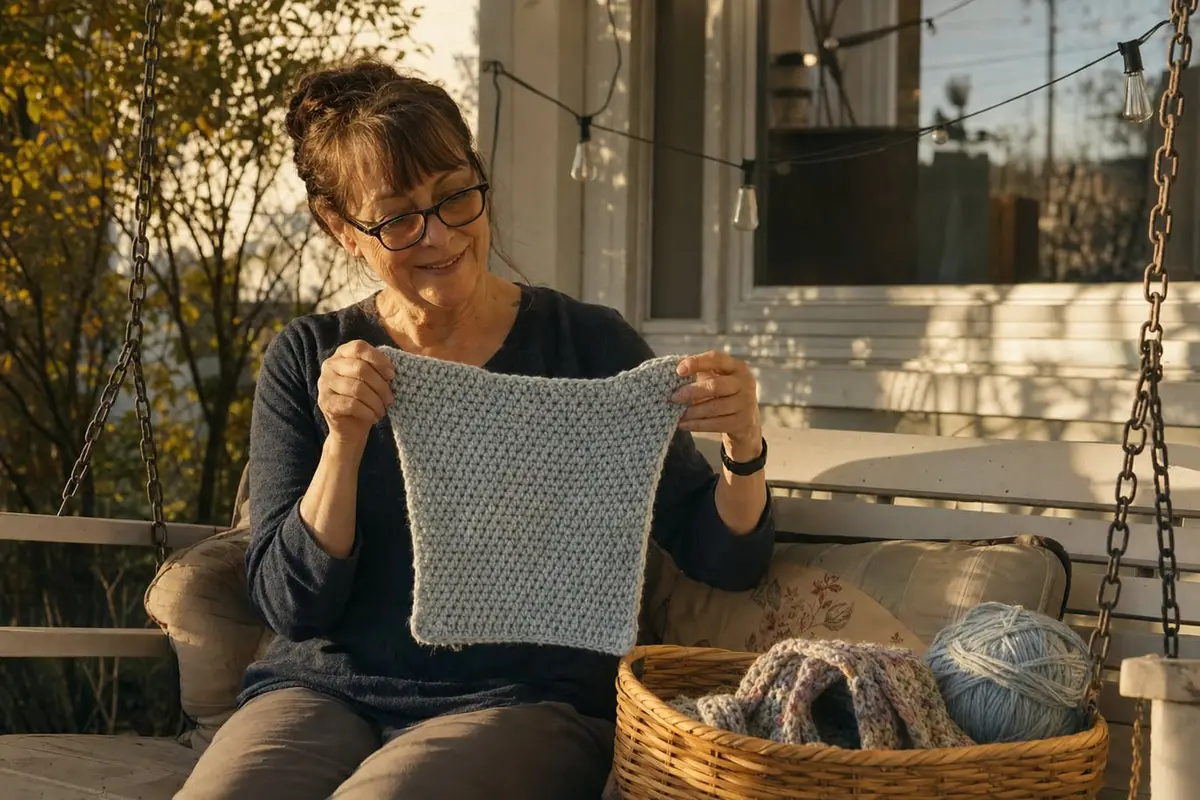
Following the Craft Yarn Council's 2018 project levels, start with a Basic project: a small, flat piece worked in rows with one or two basic stitches, such as a dishcloth or a scarf, in a smooth, light-colored medium (4) yarn with a 5 to 5.5 mm hook. Make a granny square next, then a blanket.
Beginner crochet project — A beginner crochet project is a small item, usually flat and worked in rows, that uses only the chain and one or two basic stitches without shaping, so a new crocheter can finish it while practicing even tension and stitch counting.
Some links on this page are affiliate links: if you buy through them, we may earn a commission at no extra cost to you. It never changes our rankings. As an Amazon Associate I earn from qualifying purchases. Affiliate policy
The first project decides whether you keep crocheting. Pick one that is too ambitious and it ends in a bag at the back of a closet; pick one that is small and clear and you finish it, learn from it and start the next. This guide gives you the criteria, then a short list of free beginner patterns from designers, credited and linked. We do not publish full patterns ourselves: the designers below wrote and published theirs.
At a glance: first projects in order
| Order | Project | Worked | Stitches (US / UK) | Yarn and hook in the designer’s pattern | Free pattern to try |
|---|---|---|---|---|---|
| 1 | Dishcloth | rows | ch, sc (UK dc) | Medium (4) Bernat Handicrafter Cotton, 5 mm (H-8) | The Simplest Dishcloth (Oombawka Design) |
| 2 | Scarf | rows | ch, sc, hdc (UK dc, htr) | Medium (4) Red Heart Super Saver, 5.5 mm (I-9) | Everblooms Scarf (Oombawka Design) |
| 3 | Granny square | rounds | ch, sl st, dc (UK tr) clusters | cotton with an I hook, per the designer’s comment | The Solid Granny Square (Moogly) |
| 4 | Simple blanket | rows | ch, dc (UK tr) | Red Heart Super Saver, 5.5 mm (I-9) | Simple Double Crochet Blanket (Sigoni Macaroni) |
| 5 | First amigurumi | spiral rounds | magic ring, sc, increases, decreases | worsted (4) with a standard hook in most beginner kits and books | a beginner kit or book |
Who should not start here: if you have never held a hook, learn the chain and single crochet on a practice square first (how to crochet). If you already crochet in rows with even edges, skip to the granny square or a blanket.
What makes a project beginner friendly
Look for these five things, roughly in order of importance:
- Small. A piece you can finish in one to three sessions. Lion Brand suggests starting around 15 to 20 cm (6 to 8 inches) across: dishcloths, coasters or small squares.
- Flat and worked in rows. Rows let you see each stitch and count easily. Lion Brand advises mastering straight-row projects before moving to patterns labeled easy.
- One or two stitches. Chain plus single crochet, half double crochet or double crochet. Each new stitch is a new source of mistakes.
- No shaping. No increases, decreases or fitting. Hats, sweaters and toys come later.
- The right materials. A smooth, light-colored medium weight yarn (category 4) and a matching hook. Lion Brand recommends worsted weight with a 5 mm (H-8) hook and warns that dark yarn hides your stitches; the Craft Yarn Council’s guideline for that weight is 5.5 to 6.5 mm. Either works for a first project; what matters is a smooth yarn you can see.
How to read the skill level
The Craft Yarn Council defines four project levels used by many US patterns: Basic, projects using basic stitches that may include basic increases and decreases; Easy, which may add simple stitch patterns, color work or shaping; then Intermediate and Complex. Many independent designers use their own words, such as “beginner” or “beginner-easy”. Do not rely on the label alone: look at the list of stitches and techniques the pattern uses, and check that it gives stitch counts and states its terminology. Our guide to reading a crochet pattern explains both.
The best first projects, in order
1. A dishcloth or washcloth. Lion Brand calls the dishcloth the classic first project: a small square or rectangle in single or half double crochet that teaches consistent tension and straight edges. Cotton yarn makes it useful even if the edges wander.
2. A scarf. A long rectangle repeats the same row many times, which is exactly what builds an even tension. In double crochet it grows quickly; in single crochet it takes longer but is denser.
3. A granny square. The next step: working in the round, with chain spaces and clusters of double crochet. Tamara Kelly of Moogly writes that she knows people who crocheted for years before the granny square “clicked”, so do not worry if it takes a few tries. One square is a coaster; many squares make a blanket.
4. A simple blanket. Once a scarf looks even, a blanket in one stitch, or made from granny squares, is the natural big project. It takes time, so choose a yarn you enjoy and a pattern that repeats.
5. A first amigurumi. Small stuffed toys teach increases, decreases and working in a spiral, usually from a magic ring. They are a great second or third project, especially from a kit designed for beginners.
Free beginner patterns from designers
Each of these patterns is free to read on its designer’s site. Levels and materials are as the designers state them.
| Pattern | Designer | Level stated | Stitches | Yarn |
|---|---|---|---|---|
| The Simplest Dishcloth | Rhondda Mol, Oombawka Design | Beginner | ch, sc | Medium (4) cotton, 5 mm hook |
| Kitchen Dishcloth | Rhondda Mol, Oombawka Design | Beginner | ch, sc | Medium (4) cotton, 4 mm hook |
| Pretty in Pink Half Double Crochet Washcloth | Sigoni Macaroni | Beginner | ch, hdc, hdc V-stitch | Medium (4), 5 mm hook |
| Basic Shell Stitch Washcloth | Sigoni Macaroni | Beginner | ch, sc, dc, shell | Medium (4), 5 mm hook |
| Speckle Cloud Dishcloth Set | Tamara Kelly, Moogly | Beginner friendly | ch, hdc, hdc2tog | Medium (4) cotton, 5 mm hook |
| Everblooms Scarf | Rhondda Mol, Oombawka Design | Beginner-Easy | ch, sc, hdc | Medium (4), 5.5 mm hook |
| The Solid Granny Square | Tamara Kelly, Moogly | not stated | ch, sl st, dc | not stated |
| Simple Double Crochet Blanket | Sigoni Macaroni | Beginner | ch, dc | Medium blanket yarn, 5.5 mm hook |
| Chunky Granny Square Blanket | Sigoni Macaroni | Beginner | ch, sl st, dc clusters | Super Bulky (6), 8 mm hook |
The two Oombawka Design patterns state that they use US terminology. For the others, check the pattern notes before you start.
Mistakes to avoid with a first project
- Choosing by the photo alone. A beautiful textured blanket may use five stitches and color changes. Read the stitch list first.
- Dark, fuzzy or novelty yarn. It hides your stitches, so you cannot see mistakes or count.
- Skipping the stitch count. Count at the end of every row; it is how edges stay straight.
- Starting big. A blanket as a first project often stalls. Make two or three small pieces first.
- Mixing terminologies. A UK pattern followed with US stitches comes out the wrong size. Check the terms before row 1.
Where to go next
If you have not learned the stitches yet, start with our beginner’s guide to crochet. If you prefer a book that walks you through projects in order, our comparison of crochet books for beginners includes a step-by-step course with 20 easy projects. And when your first piece is done, the Beginner Projects topic covers blankets, granny squares and handmade gifts.
Key facts
- The Craft Yarn Council's 2018 Standards & Guidelines number project levels from 1 to 4, Basic, Easy, Intermediate and Complex, and define Basic as projects using basic stitches that may include basic increases and decreases.Craft Yarn Council, Standards & Guidelines for Crochet and Knitting, 2018
- Lion Brand's 2026 beginner guide calls the dishcloth the classic first project and says a small square or rectangle in single or half double crochet teaches consistent tension and straight edges.Lion Brand, Crochet Patterns for Beginners: Start Today, 2026
- Lion Brand advises beginners to master straight-row projects before moving to patterns labeled easy, starting with pieces around 15 to 20 cm across such as dishcloths, coasters or small squares.Lion Brand, How to Find Easy Crochet Patterns for Beginners, 2026
- Lion Brand recommends worsted weight (4) yarn with a 5 mm (H-8) hook as a beginner's starting point and warns that dark yarn hides stitches.Lion Brand, How to Find Easy Crochet Patterns for Beginners, 2026
FAQ
What is the easiest thing to crochet for a beginner?
A dishcloth or washcloth: a small square worked in rows of one stitch, such as single or half double crochet. It finishes in an evening or two, shows clearly whether your tension and edges are even, and is useful even if it is not perfect.
Should a beginner start with a blanket?
A blanket is possible in simple stitches, but its size makes it slow, and early mistakes stay visible across the whole piece. Most beginners do better with a dishcloth or scarf first, then a blanket once their tension is even, often in double crochet or granny squares.
What does Basic mean on a crochet pattern?
It is the first of the Craft Yarn Council's four project levels: a project using basic stitches that may include basic increases and decreases. The next levels are Easy, Intermediate and Complex. Some designers use their own labels, such as beginner, so read the stitches listed too.
Is amigurumi a good first project?
It can be a good second project rather than a first one. Amigurumi is worked in tight rounds of single crochet with increases and decreases and starts with a magic ring, so it helps to be comfortable with single crochet and stitch counting first. Many beginner kits are designed to teach these steps.
Sources
- Craft Yarn Council: Standards & Guidelines for Crochet and Knitting (PDF, 2018)
- Craft Yarn Council: Project Levels
- Craft Yarn Council: Standard Yarn Weight System
- Lion Brand: Crochet Patterns for Beginners: Start Today
- Lion Brand: How to Find Easy Crochet Patterns for Beginners
- Sigoni Macaroni: Start Here
- Moogly: The Solid Granny Square (Tamara Kelly)