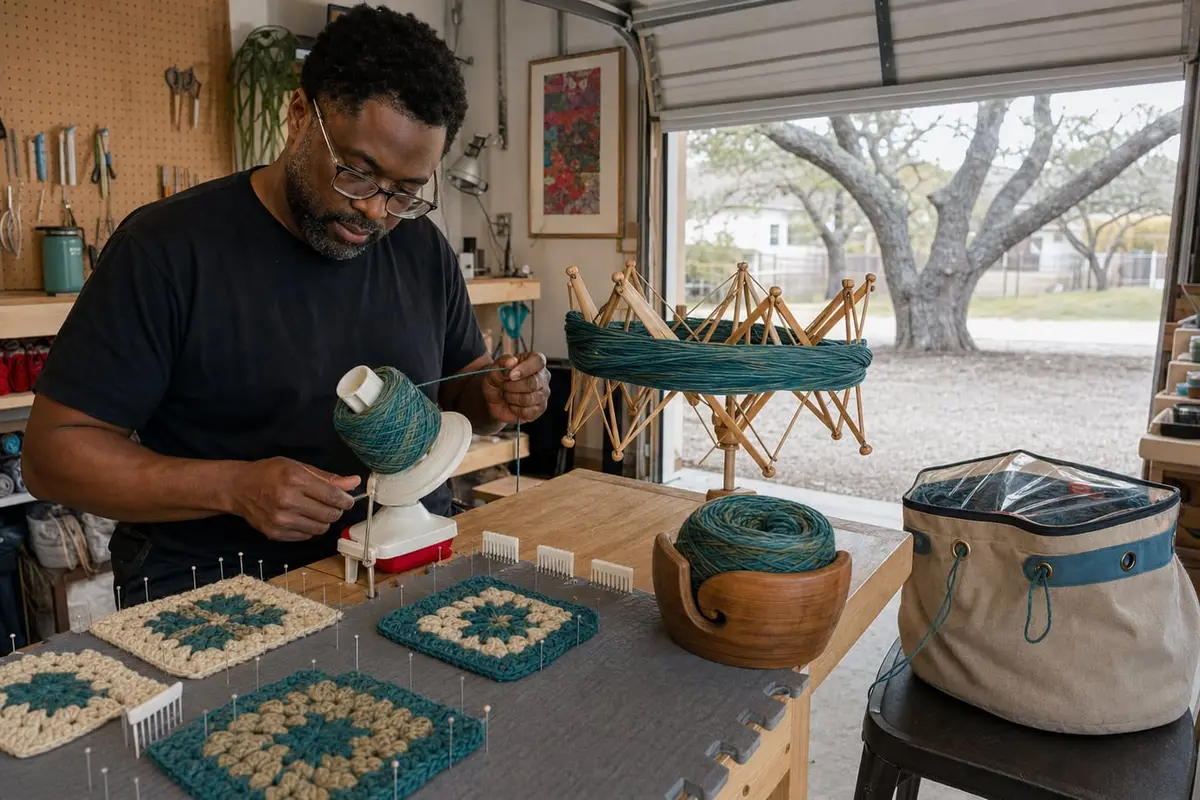
The crochet accessories worth adding once you own hooks, yarn and basic notions are a ball winder and birch swift from Knit Picks for yarn sold in hanks, a LABORWOOD ash yarn bowl, Knitter's Pride blockers for granny squares, The New Crochet Stitch Dictionary with 440 patterns and a PAVILIA project bag, based on listings checked on October 25, 2026.
Some links on this page are affiliate links: if you buy through them, we may earn a commission at no extra cost to you. It never changes our rankings. As an Amazon Associate I earn from qualifying purchases. Affiliate policy
Comparison
| Product | Accessory | Material | Detail |
|---|---|---|---|
| Knit Picks Yarn Ball Winder and Birch Swift Bundle | ball winder and swift | plastic winder, birch swift with metal hardware | winds up to 100 g into center-pull cakes |
| LABORWOOD Large Wooden Yarn Bowl | yarn bowl | ash wood | 7 x 7 x 4 in, non-slip pads |
| Knitter's Pride Mindful Knit Blockers, 20 Pieces | blocking kit | plastic with stainless steel pins | 12 eight-pin and 8 four-pin blockers |
| The New Crochet Stitch Dictionary (Nele Braas, Eveline Hetty-Burkart) | stitch dictionary book | paperback, 272 pages | 440 patterns, written and charted (2021) |
| PAVILIA Large Yarn Storage Bag | project bag | Oxford polyester | 16 x 10.5 x 12.5 in, 8 grommets |
Our picks
Knit Picks Yarn Ball Winder and Birch Swift Bundle
A ball winder and a folding birch swift that turn hanks into center-pull cakes of up to 100 g, sold by Knit Picks.
LABORWOOD Large Wooden Yarn Bowl
A handmade ash-wood bowl, 7 by 7 by 4 inches, with non-slip pads, that keeps a ball from rolling away while it feeds.
Knitter's Pride Mindful Knit Blockers, 20 Pieces
Twenty blockers with stainless pins, 12 large and 8 small, for pinning granny squares and edges straight.
The New Crochet Stitch Dictionary (Nele Braas, Eveline Hetty-Burkart)
440 stitch patterns, each written and charted, in a 272-page paperback published in 2021.
PAVILIA Large Yarn Storage Bag
A large polyester bag with eight yarn grommets and a clear top, to carry a blanket in progress.
Once you own hooks, yarn and the basic notions, the next purchases are accessories that make the routine smoother: something to wind yarn sold in hanks, something to hold the working ball, something to block finished pieces, something to carry a large project and a reference for new stitches. The five accessories below cover those tasks, one per type. We describe each from its listing and maker information; we did not use them ourselves.
At a glance
| Accessory | What it does | Material | Detail | Best for |
|---|---|---|---|---|
| Knit Picks ball winder and birch swift | turns hanks into center-pull cakes | plastic winder, birch swift | winds up to 100 g; clamps to tables up to 1.5 in thick | crocheters who buy hand-dyed or hank yarn |
| LABORWOOD yarn bowl | holds a ball while it feeds | ash wood | 7 x 7 x 4 in, non-slip pads | anyone who crochets at home |
| Knitter’s Pride Mindful Knit Blockers | pins pieces to shape while drying | plastic, stainless pins | 12 eight-pin and 8 four-pin blockers | granny square and lace makers |
| The New Crochet Stitch Dictionary | 440 stitch patterns | 272-page paperback | written and charted, 2021 | crocheters who want new textures |
| PAVILIA yarn storage bag | carries a project and its yarn | Oxford polyester | 16 x 10.5 x 12.5 in, 8 grommets | blanket makers on the move |
| Accessory | Suits | Less useful for |
|---|---|---|
| Ball winder and swift | crocheters who buy hand-dyed or specialty yarn in hanks, often Light (3) or Fine (2) | someone who only uses Medium (4) acrylic in pull skeins such as Red Heart Super Saver |
| Yarn bowl | anyone working from balls or cakes of yarn | Jumbo (7) yarns that do not fit a 7-inch bowl |
| Knit blockers | granny squares worked in double crochet (UK treble), lace and blanket panels | amigurumi, which is stuffed rather than blocked |
| Stitch dictionary | crocheters who read written and charted patterns | someone still learning single crochet |
| Project bag | blanket makers with several skeins of Medium (4) or Bulky (5) yarn | small projects carried in a pocket |
Which accessory first?
Start with the task that slows you down most often:
- Do you buy yarn in hanks? Hand-dyed and specialty yarns often come in hanks that must be wound before use. A winder and swift is then the first accessory to add.
- Do you make blankets from squares, or lace? Blocking tools make every square come out the same size before joining.
- Are you looking for new stitches? In the Craft Yarn Council’s 2014 survey, 61% of knitters and crocheters said they get project ideas from books.
- Do you crochet away from home? A project bag keeps yarn clean and untangled.
- Does your ball roll off the sofa? A yarn bowl is the simplest fix.
If you are still putting together your first kit, the essential crochet tools come first: stitch markers, yarn needles, scissors, a row counter and a hook case. A beginner crochet kit bundles the basics with a first project.
Knit Picks ball winder and birch swift: best for yarn bought in hanks
Knit Picks’ tutorial explains why the two go together: yarn sold in hanks needs a ball winder used with a swift, otherwise the hank becomes very tangled, and the result is a center-pull ball that is easy to work from. This bundle pairs a winder that makes cakes of up to 100 g (3.5 oz) with a folding birch umbrella swift; both clamp to a table or shelf up to 1.5 inches thick and fold away. It is sold by Knit Picks.
Keep in mind: a winder alone handles balls and skeins; the swift matters only for hanks. A hank heavier than 100 g will not fit in a single cake.
LABORWOOD ash yarn bowl: best yarn bowl
A yarn bowl keeps the working ball in place so it does not roll across the floor or pick up dust, and feeds the yarn through a curved slot. This one is handmade from ash wood, 7 by 7 by 4 inches, with silicone pads underneath to keep it from sliding.
Keep in mind: the listing is the only source for its specifications; wood bowls are heavier than plastic ones, which helps them stay put.
Knitter’s Pride Mindful Knit Blockers: best for blocking
Blocking evens out stitches and straightens edges. KnitPro’s guide notes that knit blockers are much quicker than T-pins; each comb-like blocker holds several pins in a line, so one blocker sets a whole edge. This pack contains 20 plastic blockers with stainless steel pins, 12 with eight pins and 8 with four. They suit granny squares, blanket panels and lace edgings.
Keep in mind: blocking also needs a padded surface such as foam mats, which are sold separately.
The New Crochet Stitch Dictionary: best stitch reference
By Nele Braas and Eveline Hetty-Burkart, published by Stackpole Books in 2021, this 272-page paperback collects 440 stitch patterns, from textures, shells and bobbles to lace, cables, chevrons, edgings and granny squares. Publishers Weekly describes it as organized in 11 sections, with every pattern both written and charted. Sold by Amazon.com.
Keep in mind: it is a stitch library rather than a project book; it suits someone comfortable reading patterns. If you are still learning to read them, our guide to reading a crochet pattern and the crochet books for beginners come first.
PAVILIA yarn storage bag: best project bag
A large Oxford polyester bag, 16 by 10.5 by 12.5 inches, with eight grommets that let several yarns feed out without tangling and a clear top to see what is inside. It holds a blanket in progress with its skeins.
Keep in mind: for a single small project, a smaller bag is easier to carry.
Winding a hank with a ball winder and swift
Knit Picks’ tutorial sets out the order. Clamp the winder to a table edge a few feet from the swift, open the swift and place the hank around it. Pull out one end of the yarn, feed it through the winder’s metal guide and tuck it into the indentation at the top of the spool so it stays free. Turn the handle: the swift spins as the yarn comes off. Knit Picks advises a steady, unhurried pace, and stopping to undo any tangle before going on. When the hank is wound, pull the center end out of the spool first, then lift the cake off with both hands, or the end can get lost inside.
The cake that comes off the winder is center-pull, so it sits still in a yarn bowl or a project bag grommet while you crochet.
Blocking crochet with blockers and mats
KnitPro calls wet blocking the most common method: soak the finished piece, press out the excess water, then pin it to shape on a padded surface and let it dry. Lion Brand’s before-and-after swatch shows the effect, a piece that lies flat with even, visible stitches once wet blocked. Blockers make the pinning quicker on straight edges, which is why they suit granny squares that must all match before joining.
Steam is an alternative for fibers that should not be soaked, but KnitPro warns that man-made fibers can be damaged by steam and heat, so check the yarn label before blocking acrylic with an iron or steamer. Interlocking foam mats are the usual padded surface; KnitPro’s own mats come in sets of nine 30 cm (about 12-inch) squares.
Accessories by type of project
- Amigurumi: a yarn bowl helps with small, light balls, and a stitch dictionary adds textures; blockers are not needed, since pieces are stuffed rather than blocked.
- Blankets: a large project bag for the skeins, blockers and mats for squares, and a winder if the yarn comes in hanks. Our guide to crocheting a blanket covers yardage, joining new skeins and blocking.
- Lace and thread crochet: blockers and mats, to pin lace edges straight while they dry.
- Hand-dyed yarn: a ball winder and swift, and a bowl to keep the cake clean while it feeds.
- First projects: none of these yet; the basic tools are enough.
What to skip
Large hook sets with many plastic hooks often duplicate the hooks you already own; if you want a better hook, see our comparison of ergonomic crochet hooks. Gadgets that promise to replace skill, such as automatic stitchers, tend to sit unused. Novelty storage that looks good but has no grommets or closure does little for a project in progress. Choose an accessory that improves something you already do every week.
Accessories we did not include
We left out a project bag whose listing contradicts itself on its own dimensions, blocking mats and blockers that were unavailable, and a hook set from the same line as one of our ergonomic hook picks. Blocking mats will be added once a listing can be verified; any interlocking foam mats work in the meantime.
Key facts
- In the Craft Yarn Council's 2014 study of 3,178 US knitters and crocheters, 48% said they primarily crochet, 84% said they crochet or knit at least three to four times a week and 61% said they get project ideas from books.Craft Yarn Council, research one-sheet, 2014
- Knit Picks' 2010 tutorial says yarn sold in hanks needs a ball winder used with a swift, or the hank becomes very tangled, while center-pull skeins need no swift; it advises turning the handle at a steady, unhurried pace.Knit Picks Tutorials, How to Use a Ball Winder, 2010
- KnitPro's 2021 blocking guide says knit blockers are much quicker than T-pins, calls wet blocking the most common method and warns that man-made fibers can be damaged by steam and heat.KnitPro, How to Block Your Knitting, 2021
- Publishers Weekly's 2021 review describes The New Crochet Stitch Dictionary as 440 patterns in 11 sections, each written and charted.Publishers Weekly, The New Crochet Stitch Dictionary, 2021
How we selected
We looked for accessories that improve a crocheter's routine once the basic tools are covered, one for each recurring task: winding yarn, holding the working ball, blocking, carrying a project and finding new stitches. We reviewed about fifteen products sold on Amazon.com on October 25, 2026, and checked them against maker pages where possible. We excluded listings that contradict their own dimensions, unavailable items, and the basic notions already compared in our essential tools list. We kept one accessory per type and describe each by what it does and what it is made of. We did not use these products ourselves.
FAQ
What accessories do you need for crochet?
To start, only a hook, yarn, scissors and a yarn needle; stitch markers come next. Once those are covered, the accessories that make the biggest difference are a ball winder and swift if you buy yarn in hanks, a yarn bowl, blockers and mats for squares and lace, a stitch dictionary and a project bag.
Do I need a yarn swift with a ball winder?
Only for yarn sold in hanks. Knit Picks explains that a hank wound without a swift becomes very tangled, while center-pull skeins are already wound and need no swift. A winder alone is enough to rewind balls and skeins into cakes.
Is a yarn bowl worth it?
It is a convenience rather than a necessity. A bowl keeps the working ball from rolling across the floor or picking up dust and feeds the yarn through a slot, which helps most when you crochet at home from balls or cakes. A heavy wooden bowl stays put better than a light plastic one.
What is blocking in crochet?
Blocking means wetting or steaming a finished piece and pinning it to shape while it dries, so stitches even out and edges straighten. It is especially useful for granny squares that will be joined and for lace. Blockers and pins hold the piece in place on a padded surface such as foam mats.
Can you block acrylic crochet with steam?
Carefully, if at all. KnitPro warns that steam and heat can damage man-made fibers, so for acrylic, wet or spray blocking at room temperature is the cautious choice. Check the care instructions on the yarn label before applying any heat.