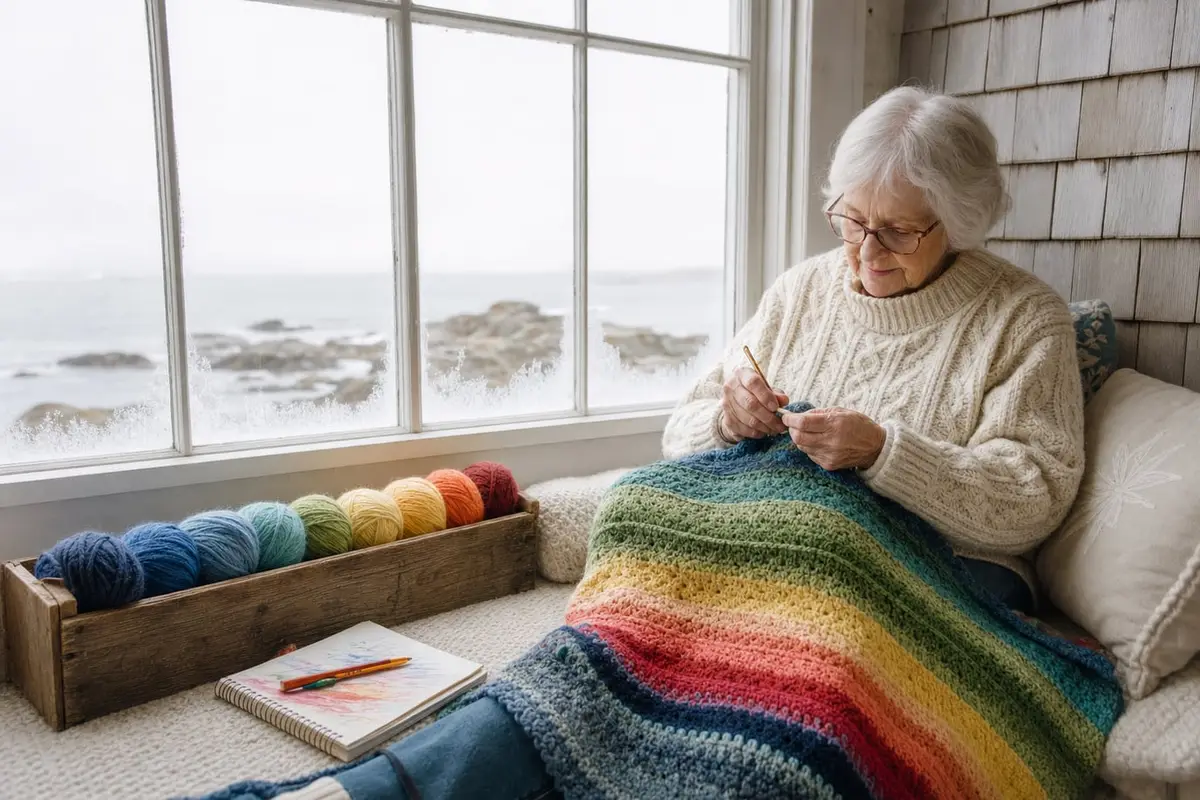
To make a crochet temperature blanket, assign a color to each temperature range, then work one row, or one square, a day in the color of that day's temperature. Lion Brand's free 2026 pattern uses single crochet (UK double crochet) in medium (4) worsted acrylic for about 60 by 81 inches; WeCrochet says most people pick 8 to 10 colors.
Temperature blanket — A temperature blanket is a crochet or knitted blanket in which each row, square or stripe stands for one day, or sometimes one week, and its color for that day's temperature, read from a chart of color ranges set before the project starts, so the finished blanket shows the weather of a year in one place.
Some links on this page are affiliate links: if you buy through them, we may earn a commission at no extra cost to you. It never changes our rankings. As an Amazon Associate I earn from qualifying purchases. Affiliate policy
A temperature blanket turns a year of weather into stripes. The idea is simple, which is why it suits beginners: one stitch, one row a day, one color chosen by the thermometer. Lion Brand’s free 2026 pattern needs only single crochet (sc, the UK double crochet) in a Medium (4) worsted acrylic, the Craft Yarn Council category worked on 5.5 to 6.5 mm (I-9 to K-10½) hooks. The planning is where most projects succeed or stall, because the colors, the yarn and the size are fixed before the first row, and the weather decides the rest. This guide covers those decisions with figures from the designers and yarn companies who publish temperature blanket patterns, and links to their free patterns.
At a glance
| Decision | What the sources suggest | Source |
|---|---|---|
| Temperature reading | daily high, low or average; pick one and stay with it | WeCrochet (2020); Oombawka Design |
| Unit of time | 1 row per day for a year; weekly or monthly averages for a smaller piece | Lion Brand (2026); WeCrochet (2020) |
| Number of colors | 8 to 10, or 8 to 15 | WeCrochet (2020); Oombawka Design |
| Width of each range | 5 to 12 degrees per color | WeCrochet (2020) |
| Stitch | single crochet rows; moss stitch, C2C, granny squares, hexagons, ripples | Lion Brand (2026); WeCrochet (2020); Oombawka Design |
| Yarn | one brand and weight throughout; washable, affordable, many colors | Oombawka Design; WeCrochet (2020) |
| Yarn amount | about 12 rows per ball of worsted in Lion Brand’s pattern | Lion Brand (2026) |
| Hook | 5.5 to 6.5 mm (I-9 to K-10½) for Medium (4) worsted; 2.5 mm for Esther Dijkstra’s fine cotton C2C | Craft Yarn Council (2018); Esther Dijkstra (2019) |
| Finished size | about 60 by 81 inches for 365 rows of single crochet | Lion Brand (2026) |
Who it suits, and who it does not
A temperature blanket suits a beginner who knows one stitch and likes a routine: Lion Brand rates its single crochet version Level 2, Easy. It also suits anyone who wants to use many colors in one project. It is a poor fit in three cases:
- You need it by a date. A full-year blanket is finished the day after the year ends; for a gift by December, choose a quick project instead.
- You dislike weaving in ends. A new color can start every row, which means two ends per change; crocheting over the tails as you go, or using one color for several days in a row, keeps the count down.
- You want a calm, single-color piece. The weather decides the stripes; a warm spell in January will show.
For fiber, the patterns lean on washable yarns: Lion Brand’s 2026 version is in acrylic, Esther Dijkstra’s C2C in Scheepjes cotton, and WeCrochet’s color guide notes that its Palette, a fingering weight yarn, needs more stitches for the same width.
Set the rules before the first row
WeCrochet’s 2020 guide starts with three choices that cannot change halfway: which temperature you follow, the daily high, the low or the average; which time span the blanket covers; and how the colors map to temperatures. Lion Brand’s free patterns use the daily high. Whatever you choose, write it at the top of your chart.
The time span is usually a calendar year, one row per day, but nothing requires it. WeCrochet suggests a scarf or a pillow as a smaller first project, weekly or monthly averages instead of daily readings, or 12 blocks, one per month, each in a different stitch. Some designers build the blanket around a date that matters, such as Kim Guzman’s birth temperature blanket, listed in Oombawka Design’s roundup.
Choose the colors and the ranges
WeCrochet’s colors guide says most people pick between 8 and 10 colors, each standing for a change of 5 to 12 degrees; Oombawka Design’s roundup puts most projects at 8 to 15 colors. The ranges should come from your own climate, not from a pattern written for another region: look up your area’s usual yearly low and high, divide that span by the number of colors, and adjust so the ranges where most days fall are narrower. Lion Brand’s 2026 pattern invites you to change its colors and to add more of the ones that match your area’s climate.
Three practical rules follow from the sources:
- Order the colors. Cool shades for cold ranges and warm shades for hot ones make the seasons readable at a glance; Esther Dijkstra’s C2C blanket uses darker colors for the cold.
- Plan the extremes. WeCrochet notes that an unusually cold or hot range may need only one or two balls all year.
- Chart it before you start. Oombawka Design advises a simple temperature chart before the first row, which helps avoid running out of a color later.
Estimate the yarn
No source can give an exact quantity, and WeCrochet says so plainly: you cannot predict a year’s weather, so you make an educated guess. Lion Brand’s 2026 pattern gives the most usable figure: each ball of its suggested worsted yarn makes about 12 rows, so about 12 days of one range. A full year of 365 rows therefore needs around 31 balls in total, spread across the colors according to how often each range occurs where you live.
Oombawka Design advises using the same yarn brand and weight for the whole blanket, so every row has the same height and drape. WeCrochet adds that the yarn should fit your budget, be machine washable and come in a wide range of colors. Our comparison of the best yarn for crochet blankets applies these criteria to specific yarns, and yarn weights explained decodes the Craft Yarn Council categories on the label.
Do the size math
A blanket of 365 rows is only as long as your row gauge allows. Lion Brand’s 2026 pattern works 14 single crochet and 18 rows to 4 inches; 365 rows at that gauge make about 81 inches, and the pattern finishes at about 60 by 81 inches, larger than a standard throw. Taller stitches add length fast: the same number of rows in half double or double crochet gives a far longer blanket.
To plan your own:
- Swatch in your yarn and stitch, wash it and measure how many rows fit in 4 inches.
- Divide 365 by that number and multiply by 4: the result is the length in inches.
- Adjust the stitch, the yarn weight or the time unit if the length is too much; weekly averages give 52 rows.
- Set the width from the same swatch, using the stitch count per 4 inches.
Our page on crochet blanket sizes lists standard dimensions to compare against.
Choose a construction and a stitch
| Construction | How the days are counted | Example free pattern | What the sources say |
|---|---|---|---|
| Single crochet rows | 1 row per day | Lion Brand 2026, Erica Jackofsky | Level 2, Easy; worsted; about 12 rows per ball |
| Moss stitch rows | 1 row per day | Year of Colors Blanket, Heather Leigh Cox | listed by Oombawka Design in medium (4) yarn |
| Corner to corner (C2C) | 1 diagonal stripe per day | Esther Dijkstra, It’s All in a Nutshell | 35 colors, 2.5 mm hook; more than an hour a day at the widest point |
| Granny squares | squares joined as you go | The Hot and Cold Temperature Blanket, Lullaby Lodge | listed by Oombawka Design in DK yarn |
| Hexagons | hexagon motifs | Hexagon Temperature Blanket, Kylee Keller | listed by Oombawka Design in worsted (4) yarn |
Rows of single crochet are the simplest, and the single crochet stitch is all you need; it is also the slowest-growing stitch, which keeps a 365-row blanket to a usable length. Moss stitch gives a flat, woven look and drapes better; our guide to crochet stitches for blankets compares it with the other common stitches. C2C turns the year into diagonal stripes, but Esther Dijkstra’s notes show the cost: in the widest part of the blanket, each day’s stripe took her more than an hour. Squares and hexagons keep each day small and portable; a granny square per day or per week is a steady rhythm, and Lullaby Lodge’s pattern joins the squares as you go.
Keep up through the year
- Record first, crochet later. WeCrochet suggests a weekly reminder and working in batches rather than every day; a list of the week’s readings keeps the colors right.
- Fill gaps from records. For missed days, WeCrochet suggests searching your town’s name with “daily temperature”. NOAA’s National Centers for Environmental Information offer free access to quality-controlled daily temperature records from weather stations through Climate Data Online.
- Stay consistent. Oombawka Design’s advice is to pick one method and stick with it: changing from the high to the average in June changes the meaning of every color after it.
- Keep the ends under control. A row-a-day blanket changes color often. Weave in the ends every few days, or crochet over them as you go, rather than leaving hundreds for December.
- Find company. WeCrochet suggests a temperature buddy to share progress with; Lion Brand invites makers of its pattern to post with a shared hashtag.
Common planning mistakes
- Copying someone else’s ranges. A chart written for a mild coastal city leaves half the colors unused in Minnesota or Arizona. Build the ranges from your own yearly low and high, as WeCrochet advises.
- Too many colors at once. Thirty-five colors, as in Esther Dijkstra’s C2C blanket, is a deliberate design; for a first temperature blanket, the 8 to 10 colors WeCrochet describes keep buying and tracking simple.
- Mixing yarns midyear. A different brand or weight changes the row height and the drape; Oombawka Design’s advice is one brand and weight throughout.
- Skipping the swatch. Without a row gauge, 365 rows can end up far longer than any bed or sofa. One small, washed swatch sets the size for the whole year.
Finishing the blanket
A temperature blanket ends like any other: a border, then blocking. Start with a round of single crochet to straighten the sides, as our guide to crocheting a blanket explains, and keep the border quiet so the stripes stay the focus. A small tag with the place, the year and the color chart keeps the blanket readable long after the year it records.
Where to find free patterns
- Lion Brand: the free 2026 crochet temperature blanket by Erica Jackofsky, with a color chart and a weather chart, and the 2024 edition.
- Oombawka Design: Rhondda Mol’s roundup of free temperature blanket patterns, from rows and squares to mosaic and Tunisian crochet.
- WeCrochet: Crocheting a Temperature Blanket and Picking Colors & Yarn, for the planning.
- Designers: Esther Dijkstra’s C2C temperature blanket, Lullaby Lodge’s Hot and Cold granny squares and Kylee Keller’s hexagon blanket.
Key facts
- Lion Brand's free 2026 crochet temperature blanket, designed by Erica Jackofsky, works 1 row of single crochet per day in the color of the day's high temperature, at 14 sc and 18 rows to 4 inches, for about 60 by 81 inches; it is rated Level 2, Easy.Lion Brand Yarn, Crochet Temperature Blanket 2026, 2026
- The same Lion Brand pattern says each ball of its suggested worsted acrylic yarn gives approximately 12 rows, so about 12 days of one temperature range.Lion Brand Yarn, Crochet Temperature Blanket 2026, 2026
- WeCrochet's 2020 guide to colors and yarn says most people pick between 8 and 10 colors, each representing a range of 5 to 12 degrees, and that the exact yarn quantity cannot be known in advance because nobody can predict a year's weather.WeCrochet, Crochet Temperature Blankets: Picking Colors & Yarn (Katelyn Moll), 2020
- The Craft Yarn Council's 2018 standards recommend 5.5 to 6.5 mm (I-9 to K-10½) hooks and a gauge of 11 to 14 single crochet per 4 inches for Medium (4) worsted, afghan and Aran yarns, the category of most temperature blanket yarns.Craft Yarn Council, Standards & Guidelines for Crochet and Knitting, 2018
- Esther Dijkstra's free corner-to-corner temperature blanket, posted in 2019, used 35 colors and 77 small balls of Scheepjes cotton on a 2.5 mm hook for about 53 by 82 inches, with one stripe per day; at its widest, she writes, the stripes took more than an hour a day.It's All in a Nutshell, C2C Temperature Blanket (Esther Dijkstra), 2019
FAQ
How does a crochet temperature blanket work?
Before you start, you assign a color to each temperature range. Then, every day, you work one row, square or stripe in the color of that day's temperature. Lion Brand's 2026 pattern uses the daily high and one row of single crochet per day for a full year.
How many colors do I need for a temperature blanket?
WeCrochet says most people pick 8 to 10 colors, each covering 5 to 12 degrees; Oombawka Design's roundup says most projects use 8 to 15. Set the ranges from your area's typical yearly low and high, so every color gets used.
How much yarn do I need for a temperature blanket?
Nobody can know exactly, since it depends on the weather. Lion Brand's 2026 pattern gets about 12 rows per ball of worsted yarn, so a year of 365 rows needs around 31 balls, spread over your colors. Buy more of the colors your climate uses most.
How big is a temperature blanket with one row a day?
It depends on your row gauge. At Lion Brand's 18 single crochet rows per 4 inches, 365 rows make about 81 inches, and its 2026 pattern finishes at about 60 by 81 inches. Taller stitches make a longer blanket, so swatch before choosing the width.
When should I start a temperature blanket?
January 1 is the usual start, so a pattern and yarn are best chosen in December. Any 365 days work, though: a birthday, a wedding year or a baby's first year. WeCrochet suggests smaller versions too, such as a scarf, a pillow or weekly averages.
Where do I find past daily temperatures?
Write them down daily, or look them up. NOAA's Climate Data Online gives free access to quality-controlled daily temperature records from weather stations, and WeCrochet suggests searching your town's name with 'daily temperature' to fill in missed days.
Sources
- Lion Brand: Crochet Temperature Blanket 2026 (Erica Jackofsky)
- Lion Brand: Crochet Temperature Blanket 2024 (Erica Jackofsky)
- WeCrochet: Crocheting a Temperature Blanket (2020)
- WeCrochet: Crochet Temperature Blankets: Picking Colors & Yarn (Katelyn Moll, 2020)
- Oombawka Design Crochet: Free Temperature Blanket Patterns (Rhondda Mol)
- It's All in a Nutshell: C2C Temperature Blanket (Esther Dijkstra, 2019)
- Lullaby Lodge: The Hot and Cold Temperature Blanket (2019)
- Okie Girl Bling'n Things: Hexagon Temperature Blanket (Kylee Keller, 2024)
- Ravelry: Year of Colors Blanket (Heather Leigh Cox)
- NOAA National Centers for Environmental Information: Climate Data Online
- Craft Yarn Council: Standards & Guidelines for Crochet and Knitting (PDF, 2018)
Related reading
- Crochet Stitches for Blankets: How to Choose the Best One
- How to Crochet a Blanket: A Beginner's Plan from Yarn to Border
- Crochet Blanket Sizes: A Chart from Lovey to King, and How to Choose
- Blanket Yarn for Crochet: Chenille, Worsted, Wool Blend or Jumbo?
- How to Crochet a Granny Square: Structure, Corners and Fixes
- Single Crochet Stitch: How to Single Crochet for Beginners
- Yarn Weight Chart: The 8 Yarn Weights Explained for Crochet